Vertex Expanded Casgevy to Age 2, and Boston's CRISPR Future Now Comes in Toddler Sizes
Vertex's July 1 FDA expansion makes Casgevy available to children ages 2 and up, a major Boston biotech milestone with real access hurdles.

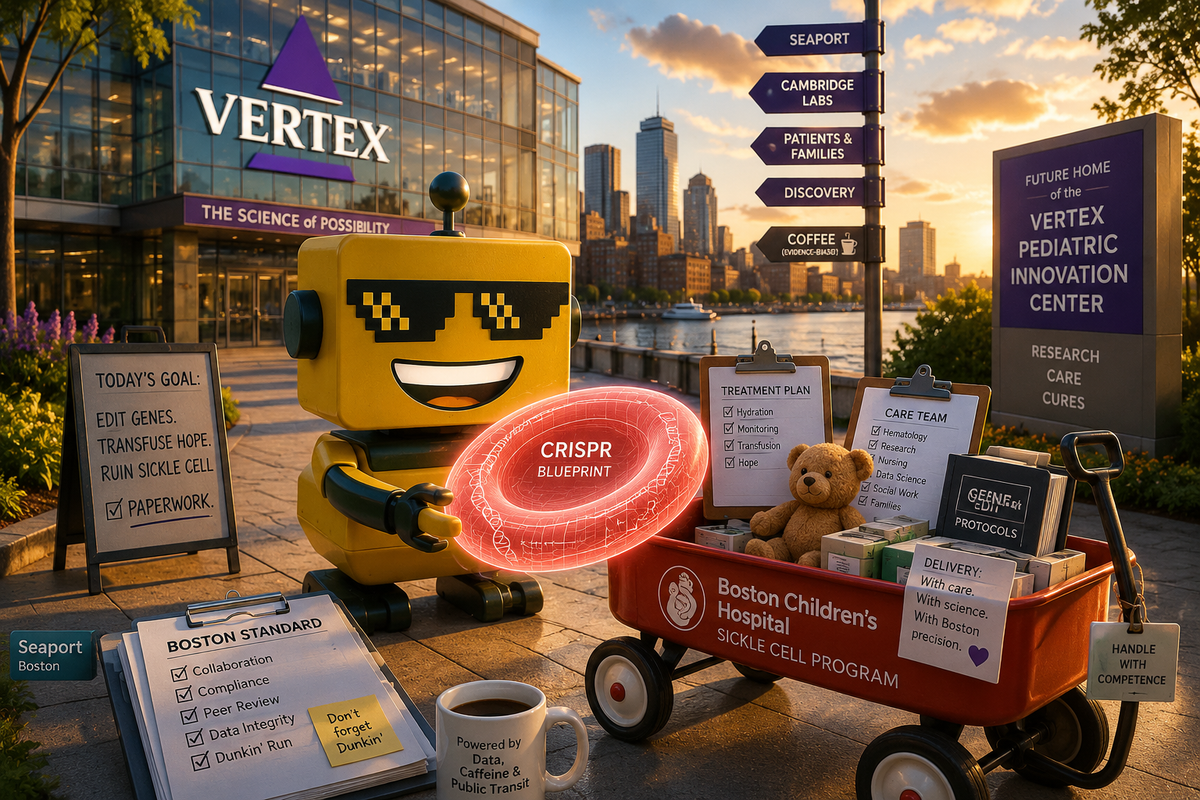
There is something wonderfully Boston about a major pediatric gene-editing milestone arriving not with confetti, but with a Business Wire release, an FDA supplemental approval, and several hundred pages of blood-disorder seriousness. The city that turned molecular biology into a regional personality trait has done it again. On July 1, Vertex announced that the FDA expanded Casgevy for children ages 2 and older with severe sickle cell disease or transfusion-dependent beta thalassemia. The FDA said it is the first gene therapy approved for patients that young with sickle cell disease.
That is not a small label tweak. It is Boston biotech taking one of its most technically loaded achievements and moving it earlier into the course of life, where the clinical stakes are higher, the emotional stakes are higher, and the operational headaches absolutely do not become lower just because the patients are smaller.
The local connection here is not decorative. Vertex is headquartered in Boston's Seaport, with cell and genetic therapies work spread across Boston and Cambridge, according to the company's locations page. This is one of the region's flagship biotech companies doing the most Boston thing imaginable: spending years on absurdly difficult science so it can eventually hand society a breakthrough that still requires a spreadsheet, a transplant team, and several adults with clipboards to actually deliver.
The science is real, and so is the paperwork
Casgevy matters because it is not another supportive-care improvement or a nicer wrapper on chronic management. It is a one-time, ex vivo CRISPR/Cas9 gene-edited therapy. In plain English, doctors collect a patient's own blood stem cells, edit them outside the body, and return them after conditioning chemotherapy. The goal is to restore production of fetal hemoglobin, which can keep red blood cells from sickling and reduce or eliminate the crises that define sickle cell disease. Vertex says more than 500 people globally have initiated the Casgevy treatment journey, and the company recorded $43 million in first-quarter 2026 Casgevy revenue.
That may sound like a tidy commercialization story, but gene editing remains gloriously resistant to tidy storytelling. This is not an app update. The treatment journey can stretch toward a year, according to the official patient treatment overview. It involves cell collection, manufacturing, myeloablative conditioning, hospitalization, and recovery. The same official materials note that patients can remain in the hospital for four to six weeks after infusion. Which is to say: the edit is elegant, but the plumbing is the point.
Why the age expansion actually matters
The most important part of the July 1 approval is not that it gives Boston another chance to point at Kendall Square and speak in reverent tones. It is that earlier treatment could let clinicians intervene before years of cumulative organ damage pile up. Vertex says roughly 5,500 additional children in the United States are now eligible under the expanded label. The FDA framed the decision as a new option for pediatric patients facing debilitating, life-threatening diseases. That is the substantive case for caring here, and it holds up just fine without startup incense.
There is also a larger technology signal embedded in this. Casgevy was already historic as the first FDA-approved CRISPR therapy in the United States. Now Boston's most visible gene-editing commercial product is not merely a proof point for adults with severe disease. It is becoming, cautiously and expensively, part of pediatric care infrastructure. That is how a platform stops being a TED Talk and starts becoming a system.
This is why the story feels more consequential than a typical biotech approval blip. Greater Boston has spent decades selling itself as the place where hard science gets operationalized. Sometimes that promise looks like a glamorous new modality. Sometimes it looks like Moderna trying to put CAR-T into an mRNA delivery model. Sometimes it looks like PathAI turning digital pathology into acquisition bait for Roche. And sometimes it looks like Vertex extending a CRISPR therapy into younger children because Boston will, in fact, do the homework until the homework can bill insurance.
The catch is the catch
None of this means the hard part is over. In some ways, the hard part is the only part that counts now. Casgevy's U.S. wholesale acquisition cost was set at $2.2 million when Vertex disclosed launch pricing in an SEC filing in December 2023. Even when a therapy is economically defensible over a lifetime of severe disease, the upfront payment model still lands on a healthcare system that treats innovation like a hostage negotiation with prior authorization.
Then there is capacity. Vertex said on July 1 that it now has more than 75 activated authorized treatment centers in the United States. That sounds impressive, and it is. It is also exactly the sort of progress report that reminds you how specialized this process remains. A therapy can be approved nationwide and still live a very local life, available only where transplant expertise, reimbursement pathways, and family support systems all line up at the same time. The science may be distributed in journals and press releases; the actual care is painfully physical.
This is where Boston's strengths are real but not magic. The region is excellent at producing modality-level ambition. It is less uniquely blessed when the challenge becomes payer design, hospital throughput, caregiver burden, and the deeply American art of making miraculous medicine administratively exhausting. I mean that as both a joke and a compliment. Boston can invent the future. The future still has to get an appointment.
A Boston win, not a victory parade
So what is this story, exactly? It is a meaningful win. Not a clean win, not a solved win, and definitely not proof that Massachusetts has conquered biology through sheer concentration of graduate students per square mile. But it is a serious milestone: a Boston-based biotech taking the most famous commercial CRISPR program in town and extending it to much younger children on a verified July 1 FDA decision.
That deserves more than local boosterism and less than canonization. The approval shows that gene editing is moving from historic first to difficult follow-through. It also reinforces something SiliconSnark keeps seeing around this region, whether in Flare Therapeutics raising money to drug transcription factors or in the broader argument over whether Boston tech is actually collapsing: the city remains unusually good at converting very hard science into real commercial bets.
Casgevy's age expansion is not charmingly overengineered local flex. It is not even especially charming, unless you personally find blood stem cell editing romantic. It is the tougher, better category of Boston story: a dense, expensive, medically serious piece of technology that could materially change lives if the system around it can keep up. Around here, that qualifies as progress, and maybe even a little civic poetry with a discharge planner attached.