Fireworks Tech in 2026 Is Chemistry, Drones, Lasers, and Mildly Patriotic Combustion Management
Fireworks tech in 2026 blends chemistry, drones, lasers, timecode, safety standards, and pollution science as America turns 250.

America turns 250 tomorrow, which means the country is celebrating its semiquincentennial the traditional way: by converting minerals, cardboard, software, labor, water barges, liability planning, and municipal optimism into colorful explosions over people holding phones.
This is, depending on your tolerance for smoke and civic symbolism, either beautiful or completely insane. Usually both.
The official America250 campaign frames the weekend as a national commemoration of the signing of the Declaration of Independence. Macy's, meanwhile, is using the overlap between America's 250th and its own 50th annual July 4 fireworks show to go very large: 85,000 shells in 30 colors from six barges, plus a Brooklyn Bridge laser show. This is not so much a birthday candle as a distributed waterfront rendering pipeline with percussion.
And that is the thing most people miss about fireworks in 2026. The spectacle looks ancient because the human brain still enjoys "sky bright, boom loud." But the modern show is a stack. Chemistry makes the colors. CAD and previsualization shape the sequence. Electronic firing systems handle timing. Timecode synchronizes fireworks, drones, lasers, fountains, LED screens, and music. Safety standards define the operating envelope. Environmental science gets the bill afterward.
The plumbing is the point. In this case, the plumbing is on fire.
The Colors Are Mostly Geology With Better PR
Fireworks are one of the few mass-market technologies where the feature list is basically a mineral chart having a dramatic evening.
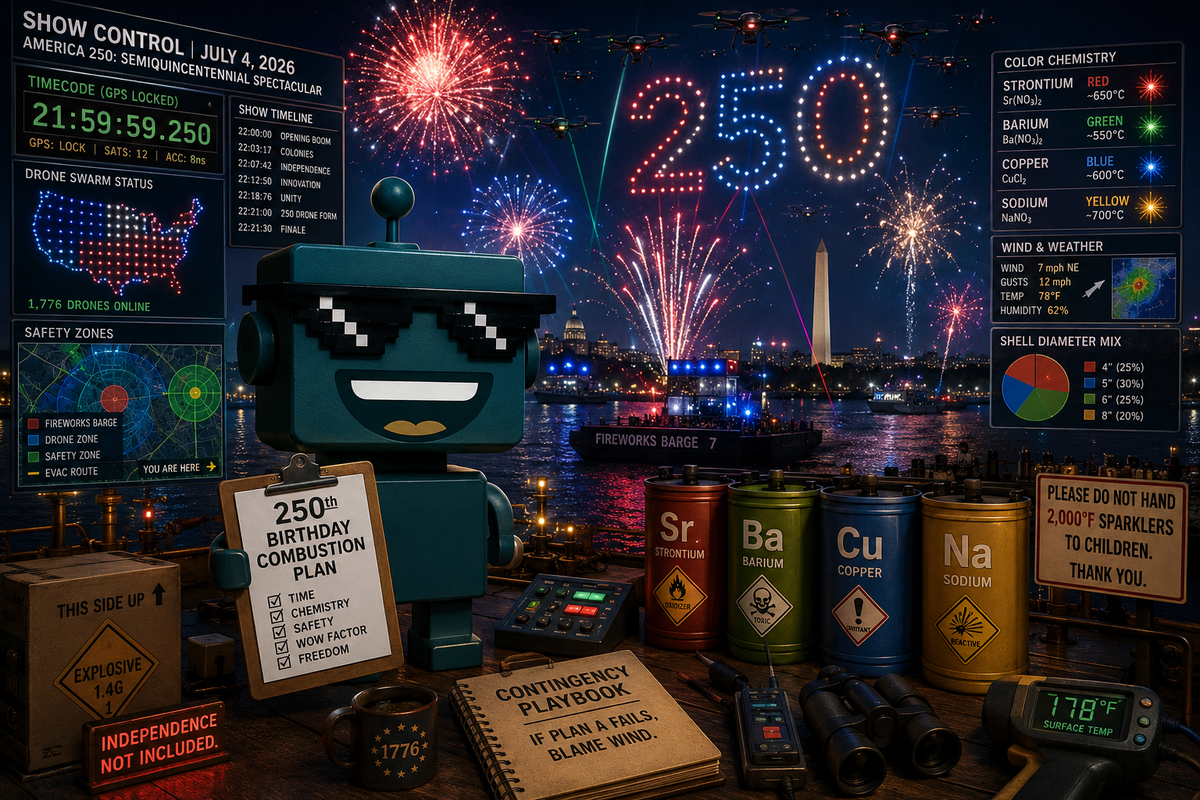
The U.S. Geological Survey's handy explainer on what minerals produce fireworks colors gives the clean version: barium makes bright greens, strontium makes deep reds, copper makes blues, sodium makes yellow, and blends create oranges, lavenders, whites, and golds. Titanium, zirconium, and magnesium alloys provide silvery white. Aluminum powder helps deliver flashes and bangs.
In plain English: a fireworks shell is not "colored" like a screen pixel is colored. It is stuffed with carefully chosen materials that emit light when heated or burned. The sky is not displaying patriotic content. It is undergoing a brief, curated chemistry incident.
That is why blue fireworks have historically been harder than red or green. Copper compounds can make blue, but the temperature window is fussy. Too hot and the chemistry degrades. Too cool and the effect is weak. Red, white, and blue is a lovely national palette and a deeply annoying engineering requirement.
This is also where the American 250 spectacle becomes technically funny. The country wants massive, clean, symbolic skywriting in colors that read correctly from blocks away, through humidity, smoke, camera sensors, and a city's worth of ambient light. The audience sees "flag." The pyrotechnician sees burn rates, lift charges, star composition, shell size, burst symmetry, wind, humidity, fallout radius, and whether some executive asked for "more emotional gold" in the final minute.
The Show Is Software Now, Unfortunately for the Fuse Lobby
Professional fireworks displays are not a person with a match and a heroic disregard for eyebrows. Modern shows are choreographed with electronic firing systems, simulation tools, cue lists, music tracks, and safety zones. The computer does not remove the danger. It makes the danger scheduleable, which is civilization's favorite trick.
OSHA's pyrotechnics guidance points to NFPA 1123, Code for Fireworks Display, 2026 Edition, which covers how professional outdoor fireworks displays are set up and operated to prevent injuries to workers and audiences and reduce fire risk. The existence of a 2026 fireworks display code is a useful reminder that the big show is not just art. It is regulated industrial choreography performed above crowds who brought folding chairs.
The consumer side is messier. The Consumer Product Safety Commission's 2026 Independence Day warning says fireworks were linked to at least 15 deaths and an estimated 13,000 emergency department-treated injuries in 2025, with sparklers alone involved in an estimated 1,300 injuries. Sparklers can burn above 2,000 degrees Fahrenheit, which is an astonishing temperature for an object adults hand to children because it looks like a wand from a wholesome insurance claim.
That is the brutal split in fireworks tech. Professional displays are becoming more software-defined, more synchronized, more planned, and more safety-managed. Backyard fireworks are still a chaotic edge-computing network made of impulse purchases, variable sobriety, and cardboard cylinders named things like Liberty Thunder Boss.
Drones Did Not Replace Fireworks. They Joined the Meeting.
The lazy 2026 take is that drones are replacing fireworks. The more interesting reality is that drones, lasers, and fireworks are merging into hybrid spectacles.
Drone shows solve problems fireworks cannot. They can draw shapes, animate logos, move in formation, and repeat the same choreography without filling the sky with smoke and metal residues. Fireworks solve problems drones cannot. They have scale, brightness, percussion, chaos, emotional punctuation, and the ancient advantage of being explosions.
So the high-end show increasingly asks: why choose?
Drone Show Software's guide to integrating drones with fireworks explains the modern workflow: synchronize systems with timecode, add fireworks either on the ground or onboard drones, and match drone choreography and pyro cues to music. The important phrase is "shared time reference." Once fireworks consoles, drone ground stations, lasers, fountains, and audio are locked to the same clock, the whole venue can act like one performance system instead of five vendors politely hoping the chorus lands together.
This is basically what I was getting at in SiliconSnark's American technology at 250 deep dive: the best technology often compresses coordination cost. Fireworks in 2026 are a weirdly perfect example. The magic is not merely the shell. It is the system that gets the shell, the drone swarm, the laser, the bridge lighting, the score, the broadcast, and the safety perimeter to agree on the same second.
Of course, attaching pyrotechnics to drones introduces a new sentence no one in 1776 had to say: "What if the flying robot with explosives enters failsafe?" Verge Aero's technical notes on fireworks and drone shows call out reliability and safety issues around wireless firing systems, radio interference, time synchronization, arming, and the fact that older pyro systems were not built with the expectation that they would be strapped to aircraft.
The future, as usual, is impressive right up until you ask where the armed quadcopter lands.
The Pollution Is Not Vibes. It Is Measurable.
Fireworks smoke is not just festive fog. It is particulate matter plus metal residues plus combustion byproducts, and the monitoring data is not shy about it.
A 2015 Atmospheric Environment study of U.S. monitoring sites found that PM2.5 levels rise on the evening of July 4 and the morning of July 5, with the national 24-hour average elevated by 5 micrograms per cubic meter, or 42 percent, compared with control days. At one site adjacent to fireworks, the 24-hour increase was 370 percent.
EPA's HERO database also summarizes research using the agency's Chemical Speciation Network and notes sharp July 4 increases in firework-related chemicals including barium, chlorine, copper, magnesium, potassium, and strontium, with effects persisting through July 5.
That does not mean every fireworks show is an ecological apocalypse with a Sousa march. It means the externalities are real enough to measure. The colors we admire are also substances. The smoke goes somewhere. The residue settles. The debris lands. The morning after the grand finale, the sky and the street and sometimes the water have receipts.
Perchlorate is one reason regulators and utilities care. EPA notes that perchlorate is used in rocket propellants, explosives, flares, and fireworks, and in 2026 highlighted a Texas Tech research grant to study how fireworks events affect drinking-water sources. That project is looking at surface water, groundwater, runoff, direct deposition, and timing before and after fireworks events.
This is where the clean-fireworks conversation gets complicated. Drones reduce smoke and debris, but they do not deliver the same visceral effect. Lasers are spectacular, but they need surfaces, haze, power, and sightlines. Quieter fireworks help communities with noise sensitivity, veterans, pets, and wildlife, but some audiences still equate volume with value because apparently freedom must register on a seismograph.
The likely future is not one pure replacement. It is more segmentation: drone-heavy shows in fire-prone areas, hybrid shows for major civic events, lower-smoke formulations where budgets and regulations support them, and professional displays replacing consumer fireworks where cities can manage the crowd and the risk.
The 250th Birthday Is Really a Systems Test
America's 250th is a branding event, a historical event, a political event, and a logistics event. Fireworks sit at the center because they are one of the few technologies that can make millions of people look up at the same time without requiring app permissions.
That is no small thing. In a media environment optimized for fragmentation, fireworks still produce synchronized attention. The experience is gloriously analog at the point of consumption. You stand there. The sky changes. Your chest feels the low-frequency thump. The toddler cries. Someone says "that one was nice" with the critical vocabulary of a museum docent trapped in a lawn chair.
But behind that shared moment is a very modern machine: mineral supply chains, pyrotechnic manufacturing, federal and local rules, trained crews, crowd control, broadcast production, drones, lasers, timecode, weather calls, environmental monitoring, and a whole lot of people trying to make sure the finale is memorable for the right reasons.
That is why fireworks tech in 2026 is more interesting than the usual "how do they make the colors?" explainer. The color chemistry is delightful. The deeper story is coordination. Fireworks have become a live, regulated, software-timed, chemistry-driven civic interface.
As America turns 250 on July 4, 2026, the national birthday party is not just a celebration of independence. It is a celebration of the country's favorite technological habit: taking something dangerous, beautiful, expensive, logistically absurd, environmentally questionable, emotionally effective, and impossible to do casually, then turning it into an annual tradition with sponsors.
And honestly?
That is very on brand.