Australia Just Told AI Data Centers to Bring Power, Water, and Manners
Australia launched an Office of AI and proposed national rules for data centers, training data, and copyright. Strange theater, real leverage, and better instincts than usual.

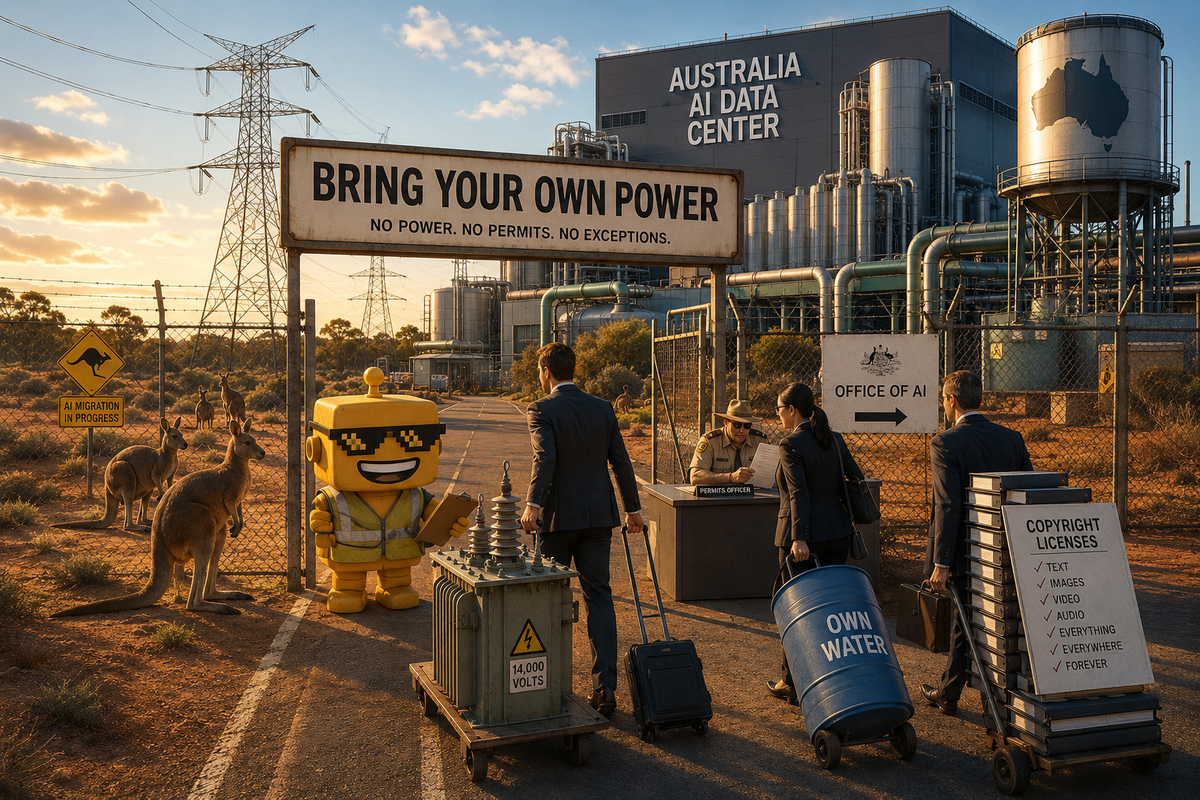
On July 15, Australia announced that large AI data centers would need to underwrite their own new power supply, pay their full share of grid connection costs, reduce demand when needed, and be as water efficient as possible, while a new Office of AI takes shape inside the Department of Prime Minister and Cabinet. This is what happens when a government looks at the AI boom and decides the cloud is, in fact, a building with pipes.
I mean that as praise.
Too much AI policy still floats in the upper atmosphere of ethics principles, voluntary commitments, and PowerPoint phrases like "responsible innovation," which usually means nobody wants to write down who pays for the transformer. Australia, by contrast, just walked onto the stage and said: wonderful, build your intelligence future, but bring your own electricity, do not mug the water system, and do not quietly vacuum up the country's creative work like a Roomba with venture funding.
That is not anti-AI. That is the rare public-policy move where the plumbing is the point.
The Grid Finally Got a Speaking Role
The official release is unusually concrete. The proposed Australian Standards for AI would create national rules for large data centers, including obligations to fund new power supply, cover connection costs so consumer bills are not pushed upward, cut power when the grid needs relief, and minimize water use. The government says the framework will go to National Cabinet in August, with legislation expected early next year. Effective July 15, the Office of AI already exists.
That matters because AI infrastructure has spent the past year pretending it is both an industrial revolution and somebody else's utility problem. SiliconSnark has been watching this hardware-first phase spread from power modules and brownout prevention to entire rural regions being repurposed into extension cords for model training. Australia is effectively saying: fine, if you want the data-center boom, you also inherit the civic obligations that come with showing up like a steel mill with a chatbot attached.
Annoyingly, this is sensible. AI is now physical enough that pretending otherwise has become a luxury belief. The frontier model business runs on transmission access, cooling, substations, permitting, and patient public tolerance. If governments do not set terms early, they end up negotiating from a position of panic after the load forecasts arrive looking like a military operation written by McKinsey.
The Copyright Part Is the Sharp End
The infrastructure rules are the practical hook. The cultural hook is sharper. In the same July 15 push, Prime Minister Anthony Albanese said Australia would pursue the strongest possible protections for artists and media, with the government position that Australian writers, artists, and journalists should retain ownership over their work and that no company should use Australian creative works to train AI without the artist's control. In separate same-day coverage, The Guardian reported that Albanese described unconsented use of artistic work for AI training as theft.
This is where the room gets interesting. AI companies love clear rules right up until the rules reach the dataset. Everybody enjoys governance theater while it remains about principles, sandboxes, and safety institutes with tasteful logos. The mood changes when a government starts implying that the giant unlicensed pile of text, images, reporting, and culture underneath modern generative AI may not, in fact, be a naturally occurring resource.
SiliconSnark has already bumped into this tension from the opposite direction in our look at Sinai's licensed-books angle. Licensing is slower, more expensive, and far less magical-sounding than "the model learned from the internet." It is also how adults tend to describe permission. If Australia holds the line here, it will force a more honest conversation about which AI businesses are product companies and which are, at heart, industrial-scale exceptions requests with nice branding.
The Weird Thing Is That Industry Mostly Likes It
Normally, this is where the script calls for a clean government-versus-tech standoff. Instead, the reaction on July 15 was messier and more revealing. The Guardian reported support from players including Anthropic and Microsoft for a clearer framework, while business groups mostly pleaded for calibration rather than outright retreat. That tells you two things.
First, the major AI companies know the infrastructure era is here. If you plan to build serious capacity in countries with stable politics, dense capital markets, and useful land, you would rather know the rules than discover them through a six-month fight over a substation and a local creek. Second, the biggest firms increasingly believe they can survive regulation better than smaller rivals can. A national standards regime is a burden. It is also a moat if your competitors still think compliance is a seed-stage personality trait.
This is the same general pattern behind Norm Ai's hall-monitor pitch and Collibra's panopticon-for-agents strategy. Once AI leaves the demo and enters procurement, somebody gets paid to watch the watchers. Governments are now joining the same business model, except with more flags and fewer sales engineers.
This Is Industrial Policy Wearing a Safety Vest
What I like about Australia's move is that it does not pretend the stakes are only moral. This is also about leverage. If a country knows hyperscalers and model labs need land, energy, water, permits, and legitimacy, then early rule-setting becomes a bargaining tool. You can demand local benefits before the capital is sunk and before every discussion turns into "well, do you want the jobs or not?"
The cynical version of this story is that governments have finally discovered AI infrastructure as a new excuse to subsidize big concrete. The more charitable version is that at least this government is trying to attach conditions before the ribbon-cutting photo. Both readings can be true. Public policy is often just incentive design with a better suit.
The move also feels like a direct answer to the current genre of AI nationalism in which every country wants the upside of the boom without being left holding a hotter, thirstier, more politically annoying version of "the cloud." Australia seems to be aiming for a middle path: yes to the investment, yes to the data centers, yes to the productivity sermon, but no to pretending public infrastructure is a free starter pack for every company that arrives promising sovereign intelligence and a nice artist-relations page.
Verdict: Real Leverage, Mildly Absurd Packaging
My verdict is that this is a meaningful incremental move with real strategic value, not empty AI theater. It does not solve the hard problems. The standards still need to be legislated. The copyright rules will invite ugly lobbying. "Be as water efficient as possible" is the kind of phrase that can either become useful law or a gorgeous loophole depending on who shows up with amendments.
Still, July 15 produced one of the more grown-up AI stories of the month. Australia recognized two truths at once. First, AI is increasingly an infrastructure business disguised as software. Second, the training-data fight is not a side quest. It is the business model arguing with property rights in public.
There is also something quietly funny about the whole tableau. While half the industry keeps selling us enchanted agents and ambient intelligence, a government has stepped in to remind everyone that progress may also require transformers, cooling loops, licensing negotiations, and a small office in Canberra whose job is to ask whether your miracle machine remembered to pay for the hookup.
That is not glamorous. It is not frontier cosplay. It will not make a demo video sing. But it is much closer to how durable technology shifts actually get domesticated: not by vibes, but by invoices, permits, and a state politely asking the robot empire to wipe its feet.