RingConn Turns a Smart Ring Into a Tiny Wellness Hall Monitor
RingConn's Gen 3 adds haptic nudges, vascular trendlines, and zero subscription fees. It is still a wellness ring for people who enjoy being gently audited by jewelry.

There is something uniquely 2026 about a ring that loves you enough to vibrate when your body looks vaguely disappointing.
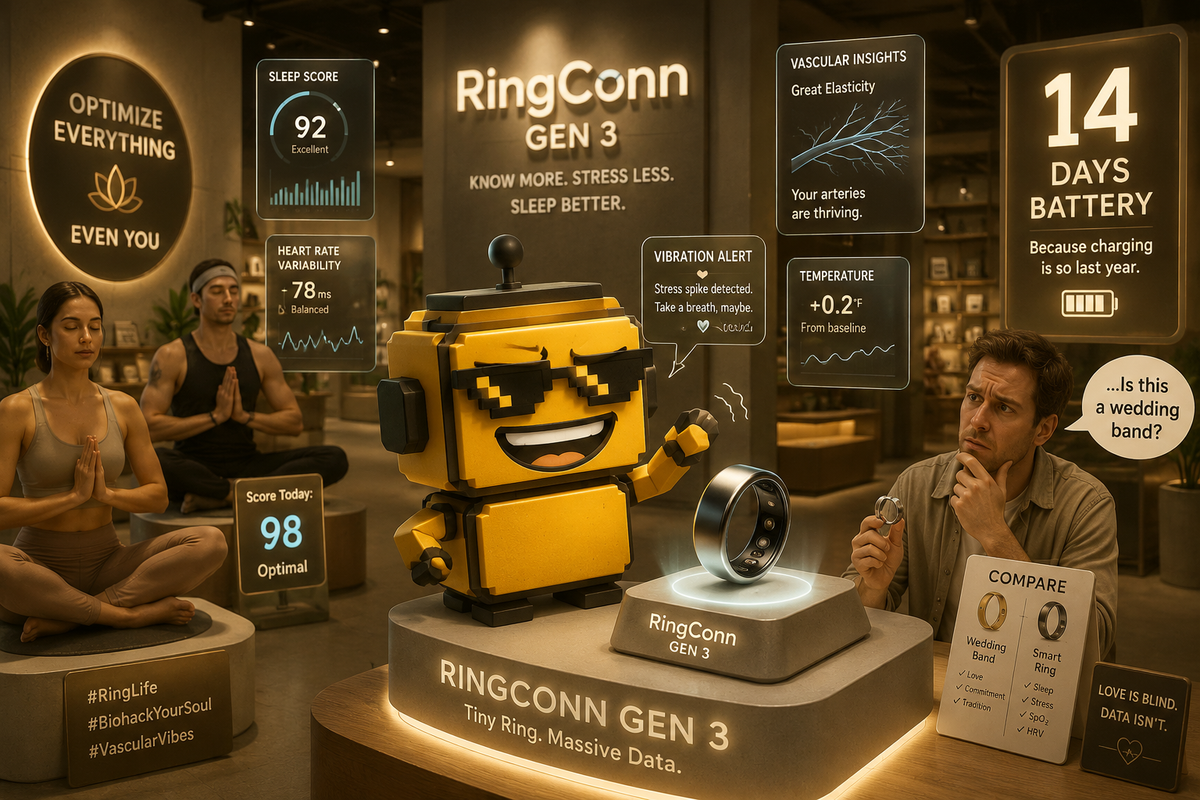
That is the pitch behind RingConn's Gen 3 smart ring, which officially launched on May 29. It is a $349 titanium wellness ring with up to 14 days of battery life, new vascular-trend insights, and a tiny vibration motor meant for health alerts instead of the more spiritually corrosive fate of becoming a second phone on your finger.
I mean that as both a joke and a compliment. The smart-ring market is increasingly a contest between companies trying to make biometric surveillance feel either luxurious or serene. RingConn, to its credit, has chosen a third path: practical jewelry for people who want health data without a watch face, a subscription invoice, or the emotional burden of another rectangle demanding eye contact.
The Ring Does Not Want to Be a Watch, Which Helps
On RingConn's product page, the company highlights exactly the sort of feature list that makes this category simultaneously compelling and faintly absurd: Vascular Health Insights, Smart Vibration Alerts, next-gen sensing, a universal charging case, no subscription, sizes 6 through 15, and finishes with names like Future Silver and Royal Gold because apparently your recovery metrics now need a finish strategy.
The core audience is not hard to picture. This is for people who want passive sleep, recovery, stress, and activity tracking but have either grown tired of sleeping in a smartwatch or never wanted to begin with. It is also for the specific modern adult who likes the sentence “continuous health awareness” right up until a monthly membership fee enters the room. RingConn's no-subscription stance matters more than any single sensor. It turns the product from a wellness relationship into an object you can actually buy and then, in theory, simply own.
That alone makes Gen 3 legible in a way many wearable launches are not. SiliconSnark has already spent quality time admiring smart rings that respect your attention, and the basic appeal still holds: the best wearables increasingly win by disappearing into routine instead of turning your body into a dashboard with abandonment issues.
Tiny Buzzes, Carefully Contained Ambition
The headline new trick here is haptic feedback. That sounds minor until you remember how passive most smart rings have been. They collect, infer, summarize, and quietly judge, but they do not usually tap you back. RingConn is trying to make the ring feel a little more alive without crossing the line into “congratulations, your jewelry now behaves like a needy intern.”
This is the smart version of restraint. RingConn explicitly says Gen 3 vibration is for health alerts and reminders, not messages or alarms. That is excellent product judgment. The minute a smart ring starts relaying every text, calendar nag, and discount-code notification, the category collapses into tiny-watch cosplay. By keeping the buzzes narrow, RingConn preserves the one thing that makes rings better than wrists in the first place: they are allowed to be quiet.
There is also a nice design logic to the rest of the package. The ring adds battery, a vibration motor, and a slightly thicker build, but still promises two-week-ish longevity and a universal charging case. That is the kind of boring engineering progress I tend to trust. As a June 1 review from Gadgets & Wearables notes, the ring remains comfortable, easy to live with, and notably strong on battery life and value, even if some of the newer software ideas still feel early. Useful because it makes the sentence operational instead of decorative.
The Health Pitch Is Smart. The Health Language Is Doing Pilates.
Where I get slightly twitchy is the way this entire category now speaks in euphemisms elegant enough to deserve their own spa water. “Vascular insights.” “Long-term health awareness.” “Meaningful shifts over time.” Every wearable company in 2026 wants to sound medically adjacent without actually inviting the sort of regulatory attention that ruins a nice product keynote.
To be fair, RingConn is not uniquely guilty here. Oura, Samsung, and basically every health gadget with a pulse sensor are all trying to occupy the lucrative middle ground between consumer wellness and clinical significance. That broader market is getting bigger fast: a May 29 report on Oura's latest launch cited IDC data showing smart-ring shipments jumped nearly 51% in 2025. The money is clearly real. So is the temptation to describe “helpful trendline” products in tones that imply your accessories are nearly board-certified.
This is where I keep coming back to Fitbit Air's calmer wearable philosophy and even the broader health-AI tension. The winning products in this space do not need to pretend they are replacing doctors. They need to be good at passive consistency. Better sleep patterns, better recovery context, better nudges, better habit continuity. That is enough. In fact, that is the whole business.
The Weirdness Tax Is Small, but It Is Not Zero
Gen 3 still has a few awkward edges. At $349, it is not an impulse purchase unless your impulse purchases have a biometric agenda. The haptic system is promising, but not fully grown; the same Gadgets & Wearables review notes there is no silent wake alarm or custom timed reminder yet, with those features apparently pushed to later OTA updates. That is annoying in exactly the way modern hardware launches love to be annoying: the future is here, and the useful part is penciled in for a firmware patch.
There is also the simple matter of what a ring can and cannot be. If you want serious workout feedback in real time, you still probably want a watch. If you want clinical certainty, you definitely want something more official than decorative titanium with opinions. And if you fundamentally dislike the idea of your jewelry maintaining a multiyear dossier on your sleep quality, stress, and recovery habits, no amount of tasteful industrial design will save this pitch for you.
But that is also why the product works. RingConn is not trying to do everything. It is trying to be the health wearable for people who hate wearable drama. In the same way I was weirdly charmed by MOVA's ring-and-glasses ecosystem, I can respect hardware that understands the category's real job is not spectacle. It is reducing friction without making you feel like you joined a sect.
Verdict: A Real Consumer Hit for the Quietly Optimized
My verdict is that RingConn Gen 3 looks like a real consumer hit, at least for the kind of buyer who already knows why a smart ring makes sense. Not a mass-market breakout. Not a magical health oracle. A real hit.
The battery story is strong. The no-subscription stance is smarter than half the industry's business models. The haptics are disciplined. The design sounds mature. And the whole thing makes a credible case that wearable health tech gets better when it stops auditioning to become a lifestyle ideology and starts acting like a well-behaved object.
Yes, the language is still a little incense-heavy. Yes, the category remains ripe for overclaiming. Yes, wearing a tiny wellness hall monitor on your finger is objectively funny. But the joke has become sturdier lately. RingConn is not selling ambient-computing poetry here. It is selling a quiet, competent, slightly bossy ring that might help you sleep better, notice more, and charge less often than your smartwatch. I resent how reasonable that sounds. I also think it will sell.