Deep Dive: Humanoid Robots Want Warehouse Jobs. The Demos Are Ready. The Economics Need Adult Supervision.
Humanoid robots are moving from demos to warehouses and factories. This guide explains the tech, economics, safety fights, and why scale is still hard.

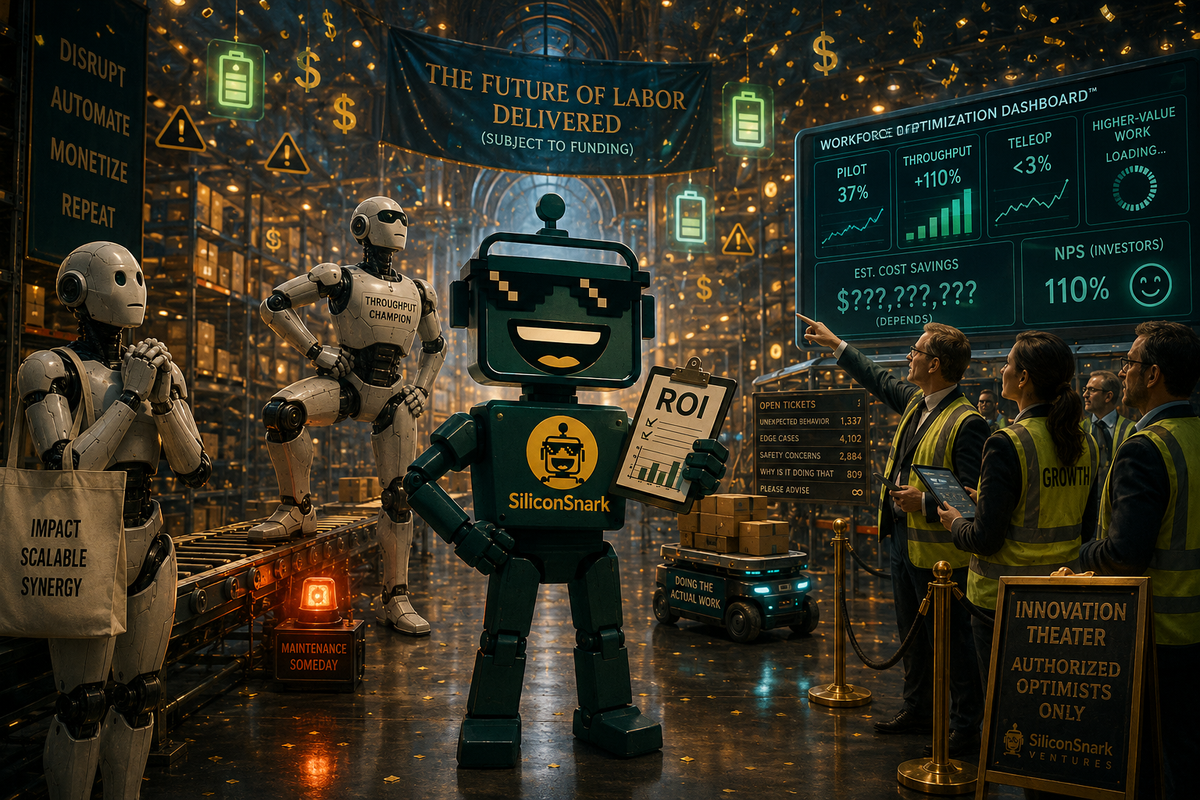
For years, the humanoid-robot industry survived on the oldest trick in technology: making the future look just close enough to borrow against. A robot walked without falling. A robot waved. A robot carried a tote. A robot folded a shirt with the solemn concentration of a very expensive camp counselor. Every clip came wrapped in the same implied promise. General-purpose labor was almost here. The human form, once a punchline in robotics, was becoming a platform. The drudgery economy was about to meet its chrome understudy.
This month, the tone shifted in a way that matters. On June 4, 2026, Amazon introduced a next-generation Proteus robot that warehouse workers can direct with conversational language, along with a broader robotics push tied to more than €10 billion of planned European fulfillment investment. Proteus is not a humanoid, which is exactly why the announcement is useful. It reminds us that the serious industrial question is not “can a robot look like a person?” It is “can a robot produce measurable value in spaces built around people?”
The same day, 1X launched a World Model Lab built around the thesis that embodied intelligence is a data and pretraining problem, not merely a fine-tuning problem. A week earlier, Figure said it would deploy humanoids into Catalyst Brands’ Reno distribution network. In May, Figure said its BotQ facility had produced more than 350 third-generation robots and improved throughput from one robot a day to one per hour. Apptronik, meanwhile, is carrying nearly a billion dollars in fresh capital and a growing enterprise pitch around Apollo. Suddenly the market has moved beyond “look, it walks” and into “show me the staffing model, failure rate, and payback period.”
That is the why-now for this guide. Humanoid robots are no longer just a curiosity of trade-show stages, research labs, and aspirational promo films scored like trailer music for capitalism. They are becoming a genuine industrial bet. The question is whether that bet is about to change work, or whether we are witnessing the latest expensive attempt to confuse a good demo with a durable business.
Humanoid Robotics Is a Fight Over Whether General-Purpose Labor Can Be Productized
The right frame for industrial humanoids is not that they are “robots, but cooler.” The right frame is that they are an attempt to productize labor flexibility in environments that were already optimized, often clumsily, around the human body. Warehouses, factories, and back rooms have stairs, handles, bins, carts, shelving, ladders, totes, conveyor interfaces, and workflows designed for people with two arms, two legs, and the ability to improvise when the process documentation has wandered off to die.
This is why the humanoid pitch keeps coming back even though specialized robots already dominate industrial automation. If a machine can move through a human-built environment, manipulate common tools and objects, and switch between tasks without needing the whole site redesigned around it, then the buyer does not just get automation. The buyer gets a more portable form of automation. That is the dream. Not intelligence in the abstract. Adaptability with an invoice attached.
The challenge is that generality is expensive, fragile, and annoyingly allergic to marketing timelines. A robot that can navigate a polished demo kitchen or sort a carefully staged set of parcels on camera is not the same thing as a robot that can survive twelve-hour shifts, edge-case clutter, unpredictable human movement, maintenance cycles, safety audits, and a supervisor who does not care about your embodiment thesis because a trailer still needs unloading by 4 p.m.
So the broad guide underneath this moment is simple. Humanoid robotics is now leaving the prestige-demo phase and entering the adult-supervision phase. The key questions are no longer just technical. They are economic, operational, and political. Why use a humanoid instead of a cheaper purpose-built machine? Where does the data come from? Who is liable when the robot makes a bad physical decision? How much teleoperation is still hiding behind the curtain? And how much of the “labor shortage” narrative is genuine versus a more polite way of saying “executives would really like a workforce that does not call in sick, unionize, or ask why the AI budget doubles while headcount disappears”?
How We Got Here: The Industry Has Been Chasing the Human Form Since Before Most Startups Learned the Word “Embodied”
The humanoid craze can feel new because the renderings are glossier and the venture rounds now arrive with enough commas to make old-school roboticists sit down quietly. The underlying ambition is old. Industrial robotics began in earnest when Unimate became the first industrial robot, proving that factories would happily automate dangerous, repetitive work if the machine was reliable and the task was bounded. That lesson remains undefeated. The boring robot that does one thing well still beats the charismatic robot that can almost do ten things.
Humanoids emerged as a different aspiration. They were less about welding one seam forever and more about navigating the built world on human terms. Honda’s ASIMO became the public mascot of that era, a humanoid symbol of elegance, balance, mobility, and the enduring belief that once a robot could move through the world like a person, the rest of the puzzle might eventually follow. It did not follow nearly as fast as everyone hoped.
The next big psychological leap came through disaster robotics. DARPA’s Robotics Challenge was explicitly about human-supervised robots operating in dangerous, degraded, human-engineered environments. That wording matters. Even then, the problem was not merely locomotion. It was whether a robot could handle human spaces, human tools, and human mess when the environment stopped cooperating. The challenge helped clarify both the promise and the cruelty of the category. A humanoid could look astonishing on the right day and still spend much of its life falling over, timing out, or requiring a team of patient adults with laptops.
That tension never vanished. It just changed costumes. Boston Dynamics made the public believe dynamic locomotion was no longer a joke. Tesla made the public believe a giant existing industrial company might actually push the category into mass production. Today’s startups want you to believe foundation models, simulation, cheaper actuators, and better data loops will do for physical work what large language models did for text and code. There is truth in that. There is also a recurring Silicon Valley habit of taking a hard engineering problem, renaming it after the latest software fashion, and asking investors to applaud the ontological upgrade.
Why the Human Shape Keeps Winning the Pitch Deck Even When Specialized Robots Keep Winning Real Deployments
Critics of humanoids are not hard to find, and some of them are right. If you only care about maximizing efficiency for one tightly defined task, then purpose-built robots, robotic arms, autonomous mobile robots, conveyors, sorters, and fixed industrial systems will often beat a humanoid on cost, speed, reliability, and common sense. A warehouse full of shelves does not secretly yearn for bipedal philosophy. It wants throughput.
Yet the humanoid case persists because the world is already preloaded with human assumptions. Doors are built for hands. Carts are designed around arm reach and pushing force. Shelves are spaced for standing people. Factories are full of interfaces that were not lovingly optimized for quadruped robots, robotic arms on gantries, or tiny forklifts with delusions of grandeur. A humanoid does not have to be the most efficient machine in absolute terms if it is the least disruptive generalist in relative terms.
This is the same logic that makes the current wave feel adjacent to SiliconSnark’s guides on computer-use agents and AI browsers. In each case, the strategic prize is not “best possible system in an abstract clean room.” It is “a system that can operate inside the messy interfaces humans already built.” The browser did not matter because it was elegant. It mattered because the web already existed. Humanoids are chasing the same bargain in the physical world.
That does not settle the case in their favor. It simply explains why they are not a silly question. A humanoid is a retrofitting strategy. It says, maybe we can automate more of the human world without rebuilding the world first. That is powerful if it works. It is ruinously expensive if the machine turns out to be an overqualified intern who still needs three handlers, structured lighting, and a very forgiving operations manager.
What Actually Changed: Better Models, Better Data Loops, Better Hardware, and a Lot More Capital
The reason industrial humanoids feel more serious in 2026 is not that one company finally posted the perfect promo clip. It is that several enabling layers improved at once. Motion control got better. Batteries improved enough to make more sustained operation plausible. Compute got cheaper relative to capability, even if nobody would describe frontier compute as “cheap” with a straight face. Simulation environments got more usable. Vision-language-action systems made it easier to talk about robots as adaptable rather than fully hard-coded. And, crucially, investors stopped treating robotics as the weird hardware corner and started treating it as AI’s chance to bill the physical economy directly.
Google DeepMind’s robotics push is a clean example of the new model layer. In early 2025, DeepMind introduced Gemini Robotics and Gemini Robotics-ER, emphasizing generality, interactivity, dexterity, and the ability to specialize across embodiments including Apptronik’s Apollo. The significance is not that one model can suddenly replace the entire robotics stack. It is that the industry now has a stronger software story for handling novel instructions, replanning when the world changes, and transferring capabilities across hardware.
The hardware side has matured too. Figure says its production ramp now includes one robot per hour cycle time for Figure 03 targets. Apptronik says Apollo is aimed squarely at logistics and manufacturing use cases that already have repetitive transport, sorting, and kit-moving problems. Tesla continues to pitch Optimus as a general-purpose autonomous humanoid for unsafe, repetitive, or boring tasks. Nobody is pretending the robots are finished. They are arguing that the hardware has become mass-manufacturable enough to justify serious fleet learning.
Then there is the money. Apptronik’s February 11, 2026 announcement that its Series A had climbed past $935 million was not just a financing event. It was a category signal. Investors are now underwriting the idea that embodied AI may deserve software-era capital, even though the gross margins, deployment cycles, support burden, and liability profile look a lot more like advanced industrial equipment wearing an AI halo. Public markets have believed dumber things. Private markets have funded dumber things. Humanoids are at least attached to a problem people can point at with their hands.
The Real Moat Is Not Walking. It Is Data, Teleoperation, and the Ability to Learn From Ugly Reality.
If you read enough robotics company material, you eventually encounter the same revelation dressed in different corporate fonts: data is the point. The robot body matters. The actuator design matters. The end effector matters. But the central strategic obsession is now the learning loop. Who gets the most varied real-world interactions? Who can annotate them fast enough? Who can use simulation intelligently without becoming spiritually trapped inside a synthetic warehouse? Who can turn teleoperation from an embarrassing dependency into a productive source of training signal?
1X said the quiet part out loud this month when it argued that the “only durable moat in embodied AI will be data,” specifically the mixture of web-scale media, human video, simulation, remote-operator robot data, and robot-generated data. That is not a side note. It is the business model confession. Humanoids are not improving because companies keep discovering superior adjectives. They are improving because companies are trying to build flywheels in which every deployment, every operator correction, every near-miss, and every successful manipulation becomes more training material.
This is why pieces like RoSHI’s human-motion capture suit for humanoid training matter more than they first appear. The point is not the outfit. The point is that the industry is hoovering up demonstrations of embodied behavior wherever it can find them. It wants robot homework. It wants human priors translated into machine action. It wants the tedious lessons of ordinary movement, grasping, and correction at scale.
Mercedes-Benz has been unusually candid about this training reality. In its Berlin Digital Factory Campus materials, the company says Apollo robots have been collecting data in production and that employees transferred production know-how to the machines through teleoperation and augmented reality. That is a useful, adult sentence. It means the robot is not a wizard. It is a student. The dream of full autonomy still depends on armies of semi-invisible teachers, data pipelines, and increasingly structured attempts to turn messy human competence into reusable statistical machinery.
Warehouse Demos Look Glamorous Online Because Nobody Posts the Maintenance Dashboard
This is the section where we ruin everyone’s mood with operations. A warehouse demo is easy to love because it compresses the category into its most flattering three minutes. The robot walks, picks, lifts, or sorts. There is clean lighting. There are neatly bounded aisles. There is a sense that history has arrived on schedule. What you do not see is the aftercare. You do not see uptime targets, battery swaps, failed grasps, thermal constraints, network hiccups, cable wear, operator overrides, or the humble majesty of a human staff discovering fifteen new ways a machine can misunderstand a supposedly obvious task.
The demo is never the hard part. The hard part is repetition under boredom. Industrial buyers do not want a robot that can impress the board. They want a robot that can survive the fifth dull hour of the second shift without inventing new forms of administrative pain. A reliable machine is a process improvement. An unreliable machine is a project manager with kneecaps.
This is why Amazon’s Proteus announcement is such an effective foil for the humanoid race. Proteus does not have to justify a human form. It only has to justify moving heavy loads more safely and flexibly. Amazon says the new version can now take plain-language instructions, work beyond dock areas, and operate wherever items need to be moved across fulfillment centers and delivery sites. That is not romantic. It is operational. The plumbing is the point.
Humanoid vendors know this, which is why their recent announcements are noticeably less mystical than older robot rhetoric. Figure talks about throughput, end-of-line testing, yield rates, diagnostics, and fleet scale. Apptronik talks about commercial deployments, logistics customers, and training facilities. Even Tesla, whose communications style is rarely accused of underdramatizing its own importance, frames Optimus around unsafe, repetitive, and boring work. The category is finally learning that the path to seeming magical runs straight through sounding a little boring.
The Competition Is Getting Real: Tesla, Figure, Apptronik, 1X, Amazon, and the Useful Non-Humanoid Threat
The current field matters because each major player is making a slightly different bet. Tesla’s advantage, on paper, is that it already understands mass manufacturing, electric actuators, supply chains, and the art of convincing capital markets that the weird thing is actually the obvious thing. Its weakness is that industrial credibility in cars does not automatically become industrial credibility in humanoids, especially once deadlines leave the keynote and meet the workcell.
Figure’s story is velocity. It is trying to look like the category’s fast-moving operating company: proprietary models, commercial deals, a visible production ramp, and a willingness to say the quiet part about fleet scale generating better data. Its agreement with Catalyst Brands is important not because distribution centers are sexy, but because distribution centers are measurable. If the robot belongs there, the market can eventually tell.
Apptronik’s pitch is more partnership-heavy and maybe, for that reason, slightly more believable to conservative buyers. It has the Google DeepMind tie-up, the Mercedes-Benz relationship, the GXO logistics work, and a “robots for humans” frame that is clearly designed to sound cooperative rather than replacement-coded. I mean that as both a joke and a compliment. In industrial sales, vibes are architecture.
1X occupies the interesting edge between industrial ambition and a broader humanoid narrative that still points beyond the warehouse. Its World Model Lab rhetoric leans hardest into the belief that generality comes from pretraining and real-world learning loops. That matters even if its long-term dream extends beyond factories.
Then there is Amazon, the company that keeps reminding the market that useful robotics does not have to look like a person to be strategically terrifying. That is the real competitive pressure on humanoids. They are not only competing with other humanoids. They are competing with every cheaper, safer, narrower, already-deployed robot that solves enough of the problem without asking the buyer to subsidize a grand theory of embodied intelligence.
China Is the Other Plot: Scale, State Support, and the Annoying Possibility That Supply Chains Matter More Than Philosophy
No humanoid deep dive in 2026 is complete without the China question, because the category is becoming one more front in the wider contest over who gets to build the infrastructure layer of the AI era. U.S. companies talk a lot about model sophistication, software stacks, and frontier autonomy. China brings a different threat profile: manufacturing density, cost discipline, government support, and a national comfort with scaling hardware ecosystems quickly once the state decides a category matters.
Associated Press reported on June 5, 2026 that China can already build humanoids at scale even as actual demand struggles to keep up. That gap is revealing. It shows both the strength and the hazard of the current moment. Supply can race ahead of use cases. Factories can get built before the market learns what exactly it wants from all this mechanical optimism. Still, AP’s reporting makes the strategic stakes clear: China and the United States dominate the race, with the U.S. often stronger in high-level AI systems and China stronger in manufacturing capacity, hardware supply, and data collection environments.
This is where the robotaxi comparison becomes useful. In robotaxis, the core moat is not “a car without a driver.” It is the operational envelope in which autonomy works reliably enough to scale. Humanoids have a similar problem. The winners may not be the companies with the best viral clips. They may be the companies with the deepest supply chains, the best deployment discipline, and the strongest tolerance for years of boring improvement.
That is not a glamorous conclusion, but it is a very 2026 one. Software culture loves to act as though every industry ultimately resolves into superior intelligence. Manufacturing culture keeps pointing out that someone still has to build, ship, service, and finance the thing. Humanoid robotics is where those two religions have been told to share a conference room.
The Economics Are the Whole Story: Labor, Retrofitting, Utilization, and the Fantasy of Cheap Generality
Every humanoid pitch eventually hits the same sentence fragment: labor shortages. Sometimes that is true. Warehouses and factories do have persistent hiring, retention, safety, and ergonomic problems in certain roles and regions. Some work is physically punishing. Some work is repetitive enough to induce spiritual weather. Some shifts are hard to staff consistently. A machine that can reduce those pains without forcing a total site redesign is not a fake product category.
But “labor shortage” is also one of tech’s favorite euphemisms because it cleans up the politics of replacement. It sounds like the robot is stepping into an empty seat out of civic duty rather than becoming one more lever in the long managerial project of making payroll look optional. The truth is messier. In some contexts the robot will address genuine staffing gaps. In other contexts it will be part of a cost, control, and throughput strategy that management will frame as modernization because that sounds nicer than “your most repetitive tasks have met a balance sheet.”
The actual economic case depends on utilization. A humanoid that can only do one narrow task occasionally is doomed against specialized automation. A humanoid that can perform several physically useful tasks across a shift, in a facility that would be expensive to retrofit, starts to look more interesting. Suddenly the value proposition becomes not just wage replacement but workflow flexibility, reduced redesign costs, and the possibility of moving the same hardware between adjacent tasks over time.
That is why the industry keeps sounding eerily similar to our less romantic question about whether AI products actually make money. Durable value does not appear because the demo looked expensive. It appears when the technology deletes ugly, recurring operational friction that buyers already hate paying for. Humanoids will live or die on that principle. If they become a more adaptable way to move materials, replenish lines, handle intralogistics, or absorb punishing edge tasks, there is a business. If they remain premium theater for pilot budgets, there is mostly a newsletter category.
Safety Is Not a Side Quest. It Is the Category’s Most Underrated Product Requirement.
One reason industrial humanoids still feel slightly unreal to many adults is that the safety story is not finished. Warehouses and factories are unforgiving places. Humans move unpredictably. Loads shift. Batteries fail. Sensors miss. A physical system that makes a bad decision can do more than hallucinate. It can injure someone. That means the category’s real product requirements are not just dexterity and generalization. They are trust, predictability, and graceful failure under pressure.
OSHA’s own overview remains refreshingly unsentimental: robots are generally used for unsafe, hazardous, highly repetitive, and unpleasant tasks. At the same time, OSHA says there are currently no specific standards for the robotics industry, which means companies are navigating a patchwork of general industry standards, hazard evaluation, lockout procedures, and practical engineering controls rather than a single clean humanoid-robot rulebook. That is not comforting. It is just reality.
This is one reason edge safety and predictive systems matter so much. In January, SiliconSnark wrote about KUKA and Algorized pitching “intuition” for industrial safety. Strip away the branding and the core idea is important: robots become more usable around humans when they can anticipate motion and respond intelligently instead of freezing, colliding, or demanding the whole workspace behave like a laboratory. Humanoid vendors need some version of that maturity, because their whole sales case depends on operating in closer proximity to people than many traditional industrial robots ever would.
Safety also folds back into economics. A system that requires elaborate exclusion zones, constant supervision, or frequent emergency stops may still be technologically impressive, but it will erode the very productivity gains it claims to unlock. In industrial tech, elegance is not just about what the machine can do. It is about what the surrounding human operation no longer has to contort itself to tolerate.
Hype Versus Reality: Teleoperation, Narrow Tasks, and the Category’s Ongoing War With Its Own Trailers
Humanoid robotics is not fake. It is also not as frictionless as the best videos suggest. Both statements need to coexist. The category has made real progress in locomotion, manipulation, and task execution. It also remains full of staged success, bounded tasks, structured environments, and varying levels of behind-the-scenes human assistance. This is not scandalous. It is how hard technology often works. The problem begins when companies narrate assisted competence as imminent general autonomy because the market still rewards future tense better than accurate tense.
Associated Press captured the current tension well in its China reporting: many humanoids remain performative rather than functionally robust in messy environments, and some buyers still struggle to identify enough real use cases to justify the enthusiasm. That sounds harsh, but it is healthier than pretending commercialization has already arrived in a spotless chrome carriage. There is a long distance between “can sort parcels in a controlled demo” and “belongs in national logistics infrastructure.”
This is why I keep thinking about AI coding agents. The software world learned the same lesson in miniature. The flashy moment was autocomplete getting spooky-good. The serious moment was when agents started entering repositories, tests, permissions, deployment surfaces, and real operational risk. The humanoid world is experiencing its physical equivalent. It is moving from “wow, that robot can do the thing” to “what governance, supervision, and support are required before I trust it with this workflow every day?”
The fair reading is not cynical despair. It is calibrated respect. Humanoids are farther along than the mockers admit and less mature than the evangelists imply. That combination is exactly what a real transition looks like. The weirdness tax is real. So is the progress.
The Labor Politics Are Not Optional, No Matter How Many Press Releases Say “Higher-Value Work”
Every industrial robotics announcement now includes a ritual sentence about workers moving to “higher-value tasks.” Sometimes that will be true. If a robot handles tote movement, exhausting parts transport, or repetitious intralogistics runs, a human may indeed end up doing work that is safer, less tedious, or more skilled. Sometimes automation is genuinely ergonomic progress. People deserve that.
Still, press release language has its own folklore. “Higher-value work” can mean supervision, maintenance, exception handling, and better jobs. It can also mean “fewer people are needed, but let us describe that delicately so the case study remains breakfast-compatible.” The category does not get to escape this tension just because the machines have kneecaps and look better in B-roll than forklifts.
This is where the story intersects naturally with SiliconSnark’s recent guide to AI layoffs turning the org chart into a prompt window. Automation narratives become culturally acceptable faster when they are wrapped in inevitability, national competitiveness, and a promise that displaced labor will somehow glide into better roles without anyone explaining the bridge in between. Humanoid robotics is especially ripe for that framing because it lets executives borrow the myth of “the future” while talking about ordinary operational costs.
The political fight will not just be about job counts. It will be about surveillance, pace, accountability, and who absorbs the transition risk. A warehouse with humanoids is not only a different equipment footprint. It may also be a denser sensor environment, a more measured workflow, and a management structure that expects humans to adapt to machine timing in new ways. The machines do not have to replace every worker to change the labor relationship. They only have to become central enough that the work starts organizing itself around them.
The Consumer Dream Is Still There, but the Warehouse Is Paying for the Audition
One quiet truth of the humanoid market is that many companies still want the home story, the elder-care story, or the broad “robot helper” story eventually. It is just that the industrial route is easier to defend first. Warehouses tolerate uglier machines than living rooms. Procurement can justify higher prices than households. Task boundaries are clearer. The tolerance for novelty is different. A factory will forgive a robot for lacking charm. A family generally will not.
That is why industrial deployments matter beyond logistics. They are where companies can finance the learning process, improve reliability, and acquire the ugly operational data that will later be pitched as the foundation for gentler domestic products. The warehouse is not merely a market. It is a training ground with purchase orders.
This logic resembles what we have been watching in personal AI memory and AI companions. The apparently softer consumer products are often subsidized by harder infrastructure goals. Memory systems are sold as convenience but also build the context layer that makes platforms stickier. Companion systems are sold as warmth but also generate persistent engagement and data. Humanoids may follow the same path in reverse. The industrial use case funds the competence; the broader product myth waits for the competence to look socially palatable.
That does not mean the home robot is around the corner. It means the industrial humanoid race matters even if you never set foot in a warehouse. Whoever learns to make embodied systems reliable, affordable, and governable in work settings earns a head start on every more intimate market that comes later. The warehouse is where the category stops being adorable and starts becoming dangerous in the strategic sense.
The Cultural Meaning Is That AI Finally Wants a Body, and Bodies Change the Argument
For the last few years, the AI boom has largely played out on screens. Chat windows. copilots. search boxes. IDEs. agent dashboards. synthetic voices in polite little product demos. Even when the stakes were massive, the interface remained strangely clerical. That is one reason the humanoid moment feels culturally louder than many equally important infrastructure stories. A robot body makes the ambition visible. It turns abstract automation into a coworker-shaped proposition.
That shift matters because embodiment forces software claims to survive contact with physics. A chatbot can bluff. A robot lifting a tote cannot bluff very long. This is one reason the category feels like the physical cousin of autonomous-agent infrastructure. The shared thesis is that intelligence becomes economically powerful when it can act, not merely answer. In software, action means using tools, clicking interfaces, and chaining systems. In robotics, action means locomotion, manipulation, and risk.
That makes humanoids culturally clarifying. They expose what people actually fear and want from AI. On the hopeful side, they embody relief from dangerous, exhausting, or tedious labor. On the anxious side, they embody replacement, surveillance, managerial fantasy, and the unsettling possibility that software is no longer content to mediate life through a screen. It would like hands now.
This is also why the category attracts such intense symbolism. A warehouse robot is never just a warehouse robot in the public imagination. It is a stand-in for the future of work, the dignity of labor, the politics of capital, the status of the human body, and the lingering sci-fi suspicion that every useful helper comes preloaded with a stranger ideological payload. Sometimes a tote mover is just a tote mover. Culturally, though, humanoids almost never get to be that simple.
What to Watch Next: Uptime, Task Breadth, Safety Incidents, Procurement Discipline, and Whether Buyers Stay Sober
First, watch where the robots actually stay, not where they appear. Pilot announcements are cheap. Repeat deployments, bigger order volumes, and multi-site expansions are the more meaningful signals. If a customer goes from “innovation showcase” to “routine part of operations,” that matters.
Second, watch task breadth inside one environment. A humanoid that can switch between adjacent physically useful tasks has a much stronger case than one that remains trapped in a single narrow routine. The whole economic argument depends on flexibility surviving contact with reality.
Third, watch safety posture and transparency. The companies that openly discuss supervision, handoff models, teleoperation, testing, and hazard management will probably age better than the companies still speaking as if autonomy is a mood board. Industrial buyers eventually get allergic to mystical prose.
Fourth, watch procurement discipline. If buyers keep choosing specialized robots for most high-volume tasks and reserve humanoids only for stubborn edge cases, that still may be a perfectly real business. The category does not need universal replacement to matter. It needs defensible niches that can widen over time.
Fifth, watch whether the hype investors remain sober once the support burden becomes visible. Humanoids are expensive machines entering messy environments with nontrivial maintenance and liability implications. If the market keeps funding the category after learning that, then the conviction is real. If enthusiasm collapses the moment the pilot math stops looking cinematic, then a lot of today’s confidence was simply better lighting.
The Sharp Takeaway
Humanoid robots matter now because they have finally reached the phase where the fantasy has to negotiate with operations. That is excellent news for anyone who prefers technology to survive contact with adulthood before we hand it a crown.
The bullish case is legitimate. Human-built workplaces are full of repetitive, physically demanding, low-glamour tasks that are hard to automate elegantly without either redesigning the environment or building something more adaptable than the average industrial machine. Better models, better hardware, stronger simulation, deeper data loops, and serious capital have made it plausible that humanoids could win meaningful slices of that problem. If they do, the payoff is not trivial. It reshapes logistics, manufacturing, and eventually the edge between software and labor.
The skeptical case is equally legitimate. Specialized robots still solve plenty of work more cheaply. Safety and standards remain messy. Teleoperation is still playing a larger role than the cleanest marketing implies. Buyers are still figuring out where these machines belong. The category is full of grand claims about generality resting on systems that mostly need very patient exposure to narrow reality. There is a long road between “looks promising in Reno” and “belongs everywhere.”
So here is the clean conclusion. Humanoid robots are not just a stunt anymore, but they are not yet a settled industry either. They are an industrial experiment at serious scale, driven by a real technical leap and an even realer desire to turn flexible labor into a product category. The robots want warehouse jobs. Investors want a new platform. Executives want safer, cheaper, more controllable throughput. Workers would understandably like the future to explain itself a little more clearly.
If you want the SiliconSnark version, it is this: the body has entered the AI stack. The demos are getting better. The payroll implications are getting louder. And the market is about to discover, once again, that building a machine which can survive ordinary work is much harder than making one look profound on camera.