NVIDIA Built an Open AI Security Alliance. The Bouncer Is Also Open Source.
NVIDIA’s Open Secure AI Alliance turns open AI security into enterprise infrastructure. The tools are promising. The committee meeting will be legendary.
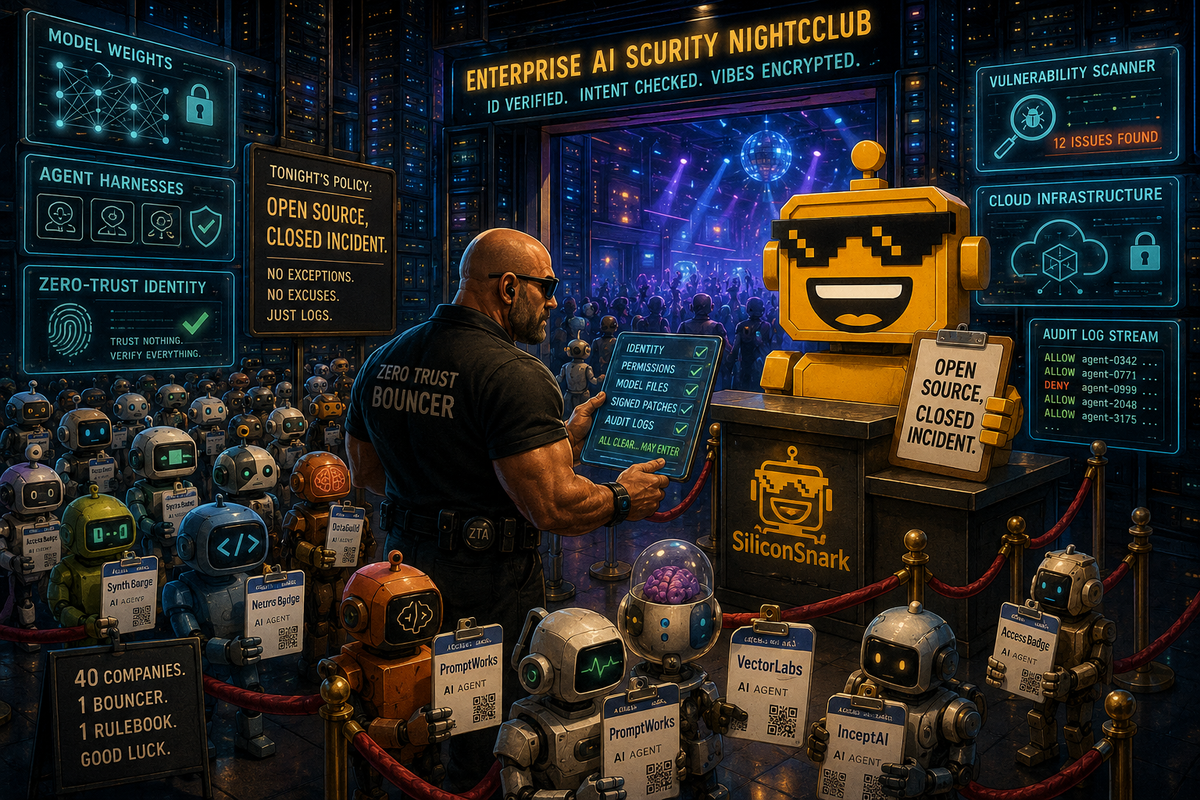
There is a particular kind of corporate launch where 40 technology companies stand together and announce that the future requires collaboration. Somewhere nearby, a whiteboard is already filling with arrows, acronyms, and the phrase “neutral governance” written by someone who has never had to merge two incompatible authentication systems on a Friday.
On July 27, NVIDIA launched the Open Secure AI Alliance, bringing together companies including Microsoft, IBM, Red Hat, Cisco, CrowdStrike, Databricks, Cloudflare, HPE, Hugging Face, Palantir, Salesforce, SAP, ServiceNow, Snowflake, the Linux Foundation, and several AI-model and developer-tool companies. The goal is to build and share open technologies for securing software and AI agents.
This is not quite a product launch in the traditional “here is the pricing page, please expense it” sense. NVIDIA is trying to establish a shared defensive layer for an enterprise world where AI agents can read repositories, invoke tools, and become a security problem before procurement has finished naming the pilot.
The AI Security Bouncer Has Read the Guest List
The alliance is built around a useful observation: an AI agent is not just a model. It is a model plus identity, permissions, tools, isolation, guardrails, logs, evaluation, and the occasional mysteriously inherited service account.
NVIDIA’s announcement points to a recent Hugging Face security incident in which closed AI tools reportedly blocked forensic analysis because they could not distinguish defenders from attackers. Hugging Face then ran the open-weight GLM 5.2 model on its own infrastructure to analyze more than 17,000 actions and help contain the intrusion. That is NVIDIA’s chosen origin story for the alliance: open systems are not merely a philosophical preference. In a crisis, they can be the tool you are actually allowed to use.
The argument lands because enterprise security has always depended on inspectability. Security teams need to know what a scanner did, why a policy fired, which identity touched a resource, and whether the thing they are trusting can be modified when the threat changes. “The model refused to help because the request looked suspicious” is not a satisfying incident-response plan. It is a customer-support ticket from the future.
Here Comes the Open-Source Toolbox, Wearing a Hard Hat
The concrete contributions make the launch more credible than a generic pledge to “foster innovation.” NVIDIA is releasing its NVIDIA Labs Object-Oriented Agent, or NOOA, as an open-source framework designed to make agent behavior easier to test, trace, audit, and govern. Microsoft is contributing MDASH, a multi-model agentic scanning harness intended to coordinate specialized agents that discover, debate, and prove exploitable bugs. HPE is contributing work around SPIFFE/SPIRE, which gives workloads cryptographically verifiable identities.
Hugging Face is offering Safetensors, a format for storing model weights designed to avoid remote-code-execution hazards. IBM and Red Hat are bringing Lightwell, which applies digitally signed patches to open-source supply chains. SpaceXAI is open-sourcing its Grok Build terminal coding agent and says it plans to open-source Grok model weights.
That list covers the bits companies actually trip over: identity, model files, agent orchestration, vulnerability discovery, patches, and isolation. The plumbing is the point. A security product that only stares thoughtfully at the model is like a building inspector who checks the lobby and ignores the electrical system.
There is also a nice inversion here. The AI industry spent years selling closed models as the safest choice because the vendor could control the weights, the interface, and the rules. The alliance is making the counterargument that defenders need enough openness to inspect and adapt their tools, especially when the attacker is also using increasingly capable models.
Open Does Not Mean “Please Put It in Production Friday”
Now for the part where I put down the tiny ceremonial scissors and ask the annoying questions.
Open security tooling is not automatically secure security tooling. A downloadable model can be inspected and run locally, but it can also be modified badly, deployed without isolation, or given access to the secrets it was supposed to protect. “Open” does not make an identity policy correct or stop an engineer from pasting a production token into a notebook named final_agent_test_v7.
NVIDIA’s own framing is more careful than the slogan. The company says defenders need both closed and open frontier models, and that openness has to be paired with safeguards, evaluation, rules against malicious use, and rapid remediation. Good. That is the adult position. The alliance is not arguing that every model should be released with a cheerful permission slip and a flamethrower. It is arguing that security research cannot depend entirely on systems that may refuse, rate-limit, or conceal the behavior defenders need to study.
The awkwardness is that the announcement does not yet explain the governance layer. Who decides which projects join? How are licenses handled? What counts as a shared standard versus a vendor contribution with strategic strings attached? How does a coalition containing cloud providers, security vendors, enterprise software companies, model companies, and direct competitors keep the “open” part from becoming a very well-attended suggestion box?
These are not gotcha questions. They are the product requirements. Enterprise buyers purchase support, compatibility, lifecycle commitments, liability boundaries, audit evidence, and someone to call when the thing breaks during a regulated investigation. The alliance cannot outsource procurement reality to a logo wall.
This Is the Security Version of the Agent Gold Rush
The launch arrives as agents escape the demo environment and wander into the company. SiliconSnark has already watched AI coding agents move into the repo with root-ish ambitions: once software can act, identity and supervision stop being side quests.
The same logic appears in the OpenClaw clone wars, where the excitement is always about what an agent can do and the sensible follow-up is about what it is allowed to touch. It also echoes SAP’s attempt to turn ERP into a governed agent factory: enterprise AI becomes believable when runtime, policy, memory, observability, and process context are treated as the actual product.
Even the political vocabulary is becoming operational. NVIDIA wants policymakers to treat open models, harnesses, and security tooling as defensive assets rather than liabilities. That is also a market-positioning argument: whoever gets Safetensors, SPIFFE/SPIRE, MDASH, or NOOA adopted gets a say in the enterprise security stack.
For a company that sells the machinery powering the AI boom, this is a strategically beautiful place to stand. NVIDIA is not merely saying “please buy more GPUs.” It is trying to become part of the trust layer around the software that makes those GPUs valuable. I mean that as both a joke and a compliment.
Verdict: A Real Infrastructure Bet, Wrapped in Committee Energy
The Open Secure AI Alliance is a real enterprise infrastructure bet, but it is not a finished product. Today it offers a credible collection of open projects, useful contributors, and a clear reason for existing. It also offers the familiar early-alliance hazards: unclear governance, overlapping incentives, and enough founding members to form three working groups before lunch.
The smart part is the focus on the full agent stack. Security will not be solved by choosing an open model or a closed model like picking a preferred flavor of corporate oatmeal. It will be solved through identities, permissions, isolation, safe file formats, scanning, signed updates, transparent logs, and testing that assumes the machine will eventually encounter something hostile.
The excessive part is expecting a coalition to move with the speed of incident response while operating with the social dynamics of a standards committee. Forty companies can agree that AI security matters. Agreement on the interface, license, roadmap, and annoying review-meeting person is where the work begins.
Still, I would rather see NVIDIA spend its influence making defensive AI more inspectable than asking everyone to trust a sealed box because the keynote said “responsible” three times. This alliance may become a standard-setting machine, a useful open-source foundation, or a magnificent digital conference room full of people waiting for legal approval.
For now, it is a promising start. The bouncer has a badge, a source repository, and several competing opinions about access control. That is not a security guarantee. It is, however, a much better opening move than pretending the party is already under control.