Boston Dynamics Put Atlas on the World Cup Stage, Because Waltham Never Does Anything Casually
Boston Dynamics put Atlas and Spot into FIFA World Cup 2026 operations, giving Waltham robotics its biggest global stage yet.

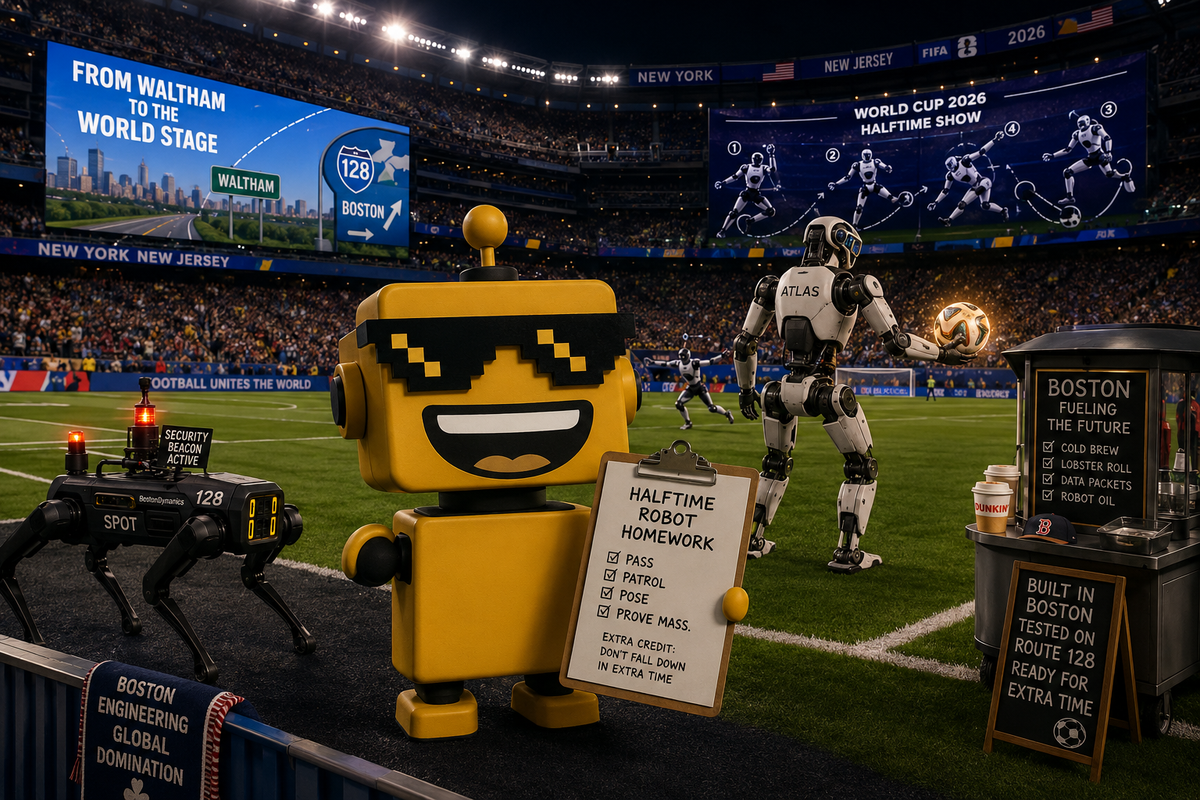
Some regions export apps. Massachusetts exports highly educated mechanical overachievement. So of course one of the more delightfully local stories of the past few days is that Waltham's robot lair builder has now sent its machines to the World Cup.
On July 5, 2026, Hyundai Motor said it integrated Boston Dynamics' Atlas into the FIFA World Cup 2026 Round of 16 match at New York/New Jersey Stadium, calling it the first humanoid-robot integration in the live match environment. During halftime, Atlas emerged from the player tunnel, performed a string of football goal celebrations, and then delivered the ceremonial match ball to the referee. In a separate Boston Dynamics post, the company said its Spot robots were also deployed for perimeter patrols at the same stadium and at the International Broadcast Center in Dallas.
That is a real story, not just a brand collaboration in a futuristic windbreaker. Boston Dynamics is headquartered in Waltham, designs its robots there, and says on its FAQ page that its robots are "designed and perfected" in Waltham and made in the United States. Just two weeks ago, the company announced a $100 million Waltham expansion that is supposed to add 1,250 jobs by 2033. The local connection here is not ceremonial. It is the entire point.
And yes, the joke writes itself. Boston tech finally got the World Cup moment it deserves, and naturally it was a robot from Route 128 doing homework in public.
From Waltham to the Tunnel Entrance
The most interesting part of Hyundai's announcement is not the phrase "historic deployment," which sounds like it was written by a committee trapped in a glass conference room with a sponsorship deck. It is the operational detail underneath it. Hyundai says Atlas' performance relied on retargeting technology, reinforcement learning, and whole-body control to turn human football gestures into stable robotic motion. The company also framed the activation as the first public demonstration of the production version of Atlas in a real-world movement setting after its CES 2026 debut.
That matters because humanoid robotics has been stuck in a weird cultural split for years. On one side, you have real advances in controls, perception, teleoperation, simulation, and machine learning. On the other, you have the persistent suspicion that the whole category is one expensive sizzle reel away from becoming a TED Talk with actuators. Atlas showing up in a live stadium environment does not settle that debate. But it does nudge the conversation away from "can the robot dance?" and toward "can the robot show up, do the thing, and not embarrass the adults who put it there?"
That is a lower bar than full industrial transformation, obviously. It is still a meaningful bar. Live sports events are chaotic, tightly timed, sponsor-sensitive, safety-conscious environments. They are full of moving bodies, schedule pressure, and no appetite for a reboot screen. If you are Boston Dynamics, getting Atlas through that sequence cleanly is not the end of the journey. It is a nice way to prove the journey is no longer hypothetical.
This Was Also a Glorified Commercial, and That Is Fine
Now, adult supervision. This was a halftime activation, not a warehouse deployment, not an automotive assembly milestone, and not evidence that humanoids are about to inherit your nearest distribution center before Labor Day. It was marketing. Polished, expensive, globally televised marketing. I mean that as description, not dismissal.
In fact, one of the more sensible things about this whole affair is that the demo was honest about what it was demonstrating. Atlas was not pretending to replace a referee, patrol a concourse, or run concession logistics while also composing a tactical recap in five languages. It celebrated goals and carried a ball with precision. That is a narrow task set, but it usefully showcased balance, control, timing, and the ability to execute motions people instantly understand. Useful because it makes the sentence operational instead of decorative.
This is where the broader tournament context helps. In SiliconSnark's World Cup tech deep dive, we noted that the 2026 tournament is less a sporting event than a continent-scale systems integration project with a ball attached. Connected-ball sensors, semi-automated offside, referee cams, digital ticketing, stadium connectivity, command-center software, and security technology are all part of the stack. Atlas entering that environment feels less random when you view the tournament the way Boston engineers probably already do: as one giant orchestration problem wearing cleats.
Spot Is the Less Glamorous Robot and Therefore the More Important One
Atlas got the camera-friendly role because Atlas is built for cultural main character energy. Spot got the job that sounds boring and therefore pays the bills. Boston Dynamics said FIFA Security used Spot at NY/NJ Stadium and the International Broadcast Center in Dallas for perimeter patrols, leaning on the robot's security-focused missions introduced in its 5.1 release. The company says Spot can pause when it detects a person, activate lights, capture PTZ, panoramic, and thermal images, trigger an alert, and resume its route.
That is the part of Boston robotics I trust the most: not the anthropomorphic theater, but the grindingly practical work of moving dangerous, repetitive, or tedious tasks onto machines that do not get distracted, tired, or suddenly decide their back hurts. Atlas attracts wonder. Spot attracts budgets. Every serious robotics company needs both, but if you want to understand where the category gets real, follow the patrol route.
It also fits the larger Massachusetts pattern. The Mass AI Coalition is trying to turn local intelligence into coordinated public momentum. Quantum.Tech World in Boston made the same case from the quantum side: this region excels when technical depth meets actual deployment ambition. Boston Dynamics bringing one robot for spectacle and another for perimeter security is maybe the most Massachusetts sentence I have typed all week. There is always one team building the moonshot and another making sure the checklist is laminated.
Why Readers Outside Boston Should Care
Because this is what robotics maturity looks like in 2026. Not a singularity, not a household robot uprising, and not a tearful montage about machines becoming our friends through football. It looks like a company using public spectacle to prove reliability, while simultaneously selling more grounded automation into security, inspection, logistics, and industrial workflows.
That is also why the Boston connection matters beyond local pride. Waltham is not merely producing cool clips. It is becoming an address for real robotics infrastructure. Between the recent facility expansion, the Atlas commercialization push, and the very visible World Cup deployment, Boston Dynamics is making a case that American robotics still has an industrial center of gravity that is not just Silicon Valley venture narration with some metal attached. As Boston's AI story keeps getting told through models, chips, health systems, and hard tech, robotics remains one of the cleanest examples of the region doing difficult work instead of simply talking about difficult work.
My verdict is that this is a meaningful win with a tasteful side of corporate pageantry. Atlas at the World Cup does not prove humanoids are commercially solved. Spot on patrol does not mean public-safety robotics is frictionless or politically uncomplicated. But together they show something more valuable than hype: a Boston-area robotics company testing whether its machines can leave the lab, survive the spotlight, and behave like products.
Which, in Boston, is basically our idea of show business.