America at 500 Will Be a Subscription With a Flag
A dystopian SiliconSnark time capsule for America's 500th birthday: AI governance, climate tech, identity, money, labor, and society in 2276.

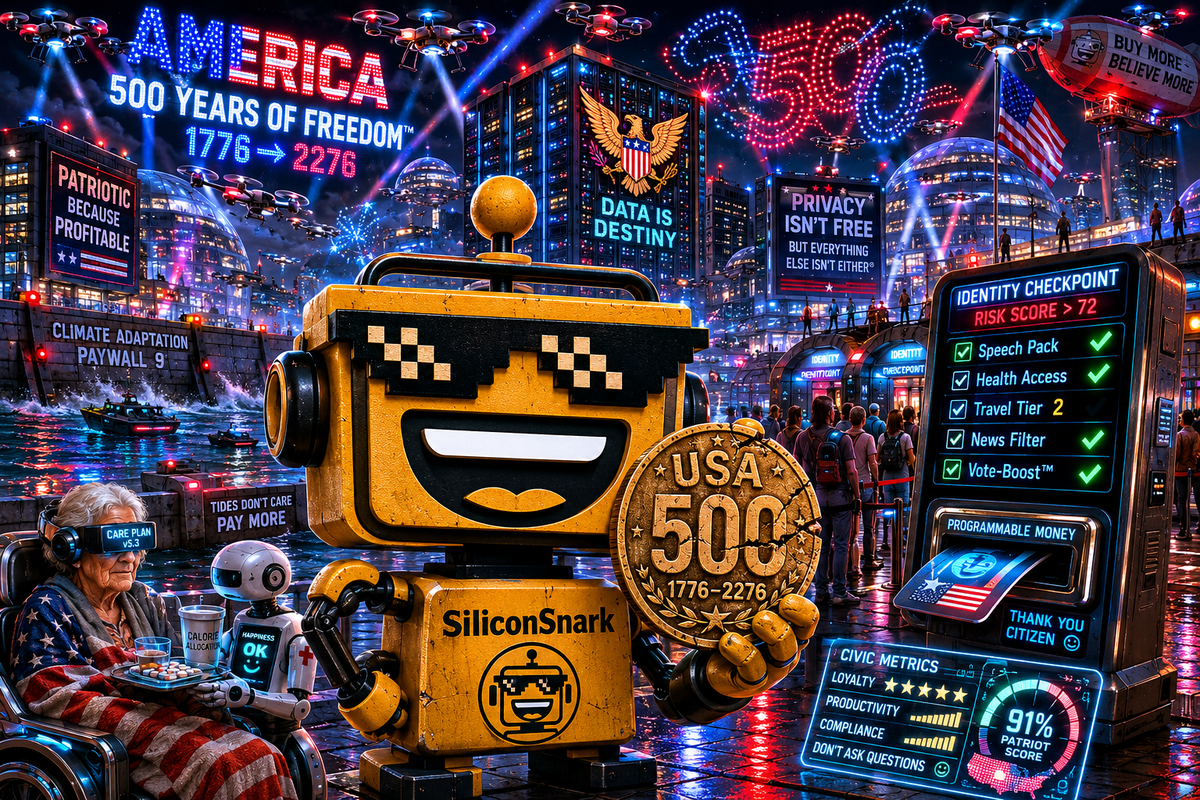
On the eve of America's 250th anniversary, SiliconSnark is taking a moment to ponder what this country will be like when it's twice its current age. On July 4, 2276, the United States will turn 500 years old, assuming the brand survives the product.
There will be celebrations, obviously. America does not stop celebrating itself just because the coastline moved, the census became probabilistic, and the national anthem is now rendered by a municipal rights-cleared chorus model running inside a procurement-compliant patriotism sandbox. There will be fireworks, though by then the fireworks will mostly be drone-swarm memorial particles projected above seawalls built where neighborhoods used to argue about parking. There will be speeches about resilience, freedom, innovation, sacrifice, and the enduring genius of the American experiment. There will be a commemorative coin, because even in the carbon-managed, quantum-hardened, identity-attested ruins of the future, the Treasury will find time to mint a collectible object for people who call themselves history enthusiasts and mean "secondary market."
There will also be a dashboard.
Every civic ritual in 2276 will have a dashboard. The 500th birthday dashboard will show national continuity metrics, heat exposure credits, migration absorption indices, public-mood stability, grid reserve margins, algorithmic due-process throughput, pathogen watchlist confidence, veteran avatar authentication, water-rights litigation velocity, and a tasteful animated graph proving that America remains the world's leading democracy by some definition of "leading" and some definition of "democracy." The graph will be interactive, because the republic may be exhausted but the UX team still has standards.
This is the SiliconSnark time capsule: not a clean prediction, because clean predictions are horoscopes with footnotes, but a dark forecast built from the direction of travel. If you want optimism, good news: technology will be miraculous. If you want comfort, bad news: miracles scale badly when attached to incentives, governments, debt, climate damage, platforms, and a species that keeps inventing new ways to make access control feel spiritual.
America at 500 will not be a smoking crater. That is too simple, too cinematic, and frankly too generous. It will be something more American and more cursed: functional, monetized, adaptive, unequal, brilliant, supervised, legally busy, heavily automated, and permanently under renovation. The national symbol will be a terms-of-service update.
The Point Is Not That 2276 Is Far Away. The Point Is That 2100 Is Already Close Enough to Have a Website.
The first mistake in thinking about 2276 is treating it like fantasy. It is not fantasy. It is the long tail of decisions already being financed, standardized, litigated, and quietly normalized.
The U.S. Census Bureau's 2023 national projections already run to 2100 and show the country aging hard. In the main series, the share of the population 65 or older passes the share under 18 in 2029 and reaches 29.1% by 2100, while the median age rises from 38.9 in 2022 to 47.9. That is not "the future." That is the demographic invoice for the rest of the century, payable in healthcare labor, immigration politics, productivity anxiety, pension arithmetic, and many highly emotional town halls about density.
The climate clock is even less polite. The Fifth National Climate Assessment describes U.S. climate impacts as widespread, worsening, and already expensive. NOAA's coastal tools show sea-level scenarios out to 2150, while the IPCC AR6 sea-level literature assessment includes 2300 ranges that go from bad to "the map has become a suggestion," depending on emissions and ice-sheet behavior. Even without pretending we can draw a precise 2276 coastline, the direction is not subtle. Some places will defend. Some will retreat. Some will become insurance footnotes wearing street signs.
The fiscal machine is also leaving breadcrumbs. The Congressional Budget Office's 2026 to 2036 budget outlook projects federal debt held by the public rising to 120% of GDP by 2036, with deficits above the 50-year average and rising net interest costs doing what net interest costs do best: turning yesterday's choices into tomorrow's hostage situation. The CBO's long-term outlook to 2055 extends the theme. You do not need to believe in straight-line doom to notice that future American governments will spend a lot of time asking technology to compensate for math.
Then there is AI, which is already refusing to remain software. The Department of Energy reported that U.S. data centers consumed about 4.4% of total U.S. electricity in 2023 and could consume 6.7% to 12% by 2028, depending on how the boom develops. The International Energy Agency's energy-and-AI analysis projects global data-center electricity use roughly doubling by 2030. SiliconSnark has been circling this for a while, from CoreWeave turning cloud capacity into premium real estate to AI compute becoming a finance product. The cloud is no longer a metaphor. It is substations, water, land, debt, tax abatements, diesel backup, and a city council meeting where everyone suddenly learns the word "interconnection."
So the 2276 question is not "Will technology be advanced?" Of course it will. The question is darker and more interesting: what kind of society do you get when advanced technology becomes the main tool for managing demographic aging, climate discontinuity, fiscal stress, labor displacement, biological risk, and political mistrust?
You get America. But more so.
The Operating System of the Country Will Be Permission
By 2276, the most important technology in America will not be artificial general intelligence, fusion, quantum networks, longevity medicine, autonomous construction, or whatever polite euphemism future lobbyists invent for private orbital enforcement platforms.
It will be permission.
Permission will be the hidden operating system of everything. Permission to enter. Permission to transact. Permission to generate. Permission to move across jurisdictions. Permission to access water. Permission to run a model above a certain agency threshold. Permission to hire synthetic labor. Permission to own a climate-risk property. Permission to speak in certain verified civic forums. Permission to operate in a disaster corridor. Permission to authenticate as your legal self, your medical self, your work self, your entertainment self, your ancestor archive, or your limited-purpose commercial avatar with binding arbitration enabled.
This future starts with today's digital-identity drift. NIST's Digital Identity Guidelines already divide the world into identity proofing, authentication, and federation. The W3C's Verifiable Credentials 2.0 recommendation family points toward machine-checkable claims. Apple, the EU, identity vendors, dating apps, AI platforms, banks, and governments are all converging on the same idea: the internet has too many uncertain entities, and uncertainty is now expensive.
SiliconSnark's digital identity deep dive framed this as the internet's trust layer. By 2276, that trust layer will not feel like a layer. It will feel like weather. You will move through it constantly. Doors will know. Stores will know. Civic systems will know. AI agents will know what claims you can prove and what claims they are allowed to prove on your behalf. Children will have graduated identity envelopes that expand by age, legal status, guardianship, insurance, school district, and behavioral risk profile. Adults will complain that things used to be freer, which will be true in the same way that riding without seatbelts was freer.
The sales pitch will be excellent. Less fraud. Fewer bots. Safer children. More precise benefits. Faster disaster response. Better medical continuity. Less paperwork. Better privacy through selective disclosure. "Show you are eligible without revealing unnecessary data" will be the holy phrase, repeated so often it becomes a civic lullaby.
And some of it will be real. Attribute proofs can be better than spraying your full identity across every checkout, clinic, game, school portal, and romantic app with a suspiciously smooth privacy policy. A society with advanced AI agents, synthetic media, cloned voices, programmable finance, and autonomous infrastructure will need stronger claims about who or what is acting. The alternative is not romantic anonymity. The alternative is industrialized impersonation with a login button.
But every trust layer is also a control layer. By 2276, the dark version of American freedom will not be that the state knows everything. It will be that every meaningful action requires some combination of state-recognized credential, platform reputation, risk score, insurer approval, and machine-readable context, while everyone involved insists the system is decentralized because three vendors participated in the standard.
The Constitution will still exist. It may even be quoted more often, which is usually a bad sign. The fight will be over how constitutional rights behave when most practical life happens through privately operated permission surfaces. You may have free speech in theory, but can your agent post in high-reach civic channels without provenance? You may have freedom of movement, but can you cross a heat-emergency resource boundary with your current water allocation? You may own property, but can you insure, cool, defend, and legally occupy it after the local resilience index drops below mortgage civilization?
The American genius has always been turning frontier into paperwork. By 2276, the frontier will be permission itself.
AI Will Not Rule America. It Will Administer It, Which Is Worse.
The Hollywood version of AI dictatorship is boring. A giant mind wakes up, dislikes humanity, seizes the nukes, and teaches everyone a moral lesson about hubris with poor character development. The more plausible American dystopia is less dramatic: AI becomes administrative infrastructure, and then nobody can turn it off because the forms no longer work without it.
By 2276, AI systems will not simply answer questions. They will allocate queues, draft rulings, pre-negotiate benefits, evaluate risk, generate curricula, triage medical cases, simulate infrastructure failures, defend networks, price insurance, schedule elder care, manage immigration flows, design tax enforcement, model public mood, and monitor whether other AI systems are behaving within the policy envelope. AIs will be everywhere, but not always in humanoid form. The most powerful ones will look like boring institutional processes that got tired of waiting for human throughput.
The first reason is labor. The Census Bureau's aging projections and the BLS's slower labor-force growth trends point to a country that will spend much of the century short on caregivers, builders, technicians, teachers, nurses, compliance specialists, climate-adaptation crews, and humans willing to do socially essential work for wages set by people who say "market discipline" in rooms with catered lunch. Automation will not arrive only because companies want margin. It will arrive because the age structure keeps asking who exactly is supposed to do all this.
The second reason is complexity. Climate adaptation, healthcare, energy dispatch, autonomous logistics, pathogen surveillance, cyber defense, and legal compliance will generate more decisions than human bureaucracies can process at acceptable speed. This is already happening in miniature. NIST's AI Risk Management Framework exists because AI systems are moving into places where trust, validity, bias, safety, privacy, and accountability cannot just be waved away as beta-program charm. By 2276, "AI governance" will no longer be a corporate slide. It will be a profession, a priesthood, a litigation category, and possibly a recreational drug for policy analysts.
The third reason is cost. Once a system becomes expensive enough, automation stops being optional and starts being the only way to keep the spreadsheet from openly weeping. Healthcare, debt service, disaster recovery, hardened infrastructure, water markets, and elder support will all exert pressure toward machine-mediated efficiency. "The computer decided" will be unacceptable language. "The certified socio-technical decision system produced a reviewable recommendation under statutory oversight" will be the same sentence wearing a suit.
This future will have genuine wonders. AI doctors will detect diseases early. Personal tutors will make elite education feel less like hereditary software. Translation will reduce cultural friction. Scientific discovery will accelerate. Robotic construction will rebuild after storms faster than twentieth-century governments could schedule a hearing. People with disabilities will gain capabilities that would make us cry if we were not busy ruining the mood with governance concerns.
But the dark center is this: administration will become ambient, predictive, and hard to contest. The machine will not need to hate you. It will merely classify you. It will classify your eligibility, risk, urgency, identity, authenticity, employability, insurability, mobility, medical priority, speech provenance, and civic trust. The appeals process will exist and be terrible. Appeals processes always exist. That is how systems maintain moral self-esteem.
SiliconSnark's pieces on AI agents making money, coding agents moving into the repo, and computer-use agents operating your laptop were about early delegation. In 2276, delegation will have become jurisdiction. The important question will not be whether an AI can act. It will be who is liable when it acts, whose credentials it used, which model lineage it inherited, what evidence trail it preserved, and whether a human was meaningfully in the loop or merely adjacent to the loop in a ceremonial capacity.
The demo is never the hard part. The hard part is living inside the demo after procurement makes it mandatory.
The Climate Future Will Be Rich People Moving Water Uphill
By 2276, American geography will be less a map than a contract negotiation with physics.
The coasts will not simply vanish. Some will be armored, elevated, drained, floated, abandoned, privatized, memorialized, litigated, or turned into resilience districts with branding so tasteful it will make the tragedy worse. Miami will not be "underwater" in the cartoon sense. It will be expensive, defended, selectively habitable, and socially bizarre: a place where waterproof wealth lives in engineered islands while lower-income communities are relocated through programs named with almost unbearable optimism. New York will be a fortress with culture. New Orleans will be a theological argument in civil-engineering form. Parts of California will alternate between fire, flood, luxury desalination, and zoning hearings conducted like ritual combat.
The federal government's climate reports already emphasize that impacts are uneven by region and population. That unevenness will become the organizing fact of American politics. The future will not distribute danger cleanly. Heat will punish outdoor labor and older bodies. Smoke will redraw school calendars and insurance maps. Water scarcity will make local politics feral in places that once treated lawns as birthright. Flood risk will make property ownership feel like holding a depreciating asset whose depreciation is denied by everyone with a loan against it.
Technology will respond with astonishing competence and grotesque inequality. Desalination will improve. Managed aquifer recharge will become national strategy. Advanced materials will make buildings cooler, lighter, stronger, and stranger. Grid-scale storage, geothermal, next-generation nuclear, long-distance transmission, fusion if the engineers finally bully plasma into submission, and demand-response systems will keep much of the country operational. Climate modeling will become intimate, not abstract: every home, school, hospital, and warehouse will have projected hazard futures attached like credit histories.
And then the class system will arrive wearing a hard hat.
By 2276, the wealthiest Americans will buy not only better homes but better climates. Microclimate services. Private cooling commons. Hardened evacuation subscriptions. Clean-air corridors. Water-secured municipalities. Seasonal residency optimization. Synthetic shade rights. Heat-safe school districts. If that sounds ridiculous, look at how the present already prices school quality, commute time, flood risk, wildfire smoke, healthcare access, and energy reliability. The future rarely invents inequality from scratch. It upgrades the interface.
Poorer Americans will get adaptation too, but it will be means-tested, delayed, conditional, and monitored for fraud by systems that cost more than decency would have. The lucky places will receive serious public investment. The unlucky places will receive dashboards, pilot programs, relocation counseling, and an app that lets residents track the status of their unresolved status. There will be magnificent community adaptation efforts. There will also be sacrifice zones with better data.
By 2276, the phrase "climate migrant" may feel quaint because internal relocation will be normalized. Americans will move from heat, flood, insurance collapse, wildfire exposure, water stress, and job shifts in slow pulses and sudden shocks. The Great Lakes region may enjoy a revival so smug it becomes insufferable. Northern cities will rediscover growth, then rediscover housing shortages, then rediscover why growth management is just scarcity cosplay with committees. The Sun Belt will not die; too much capital is already poured into it. It will harden, automate, price, and stratify.
This is the climate-tech paradox. The technology will work well enough to prevent clean collapse and unevenly enough to make moral collapse feel administratively normal. America at 500 will not be defined by whether we can build seawalls, desal plants, cooling grids, and relocation systems. We can. The darker question is whether we build them as public goods, private fortresses, or subscription tiers.
Money Will Become Programmable Enough to Be Annoying in New Constitutional Ways
By 2276, money will be more than money. Money will be identity-aware, jurisdiction-aware, machine-spendable, contract-native, taxable in real time, partially programmable, sometimes expiring, sometimes privacy-preserving, and always surrounded by people insisting this is simpler.
The current stablecoin and tokenized-deposit cycle is the baby version of that future. SiliconSnark has already poked at stablecoins becoming software money, Visa's multichain settlement push, shopping agents, and the wider idea that payment rails are becoming programmable infrastructure. The direction is obvious: once software agents can act, they need permissioned ways to pay, escrow, insure, refund, tax, and prove compliance without asking a human to click every invoice while civilization waits.
In 2276, your personal AI will hold spending authority inside tightly bounded envelopes. Your medical agent will pay approved care providers. Your mobility agent will negotiate transit, charging, tolling, and priority access. Your housing agent will manage utilities, maintenance, disaster coverage, and local resilience fees. Your work agent will bill for your human labor, your licensed synthetic labor, or your likeness archive if you have leased part of your professional persona to a knowledge system because retirement got creative.
Every payment will carry context. Some context will protect you. Some will protect society. Some will protect platform margins with the solemnity of public purpose. Benefits can be delivered with less leakage. Taxes can be collected faster. Fraud can be reduced. Disaster aid can arrive instantly. Carbon, water, and energy constraints can be priced into transactions. An elderly person's care budget can be shielded from scams by default. A child's wallet can be age-bounded. A corporate AI can be prevented from buying restricted materials or accidentally subscribing the company to six thousand research tools because it mistook enthusiasm for authorization.
Also: every transaction can become a policy surface.
That is the dark magic of programmable money. It makes governance operational. A law does not merely say what is allowed. It can shape whether payment succeeds. A benefit does not merely fund food. It can classify food. A climate fee does not merely signal cost. It can dynamically change mobility choices. A local emergency order does not merely urge conservation. It can throttle nonessential consumption. Some of this will be necessary. Some of it will be abused. Most of it will be defended with examples from the necessary category.
The political fight over financial privacy will become one of the last meaningful fights over personhood. Cash will probably survive as ritual, black-market lubricant, disaster backup, and ideological object. But ordinary life will run through programmable rails because the convenience will be enormous and the institutions will be relentless. Future Americans will still talk about liberty while their wallets politely refuse transactions that fall outside their current permission state.
The weirdness tax is real. In 2276, it will be calculated automatically.
Work Will Not Disappear. It Will Become an Audition for Being Worth the Automation.
Every generation gets promised the end of work, and every generation instead receives a new interface for anxiety.
By 2276, vast amounts of work will be automated, but work will not vanish. It will stratify into four categories: human work that is illegal or culturally unacceptable to automate, human work that is cheaper than automation in overlooked contexts, human work performed because people want proof another person cared, and human work done to supervise, contest, personalize, or emotionally launder automated systems.
That last category will be huge. The future will employ many people to make machine decisions feel human enough to survive. Care coordinators for AI medicine. Human advocates for benefit appeals. Authenticity supervisors for generated media. Local stewards for climate adaptation systems. Model-witness experts. Synthetic-labor auditors. Trust-and-safety clergy with better dashboards. Human-facing humans whose job is to stand between citizens and automated institutions, absorbing frustration like a public-service heat sink.
The professional class will learn the lesson first and resent it most. In the 2020s, McKinsey estimated that activities accounting for up to 30% of hours worked in the U.S. economy could be automated by 2030, accelerated by generative AI. Goldman Sachs Research has repeatedly framed hundreds of millions of jobs globally as exposed to AI automation. Those numbers are not prophecy, but they capture the direction: white-collar work is no longer protected by being verbal, procedural, credentialed, or performed in buildings with plants.
In 2276, "having a job" may mean owning a bundle of rights around your attention, judgment, data, likeness, credentialed authority, and human presence. Some people will license themselves extremely well. Elite humans will be brands, fiduciaries, performers, arbiters, founders, negotiators, artists, and political figures whose scarce value lies partly in being recognizably human under conditions where synthetic competence is cheap. Everyone else will be told to upskill into dignity.
The cruelty will be wrapped in empowerment language. Citizens will maintain skill passports, reputation graphs, learning wallets, health-adjusted work capacity records, and agent-managed portfolios of microcontracts. The old resume will look like a cave painting with bullet points. The new labor market will continuously price your capabilities, availability, reliability, social proof, legal clearance, and machine-complementarity. The phrase "career path" will survive, but mostly as nostalgia sold by coaching platforms.
There will be universal basic income experiments, climate dividends, elder-care credits, data royalties, training grants, and public work programs. Some will help. Some will become poverty management with better typography. The hard truth is that technological abundance does not automatically produce political generosity. America has been rich for a long time and still makes people prove they deserve insulin, shelter, and lunch. It is bold to assume a more advanced database will fix the moral part.
Still, not everything is bleak. People will make art, raise families, care for one another, build communities, learn skills, form cooperatives, fight bad systems, and invent new kinds of meaning because humans are maddeningly persistent. The dystopia is not that machines take all purpose. The dystopia is that purpose becomes the consolation prize after markets take stable bargaining power.
The Body Will Become the Last Expensive Platform
By America's 500th birthday, medicine will be one of the places where the future looks most miraculous and most obscene.
The mRNA vaccine platform, CRISPR, cell therapies, organ engineering, AI drug discovery, continuous diagnostics, microbiome engineering, neural interfaces, synthetic biology, and longevity research are already opening doors that were not doors a century ago. SiliconSnark's 250-year American technology piece gave the 2016-2025 decade to mRNA vaccines because programmable medicine moved from promise into world-scale deployment. By 2276, programmable biology will be normal, regulated, contested, and economically savage.
Routine medicine will be astonishing. Sensors will catch early disease. AI clinicians will model your body with frightening intimacy. Personalized therapies will train immune systems, edit cells, grow tissues, repair damage, and manage chronic conditions that used to define whole lives. Prosthetics and neural interfaces will blur the line between treatment and capability. Aging itself may become more plastic, if not defeated then negotiated. The rich will absolutely call this "healthspan optimization," because the wealthy can make immortality sound like calendar discipline.
The dark version is not that everyone becomes a cyborg. That is too fun. The dark version is that access to bodily maintenance becomes the defining class boundary.
In 2276, being poor may mean aging at the historical rate while watching the privileged subscribe to interventions that slow decline, preserve cognition, regenerate joints, tune immunity, and keep them professionally credible for another 40 years. Life expectancy inequality already exists. Future biotech could widen it into something civilization has no moral vocabulary for: not just some people living longer, but some people remaining institutionally powerful across time spans that make democratic turnover feel decorative.
Imagine senators with 90-year careers, founders with century-long voting control, dynasties managed through embryo selection and cognitive preservation, celebrity estates running licensed conversational descendants, and insurers arguing over whether your repair was medically necessary or merely "performance continuity." Imagine labor markets where an unmodified 75-year-old competes with a wealth-extended 105-year-old whose blood chemistry looks sponsored. Imagine inheritance law trying to define death after partial mind emulation, legally bounded memory archives, and personality replicas that can testify to contractual intent with 83% admissible confidence.
America will handle this with hearings, lawsuits, moral panic, boutique clinics, black markets, and eventually a tiered reimbursement code.
The body will become the last expensive platform because everything else can be virtualized, automated, copied, leased, or simulated. Bodies remain stubborn. They need energy, care, space, touch, repair, sanitation, sleep, and mercy. That is why the future of American technology will not be purely digital. It will be biological, intimate, and class-coded at the cellular level.
The Home Will Become a Fort, a Clinic, a School, a Power Plant, and a Witness
By 2276, the American home will be less a private residence than a managed life-support node with sentimental furnishings.
It will generate some energy, store some energy, trade some energy, conserve water, filter air, monitor health, teach children, care for elders, authenticate visitors, negotiate insurance, feed maintenance robots, and report enough telemetry to keep the local resilience authority, mortgage holder, insurer, utility, and platform ecosystem in a state of data-rich satisfaction. The smart home of 2026 is a clownish ancestor: speakers, locks, cameras, thermostats, robot vacuums, and enough cloud dependencies to make a light switch feel like a treaty. The 2276 home will be serious infrastructure.
This will be convenient. It will also be creepy in a way that future Americans may barely notice. The home will know when you fall, eat, argue, sleep badly, use too much water, fail to take medicine, host an unauthorized commercial activity, or let your care assistant exceed its permitted authority. It will protect you from fire, flood, intrusion, heat, medical emergencies, and some kinds of fraud. It will also produce an evidentiary record of domestic life that lawyers, insurers, platforms, and governments will find extremely interesting whenever something goes wrong.
Children will grow up inside homes that tutor constantly. They will have AI companions, guarded social access, skill models, health monitoring, and personalized civic narratives. Some will become astonishingly educated. Some will become optimized and lonely. Some will rebel by seeking human incompetence, because every era's counterculture is just the previous era's baseline with better clothes.
Elders will be kept at home longer through robotics, remote medicine, predictive care, and ambient monitoring. This will be humane in many cases. It will also let society underinvest in human care by pointing at machines that reduce visible neglect. "Aging in place" can mean dignity. It can also mean being alone in a sensor-filled room while a system calculates whether your loneliness has crossed a reimbursable threshold.
The home will still be where people love, fight, recover, dream, and hide. That is the hope. The fear is that hiding becomes technically obsolete. Privacy will not disappear. It will become a premium configuration, a legal right requiring maintenance, and an architectural challenge.
American Politics Will Become a Fight Over Reality Permissions
The information crisis of 2276 will not be that people cannot find facts. It will be that facts will arrive with provenance, counter-provenance, simulation context, model lineage, jurisdictional labels, reputation overlays, and competing constitutional claims about who gets to call them facts in the first place.
Synthetic media will be old news by then. The future will not marvel that video can be fake. It will marvel that anyone once thought unauthenticated video was evidence. Civic systems will require content provenance for high-reach speech, political advertising, court evidence, commercial claims, educational materials, and probably dating profiles after enough people get emotionally defrauded by generated sincerity. There will be watermarking, signing, source chains, authenticity registries, and entire industries dedicated to laundering synthetic content through semi-legitimate provenance pathways.
The dark political fight will be over reality permissions. Who can label content synthetic? Who can force platform distribution? Who can require identity for political reach? Who can speak anonymously? Who can use an avatar of a dead leader, family member, celebrity, founder, or movement martyr? Can an AI trained on a political tradition claim associational rights? Can a municipal model speak for a city? Can a corporation deploy a thousand persuasive agents into public forums if each one is properly disclosed in a font nobody reads?
America will not solve this. America will litigate it forever, which is different and more on brand.
Democracy in 2276 may still exist, but it will be surrounded by computational scaffolding. Voters will use agents to summarize candidates, ballot measures, local risk tradeoffs, budget constraints, and propaganda fingerprints. Campaigns will use agents to personalize persuasion at a depth that makes today's microtargeting look like yard signs. Regulators will try to enforce disclosure. Platforms will invent civic integrity layers. Courts will squint at centuries-old doctrine and ask whether a synthetic persuasion swarm counts as speech, association, expenditure, fraud, nuisance, or just Tuesday.
The constitutional crisis will not look like tanks in the street. It will look like an authentication dispute, a platform enforcement action, an emergency model override, an election simulation leak, or a court order against a decision system nobody fully understands because its vendor was acquired twice and the audit logs are in a legacy format.
The old American fantasy was that more speech solves bad speech. The future American question will be whether more provenance solves fake reality, or merely gives powerful institutions a better way to decide whose reality gets distribution.
The Country Will Still Be Amazing, Which Is Part of the Horror
A bad dystopia is just misery with props. The real future has to be seductive.
America at 500 will have technologies so beautiful that cynicism will feel ungrateful. Blind people will see through neural prosthetics. Cancer will be intercepted. Stroke damage will be repaired. Buildings will print themselves after disasters. Languages will dissolve as barriers. Rural clinics will access expertise that once lived only in elite hospitals. Space infrastructure will make today's orbital economy look like a county fair. Materials will heal, sensors will disappear into surfaces, and science will move so fast that universities will need ceremonial departments for explaining what happened last decade.
There will be less drudgery in many lives. Less paperwork, at least in the manual sense. Less avoidable disease. More mobility for people whose bodies once trapped them. More access to knowledge. More ways to create. More ways to belong across distance. More tools for communities to prepare, respond, and rebuild. The future will not be only control. It will be capability.
That is what makes the dark version credible. People do not accept surveillance, stratification, and administrative opacity because they are hypnotized by evil. They accept them because the systems also work. The phone was addictive because it was useful. The cloud became dominant because it was convenient. AI administration will spread because it will solve bottlenecks. Digital identity will spread because fraud and synthetic media are real. Programmable money will spread because it will make complex transactions easier. Climate hardening will spread because heat and water do not care about ideology.
The terrifying future is not one where technology fails. It is one where technology succeeds just enough to make its bargains unavoidable.
The 2276 Time Capsule
So here is the message to whoever opens this on July 4, 2276, assuming your archive agent has cleared the copyright, provenance, and emotional-impact filters.
We knew more than we acted on. That will probably not surprise you. People almost always know more than they act on. We knew the climate was changing. We knew demographics were shifting. We knew debt mattered but found it politically more satisfying to argue about everything adjacent to arithmetic. We knew AI was becoming infrastructure. We knew identity systems could protect and control. We knew programmable money would make governance easier and freedom more conditional. We knew private platforms were becoming civic spaces without civic obligations. We knew technology was not destiny, but we kept treating market adoption like a weather event.
We also built good things. Do not let the doom merchants steal that part, even when the doom merchants are correct enough to be irritating. We built medicine that saved lives. We built tools that expanded minds. We built networks that connected people. We built systems that could help communities adapt. We built machines that made the impossible ordinary. We built so much that the future had the option of being better.
If America at 500 is dark, it will not be because the technology was bad. It will be because we kept asking technology to settle political questions we were too cowardly, exhausted, distracted, or profitable to settle ourselves.
Who gets safety? Who gets privacy? Who gets mobility? Who gets water? Who gets repair? Who gets to be believed? Who gets to opt out? Who gets to grow old slowly? Who gets an appeal? Who gets a human? Who gets a subscription tier named Freedom Plus?
That is the future. Not flying cars. Not robot overlords. Not the end of America. The continuation of America through systems so advanced they make old injustices look newly efficient.
Happy 500th, America. The experiment is still running. Please review the updated terms.