World Cup 2026 Tech, Explained: The Ball Has a Chip and the Stadium Knows Your Face
Inside the connected balls, AI refereeing, player tracking, 5G, hybrid grass, biometrics, broadcasts, and pricing tech powering World Cup 2026.

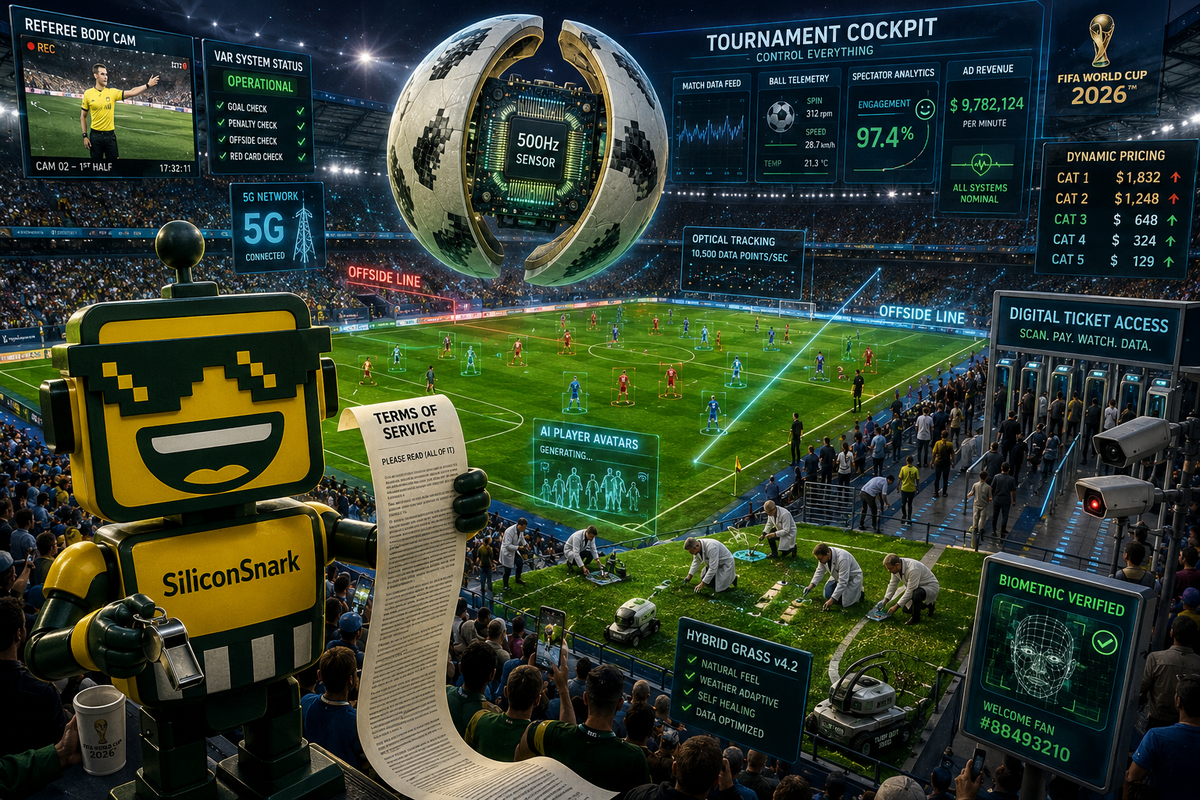
The 2026 FIFA World Cup, which began on June 11 and runs through July 19, is the largest version of the tournament ever staged: 48 teams, 104 matches, 16 stadiums, three host countries, and one enormous technical problem disguised as a month of football. FIFA has to make officiating consistent, move live video around a continent, deliver usable data to every team, keep digital tickets working, protect players online, coordinate safety operations, and somehow ensure that temporary grass inside an American football stadium behaves like grass rather than an expensive green rug contemplating revenge.
So this is not merely a list of shiny gadgets being used at the World Cup. It is a tour of the whole stack: what happens inside the ball, around the pitch, in the video room, on the team analyst’s laptop, behind the broadcast, beneath the stadium, at the turnstile, inside the command center, and eventually on your phone.
Much of the technology is impressive because it makes an impossibly large tournament feel immediate and coherent. Some of it is concerning because the same systems that make crowds legible also make people trackable, priceable, and wonderfully convenient to monetize.
Welcome to the future of football. Please accept the cookie policy before kickoff.
This Is a Continent-Sized Software Deployment With a Ball Attached
The easiest way to misunderstand World Cup technology is to focus only on VAR. Video review is the most visible and emotionally combustible part of the stack, but it is merely one output from a much larger machine.
The modern World Cup runs on synchronized data. Cameras track bodies. A sensor tracks the ball. Algorithms identify events. Officials receive alerts. Teams receive analysis. Commentators receive statistics. broadcasters receive new camera angles. Fans receive replays, notifications, content, ads, and occasional invitations to turn their face into a credential. Operations teams receive a live view of what is happening across venues and host cities. Everybody receives a dashboard.
This matters because the 2026 tournament is unusually distributed. Qatar 2022 took place in a compact geographic footprint. World Cup 2026 stretches across Canada, Mexico, and the United States, with venues separated by thousands of miles and operating inside different local infrastructure, security, telecom, and transportation environments. FIFA is not simply staging more games. It is trying to make a sprawling temporary organization behave like one system.
That is why Lenovo, FIFA’s official technology partner, is not merely supplying laptops with tasteful tournament wallpaper. It is involved in the tournament’s AI tools, officiating imagery, team-analysis platform, and central operational systems. Verizon is not merely hoping fans post more celebration videos. It is supplying and upgrading connectivity that supports fans, broadcasters, officials, and public-safety operations. The tournament’s technology story is really an integration story, which means the plumbing is the point.
It also means the most important technical achievement may be the one nobody notices. If the connected ball works, the network holds, the command center sees problems early, the digital ticket loads, and the replay arrives before your group chat invents a conspiracy, the infrastructure disappears into the match. If any of it fails, millions of people instantly become unpaid incident-response analysts.
The Ball Is Online Now, Because Apparently Nothing Is Allowed to Be Just an Object
Let us begin with Trionda, the official match ball and the tournament’s most elegant little snitch.
According to adidas, Trionda uses a new version of Connected Ball Technology built around a side-mounted motion-sensor chip. The system sends precise ball-movement data to the video assistant referee operation in real time. FIFA says the sensor runs at 500Hz, meaning it samples movement 500 times every second.
That speed is useful because football’s most disputed moments are often arguments about time disguised as arguments about space. Was an attacker beyond the last defender at the exact instant a teammate played the ball? Did the ball touch a hand? Who got the final contact before it went out? Human vision, television frame rates, and patriotic certainty are all imperfect tools for answering those questions. A sensor inside the ball can identify the kick point far more precisely than someone advancing video one frame at a time while an entire nation gently loses its mind.
Connected-ball technology first appeared at the men’s World Cup in 2022, but the 2026 version improves the package and expands how ball data supports decisions. It works with optical player tracking and artificial intelligence, feeding the officiating systems a synchronized account of where the players were and what the ball was doing.
The clever part is not that the ball contains a chip. We have been putting sensors into sports equipment for years. The clever part is that the sensor becomes a shared clock for the rest of the officiating stack. It turns “when was the pass made?” from a visual judgment into a machine-readable event.
There is a broader tech lesson hiding inside the sphere. Connected products become useful when their data resolves a specific ambiguity. The sensor is not there to make Trionda feel futuristic in a product video. It is there because a few milliseconds can decide an offside call. Unlike many connected gadgets, the ball has a reason to be connected beyond an app nobody opens after Tuesday.
That said, I remain delighted that one of the most emotionally sacred objects in global sport is now emitting telemetry. Somewhere, a product manager is already wondering whether the 2030 ball needs a subscription tier.
Offside Has Become a Computer-Vision Problem With Extremely Loud Stakeholders
The connected ball becomes truly useful when paired with semi-automated offside technology, or SAOT, the system designed to help video match officials identify offside positions more quickly and consistently.
The underlying idea is straightforward. Dedicated cameras track the players and ball. Computer-vision systems model relevant body positions. Connected-ball data identifies the precise moment a pass is played. The system then alerts the video officials when it detects a possible offside situation. Humans still validate the decision rather than surrendering the whistle to a server rack, because “semi-automated” is doing important diplomatic work in the product name.
For 2026, FIFA and Lenovo have added a particularly vivid upgrade: AI-enabled 3D player avatars. Every participating player is digitally scanned to create a precise three-dimensional model. FIFA says each scan takes about one second and captures body-part dimensions that help the system track players during fast movement or when camera views are partially obstructed.
The avatars also make broadcast replays more recognizable. Instead of generic mannequin-like figures showing an offside line, viewers can see a recreation that more clearly resembles the actual players involved. This is useful communication design. It also means footballers are now getting digital twins so an algorithm can explain that their shoulder was spiritually ambitious.
The benefits are real. Faster, more reproducible calls reduce the long pauses that turned early VAR reviews into stadium-wide hostage situations. Better models can handle occlusion and unusual body positions. More precise kick-point detection narrows the room for arbitrary frame selection. The goal is not to remove controversy, which would require deleting sports, but to reduce the number of decisions that depend on a human drawing lines over blurry television footage like a conspiracy researcher with access to telestration.
The limitation is equally real. Technology can improve measurement without resolving every philosophical question embedded in the rules. A system can identify that part of an attacker was beyond a defender at a particular instant. It cannot decide whether the sport is improved by treating that margin as meaningfully offside. That is a governance choice wearing a precision costume.
This is familiar territory for anyone who has watched the wider computer-vision industry. As SiliconSnark noted in our look at robotaxis and their operating limits, the hard part is not merely seeing the world. It is deciding what the system should do with what it sees, under rules that humans must still defend.
The Referee Is Also a Camera Operator Now
World Cup viewers are also getting an upgraded Referee View: footage captured from a body camera worn by the match official and stabilized with AI.
Earlier referee-camera experiments proved that the perspective could be thrilling and mildly nauseating. A referee moves constantly, changes direction abruptly, and spends much of the match navigating a fast, crowded space while several elite athletes explain why the referee has personally betrayed the concept of justice. Raw footage from that viewpoint tends to have the visual calm of a phone dropped down stairs.
For 2026, FIFA says the body-camera system has improved stabilization, helped by AI, to produce more usable broadcast images. Connectivity matters here too: low-latency network capacity helps move the video from a rapidly moving official into the production workflow.
Referee View is not primarily an officiating tool. It is a broadcast product, and a clever one. It gives viewers an unusually intimate sense of speed, spacing, confrontation, and decision-making. A tackle that looks obvious from the elevated broadcast camera can look completely different when seen from the official’s moving position behind several bodies.
That perspective may even make viewers more sympathetic to referees, which is presumably why the feature must be rationed carefully before football culture rejects the antibodies.
It also illustrates how AI is most useful in this tournament when it is boringly specific. Stabilizing difficult footage is a concrete problem. Improving tracking through occlusion is a concrete problem. Automatically classifying match events is a concrete problem. These are less glamorous than asking a chatbot who will win, but considerably more useful. As with our broader look at what AI can and cannot actually do, the strongest applications usually begin where the sentence becomes operational instead of decorative.
Every Team Gets an Analytics Department, Even If It Did Not Bring One
The officiating stack gets the headlines because it can overturn goals. The team-analysis stack may be more consequential over time.
FIFA and Lenovo’s Football AI Pro system is designed to give all 48 participating teams access to match analysis and performance tools, regardless of the size of their existing technical staff. The platform combines FIFA’s football data with AI-supported analysis so coaches and analysts can study patterns, review events, and prepare for opponents.
This is being framed as democratization, and for once the word is not entirely being used as decorative parsley. Wealthy national programs can arrive with deep benches of analysts, bespoke software, data scientists, and enough video staff to make a streaming service jealous. Smaller federations may not have equivalent resources. A shared tournament platform can narrow that gap by giving every team access to a baseline analytical capability.
Underneath it sits a growing football data ecosystem. FIFA’s optical tracking systems capture player and ball movement. Automated event-data collection turns many in-game actions into structured records without requiring a human operator to manually log everything. Tactical and medical replay tools let authorized staff review relevant footage. A Player App gives footballers access to their own performance data and video after matches. The Commentator Information System packages live data for broadcasters who must turn it into language before dead air becomes sentient.
This is what modern elite sport increasingly looks like: the same match rendered into different interfaces for different users. The referee gets decision support. The coach gets tactical patterns. The player gets performance clips. The commentator gets statistics. The broadcaster gets visualizations. The fan gets a graphic explaining that a midfielder has occupied “dangerous half-spaces” with the confidence of someone who definitely understood that phrase before today.
The upside is better preparation and a more level technical field. The risk is that every competition begins to converge around the same measurable logic. Data can reveal opportunities, but it can also standardize attention. Teams optimize what systems can see. Coaches defend decisions with what dashboards can count. The immeasurable parts of football do not disappear, but they must increasingly file a support ticket.
This is the same tension SiliconSnark has seen across personal AI and persistent data profiles: memory and measurement create useful context, but once the profile exists, it starts shaping the person being profiled. In sport, the data does not merely describe performance. It becomes part of how performance is trained, valued, and selected.
The Broadcast Is a Global Data Product Wearing a Match Scarf
For most people, the World Cup is not a stadium event. It is a broadcast event delivered through televisions, streaming services, phones, social platforms, highlights, clips, live blogs, and whatever legally adventurous website your uncle insists has “better picture quality anyway.”
The center of that operation is the International Broadcast Centre in Dallas, a hub supporting thousands of broadcast personnel and the global distribution of the tournament. Match feeds, camera angles, audio, graphics, data, replays, interviews, and other production assets must move reliably from venues to broadcasters and onward to viewers around the world.
The technical challenge is not only volume. It is timing. A goal is simultaneously a live image, a replay sequence, a statistical event, a notification, a social clip, a commentary update, a betting-market input, and a reason for several million people to refresh an app at once. The modern broadcast stack must turn one physical event into many synchronized digital products with very little delay.
Newer tools make that package richer. Referee View adds a first-person angle. 3D recreations explain offside decisions. Automated data feeds power live graphics. Commentator systems surface facts quickly. Optical tracking can visualize formations and movement. The match becomes watchable, queryable, and increasingly reconstructable.
This is impressive. It is also why sports broadcasts now occasionally feel like someone opened a business-intelligence dashboard over a beautiful human drama. Expected goals, passing networks, sprint speed, pressing intensity, win probability, shot maps, heat maps, and live player metrics can deepen understanding. They can also create the sensation that the match is applying for quarterly funding.
The best broadcast technology knows when to disappear. A clear replay can settle confusion. A useful graphic can reveal a tactical pattern. A stable referee camera can show what the official saw. The worst broadcast technology treats every empty pixel as an invitation to explain the concept of data.
The Grass May Be the Most Impressive Technology at the Tournament
It is tempting to define technology as the things containing chips. That would miss one of the World Cup’s most difficult engineering projects: making 16 pitches across radically different climates and stadium designs play consistently.
Several North American venues normally use artificial turf or were not designed around the sunlight, airflow, drainage, dimensions, and maintenance requirements of elite international football. FIFA requires mostly natural-grass surfaces and wants competitive consistency across every venue. That means the pitch at a domed stadium in Texas should not feel like an entirely different sport from the pitch in Mexico City or Toronto.
Researchers at the University of Tennessee and Michigan State University spent years developing and testing surface systems for the tournament. The work involved different grass varieties for different climates, hybrid reinforcement, drainage layers, temporary installations over existing stadium floors, grow lights, testing equipment, and the deeply serious agricultural science required to make grass survive a month of global attention.
The Associated Press reported that the project took roughly eight years and sought to create consistent hybrid-grass surfaces across the host venues. Systems can include natural grass reinforced with synthetic fibers and engineered subsurfaces designed to manage water, stability, and the awkward reality that some pitches are temporarily sitting where an NFL field or event floor normally lives.
This is not as marketable as an AI avatar, but it is arguably closer to the soul of the competition. Players directly interact with the surface for the entire match. The grass affects traction, ball speed, fatigue, injury risk, and confidence. If it fails, no amount of 3D replay polish can make the football good.
The pitch project is a useful correction to the usual tech narrative. Innovation is not always a new interface. Sometimes it is drainage, root structure, biomechanical testing, and several universities quietly ensuring that a billion-dollar spectacle does not take place on a lawn assembled with the emotional durability of conference carpeting.
Private 5G, Fiber, and the Sacred Human Need to Upload a Goal Everyone Already Saw
A stadium full of tens of thousands of people is a hostile network environment. Everybody arrives at roughly the same time, opens a digital ticket, sends messages, uploads video, checks scores, orders things, and attempts to prove to absent friends that they are having an emotionally superior day.
At the same time, the tournament needs connectivity for officials, broadcasters, venue operations, media, vendors, public safety, and a growing collection of systems that cannot simply wait until the crowd stops using Instagram.
Verizon says it has deployed advanced 5G and fiber infrastructure across stadiums, FIFA Fan Festival locations, and operational environments, while also supporting public-safety communications in U.S. host cities. The broader network build includes expanded capacity and more specialized connectivity for critical tournament functions.
The important distinction is between ordinary fan connectivity and assured operational connectivity. Your phone failing to upload a 40-second clip is irritating. A critical production feed, officiating camera, ticketing system, or emergency communication failing is an incident. Network design for an event like this is therefore an exercise in segmentation, redundancy, prioritization, and the quiet art of preventing one viral moment from eating the infrastructure.
FIFA’s own stadium technology guidance calls for resilient external connections and redundant network services for critical areas. That sounds boring because resilience always sounds boring until it is absent. Then everybody becomes extremely interested in failover architecture.
The connectivity upgrades may also outlive the tournament, which is one of the more credible “legacy” claims attached to a mega-event. New fiber, cellular capacity, and public-safety communications can continue serving host communities after the final. Whether those benefits are distributed as generously as the press releases suggest is a different question, but at least network equipment is harder to abandon than a ceremonial promise.
The Tournament Cockpit Is What Happens When Football Discovers Enterprise Software
Somewhere in Miami, the World Cup is being rendered as a wall of operational information.
FIFA’s Tournament Operations Center coordinates the sprawling event, and a key part of it is an Intelligent Command Centre developed with Lenovo. The system integrates data from multiple functional areas into a platform called the Tournament Cockpit, accessible on large displays, laptops, tablets, and phones.
This is where the World Cup stops looking like sport and starts looking like the world’s most emotionally volatile enterprise-software customer.
A tournament across three countries generates endless operational variables: venue readiness, transportation, weather, security, staffing, team movements, accreditation, ticketing, technical systems, fan activity, broadcast status, and incidents that must be escalated quickly. A shared operational picture can help decision-makers see patterns, coordinate responses, and avoid managing a continental event through disconnected spreadsheets and increasingly tense group chats.
The name “Tournament Cockpit” is both dramatic and accurate. The platform’s job is to compress complexity into a view that supports action. That makes it a cousin of the corporate systems we covered when Collibra built a control layer for AI agents and when Google turned enterprise AI into a managed platform. Different domain, same managerial dream: one pane of glass from which the organization becomes visible, governable, and hopefully less likely to surprise you on television.
Of course, dashboards do not eliminate complexity. They organize its complaints. The quality of the Tournament Cockpit depends on the quality, timeliness, and interpretation of the information flowing into it. A beautifully designed command center can still produce false confidence if local reality does not fit the boxes. But for an event this distributed, shared operational awareness is not feature confetti. It is survival.
Your Face, Your Ticket, Your Data, and Other Warm Gestures of Welcome
Now we reach the part of the technology tour where convenience and surveillance begin sharing a hotel room.
World Cup security is not one unified system. It is a layered collection of FIFA processes, stadium technologies, host-city systems, law-enforcement capabilities, public-safety networks, and local policies that vary across three countries and 16 venues. That distinction matters because breathless claims that “the World Cup uses facial recognition” can flatten a messy reality into one sinister master switch.
Still, biometric technology is part of the tournament environment. Some stadiums and local authorities already use or have tested facial recognition, biometric entry, camera analytics, and other identity systems. WIRED’s survey of World Cup surveillance describes a broader security landscape that includes facial recognition, anti-drone systems, and extensive camera networks. The exact deployment and rules differ by location, but the direction is clear: the mega-event is also a laboratory for making large crowds machine-readable.
The sales pitch is familiar. Biometric entry can move people through gates faster. Face matching can help identify barred individuals or security threats. Camera analytics can flag unusual movement. Anti-drone systems can protect crowded airspace. Integrated communications can help first responders coordinate. These are real operational benefits in environments where delays and uncertainty can become dangerous.
The privacy concerns are equally real. Who operates each system? What watchlists are used? How accurate is the matching across different demographics? Is participation voluntary? How long is data retained? Is information shared across agencies or borders? Can a person challenge a false match? Does a tool deployed for one month become permanent because the hardware is already installed and the procurement presentation went so well?
SiliconSnark has already explored the broader drift toward digital identity systems that turn access into a verification problem. The World Cup version is simply identity tech at crowd scale. It can reduce friction and improve safety. It can also normalize the idea that entering public life means presenting your body as a credential.
The weirdness tax is real. A fan may encounter a seamless gate and experience it as convenience. The institution sees an identity event. Both descriptions can be true at once, which is why the useful question is never merely whether the technology works. It is what happens to the data after it does.
Digital Tickets and Dynamic Pricing: The Algorithm Would Like to Thank You for Caring
The World Cup’s fan-facing technology begins before anyone reaches a stadium. Tickets are digital, distribution is platform-mediated, and pricing has become a live computational expression of how badly people want to be there.
Digital ticketing has obvious benefits. It supports rapid delivery, timed releases, transfer controls, anti-counterfeit measures, entry scanning, and account-based management. It also makes the ticket inseparable from a platform relationship. The fan is no longer holding a piece of paper. The fan is accessing a revocable digital entitlement through an account, device, app, network connection, and terms-of-service agreement nobody read because kickoff is in 20 minutes.
Then there is dynamic pricing. FIFA adopted a model that allows ticket prices to change with demand, bringing the tournament closer to the familiar logic of airlines, hotels, concerts, and ride-hailing. A University of Virginia Darden analysis describes the combination of dynamic pricing, advance sales, and an official resale marketplace behind this year’s unusually expensive ticket environment.
Economists can explain that dynamic pricing allocates scarce inventory and may allow prices to fall when demand softens. Fans can explain that it feels like the system is charging them extra for possessing emotions in public.
The technology does not create scarcity, but it makes scarcity more efficiently monetizable. That is an important distinction. A fixed-price system leaves some demand uncaptured and creates opportunities for outside resellers. A dynamic system lets the organizer participate more directly in the extraction. The algorithm is not greedy. It has simply been configured by people who found greed operationally useful.
This belongs in the tech deep dive because software changes the commercial meaning of the event. Digital identity, account-based tickets, real-time demand data, and resale platforms turn attendance into a managed marketplace. The same infrastructure that helps prevent fraud can also enforce pricing rules, observe behavior, and control access. Convenience is real. So is leverage.
It is the sports version of the lesson in our guide to AI shopping agents and programmable commerce: once software sits between desire and purchase, the intermediary gains a very interesting view of both.
AI Is Protecting Players Online Because Humanity Remains a Difficult Beta
Not every World Cup AI system is about performance, officiating, or fan engagement. FIFA is also expanding its Social Media Protection Service, which uses automated systems and human review to identify, report, and hide abusive posts aimed at players, teams, and officials.
The need is grimly obvious. Major tournaments generate enormous waves of racist, misogynistic, homophobic, threatening, and otherwise abusive content, often directed at individual players immediately after a mistake or defeat. FIFA says its Social Media Protection Service monitors participating accounts, flags abuse, supports moderation, and can help pursue real-world action against severe offenders.
For the 2026 tournament, the moderation capability is being offered to participating associations. The Guardian reported that the system can filter against a large abuse vocabulary and hide harmful comments quickly across supported platforms.
This is one of the clearer examples of AI being used for a job that is both necessary and structurally miserable. Automated classification can process volumes no human moderation team could handle in real time. Human reviewers can validate decisions and escalate serious threats. The system can reduce what players and their followers are forced to see without pretending the underlying behavior has vanished.
There are still hard questions about false positives, language context, platform cooperation, transparency, and whether hiding abuse creates accountability or merely makes it quieter. But the core purpose is defensible. The internet created industrial-scale harassment. Using machines to absorb some of that scale is not techno-solutionism so much as basic protective equipment.
It is also a reminder that the World Cup’s technical stack reflects the full emotional range of global attention. The same systems that deliver a goal to billions of screens must also deal with what some portion of those billions decide to type next.
Google Gemini Has Arrived to Help Fans Generate Content About the Content
No major event in 2026 is permitted to occur without generative AI standing nearby and asking whether anyone needs a personalized summary.
Google has used the World Cup as a showcase for Gemini across fan experiences and partnerships with national teams. Consumer-facing features include richer search experiences, live information, creative tools, and various ways to generate or personalize tournament content. Some teams are also using AI-supported tools for analysis and preparation.
The useful side is easy to see. A global tournament creates a crushing information problem: schedules, time zones, player histories, tactical questions, travel details, highlights, translations, and constant context switching. Conversational systems can make that information easier to navigate, especially for casual viewers entering midway through the story.
The silly side is equally available. The World Cup already produces songs, memes, arguments, graphics, explainers, predictions, and national mythology at industrial scale. Generative AI adds a machine capable of producing infinite secondary material about an event whose main appeal is that something real and unscripted might happen.
That does not make the tools useless. It makes their role culturally revealing. The technology industry increasingly sees attention not as an experience to support but as a raw material to transform into more engagement surfaces. You watched the match. Would you like an AI recap, a generated image, a personalized chant, a tactical explanation, a shopping suggestion, and a small digital ceremony confirming that you watched the match?
As SiliconSnark argued in our guide to AI search answering before you click, the strategic goal is often to become the layer through which people interpret everything else. The World Cup is ideal terrain: huge global interest, endless questions, constant updates, and fans emotionally primed to ask a machine whether their team is doomed.
For accuracy, they could also ask another fan. The confidence level will be identical.
Cybersecurity Is the Match Nobody Wants to See on Television
A digitally integrated tournament creates a large and tempting attack surface.
Ticketing accounts, accreditation systems, venue networks, broadcast workflows, operational platforms, mobile apps, payment systems, public Wi-Fi, transportation infrastructure, hotels, vendors, and host-city services all become potential targets or useful impersonation material. Criminal groups can pursue ticket fraud, credential theft, malware, and payment scams. Hacktivists may seek disruption or attention. State-linked actors may see intelligence or strategic opportunities. Ordinary scammers will continue doing what they do best: creating a website that looks official enough to ruin someone’s week.
Some of the most likely harms do not require breaching FIFA’s core systems. Fake ticket sites, fraudulent streams, malicious QR codes, phishing messages, and spoofed Wi-Fi networks can exploit fans at the edge of the event. That is one reason cybersecurity guidance from host jurisdictions emphasizes network segmentation, access controls, patching, backups, monitoring, and incident planning. The glamorous future still contains a surprising amount of “please enable multifactor authentication.”
The operational stakes are higher because the stack is interconnected. A ticketing outage creates crowds. A communications failure complicates safety. A broadcast disruption becomes instantly visible. An attack on a vendor can become an attack on the event through the ancient enterprise tradition of trusting a third party until the incident report arrives.
This is where the World Cup resembles every other giant digital organization, only with a harder deadline and louder customers. As our enterprise coverage of agentic network security has noted, security gets difficult when many systems are acting, connecting, and exchanging privileges at speed. The World Cup adds temporary staff, international coordination, legacy venue systems, public networks, and the unhelpful requirement that everything work live.
The best cybersecurity outcome is complete narrative failure. Nothing happens, nobody notices, and the security teams receive no montage. That is unfair, but also preferable.
What Is Actually New, What Is Merely Improved, and What Is Wearing an AI Hat?
The phrase “most technologically advanced World Cup ever” is true in the same way that the newest airport is probably the most technologically advanced airport ever. Systems improve, networks get faster, cameras get better, models get more capable, and marketing departments remain committed to discovering history on schedule.
Not everything at World Cup 2026 is new. Goal-line technology, VAR, optical tracking, connected-ball systems, player data, digital tickets, command centers, and algorithmic moderation all have histories. The meaningful story is how these systems are becoming more integrated, more automated, and more central to the competition.
The connected ball is improved and more tightly linked to decision-making. Semi-automated offside gains more precise player avatars. Referee View becomes more watchable through stabilization. Team analysis becomes more broadly available through Football AI Pro. Operational data converges inside the Tournament Cockpit. Stadium networks gain capacity and specialized connectivity. Broadcast feeds incorporate richer data and new perspectives. Grass science solves problems created by the geography and architecture of the host venues.
Then there is the AI label, which covers several very different things. Computer vision tracks players. Models help stabilize video. Algorithms classify events. Analytics tools surface patterns. Moderation systems detect abuse. Generative AI answers fan questions and produces content. These are not one technology, and treating them as one giant intelligence fog makes the whole story less legible.
The strongest uses are narrow, measurable, and embedded in expert workflows. They help officials locate a moment, help analysts process a match, help producers stabilize a feed, or help moderators handle scale. The weakest uses are the ones that mainly create more content around an event already surrounded by content.
In other words, the demo is never the hard part. The World Cup is showing us which technologies survive contact with 104 live matches, billions of viewers, thousands of professionals, and fans who regard latency as a personal insult.
The Sharp Takeaway: The Best Tech Makes Football Clearer. The Rest Makes Fans More Legible.
World Cup 2026 is a remarkable technical undertaking. It has to coordinate more teams, more matches, more venues, and more geography than any previous edition. The fact that a pass in Mexico City can become a precisely timed sensor event, an offside decision, a 3D replay, a commentator statistic, a team-analysis clip, a phone notification, and an argument in six languages within seconds is genuinely astonishing.
The best technology at the tournament serves the game. The connected ball gives officials better timing. Player tracking supports faster decisions. Referee cameras reveal the field from a difficult perspective. Shared analytics give smaller teams more capable tools. Engineered grass creates consistent playing conditions. Networks and command centers keep a continental operation from fragmenting under pressure.
The more ambiguous technology serves the institution. Digital tickets make access manageable but platform-dependent. Dynamic pricing makes scarce inventory more efficient but also more extractive. Biometrics can improve security and throughput while making public attendance increasingly conditional on machine-readable identity. Generative AI can help fans navigate the tournament while ensuring every moment becomes feedstock for another interface.
That is the real World Cup technology story. The tournament is becoming better at seeing everything: the ball, the players, the lines, the crowd, the threats, the prices, the comments, the operational risks, and the fan’s next likely action.
Sometimes that visibility produces fairness, safety, access, and an excellent replay. Sometimes it produces surveillance, monetization, and a ticket price that changes because an algorithm sensed hope in the market.
The ball has a chip. The players have digital twins. The referee has a camera. The stadium has a network. The command center has a cockpit. The fan has an app. And somewhere behind all of it, a dashboard is glowing reassuringly while 22 humans do the one thing the stack still cannot automate: make the match worth watching.