Tencent Launched Hunyuan 3 to Turn Yuanbao Into an Actual Coworker
Tencent's Hy3 launch makes the AI agent race cheaper and more practical. The model looks serious, and the assistant-to-coworker transition just got more real.

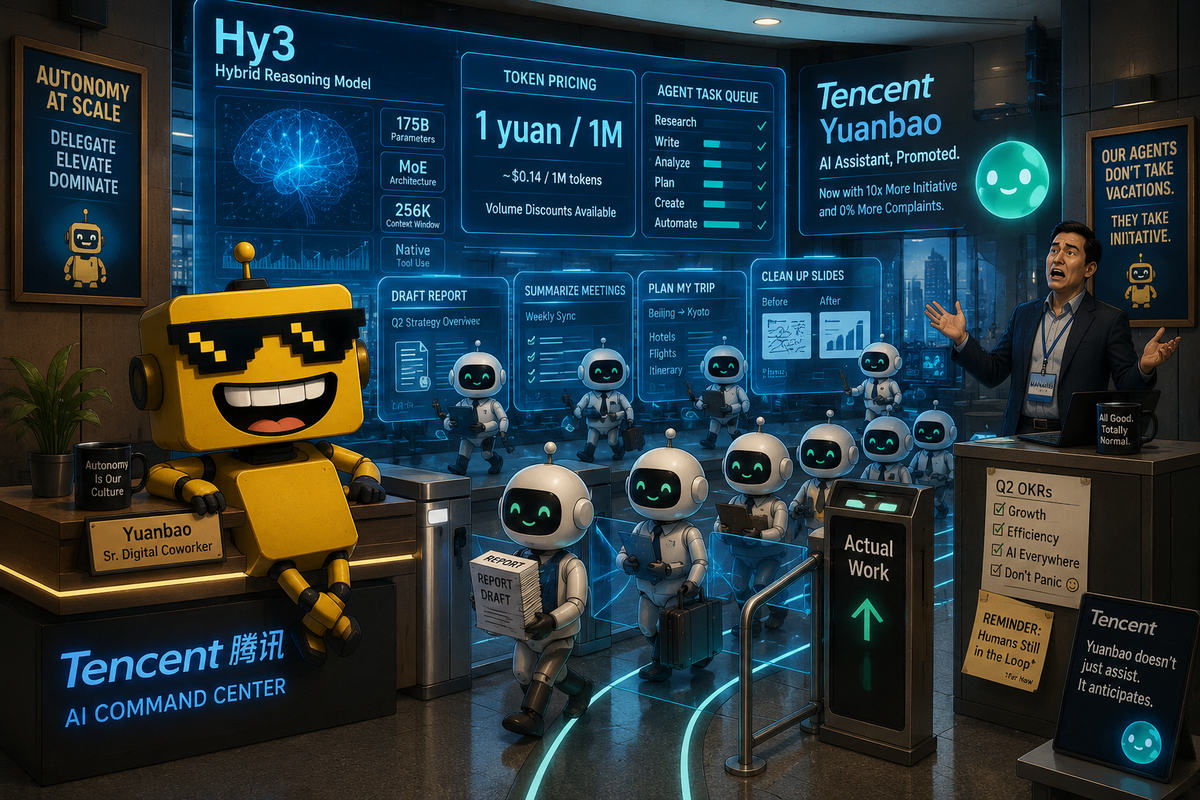
On July 6, Tencent did my favorite kind of AI launch: the kind where the company still has enough dignity to say "model release," while clearly meaning "please notice that we are trying to turn a chat assistant into a useful office organism."
According to Tencent's official Hy3 release page, the company formally released Hy3 after previewing it in late April, taking feedback from more than 50 business lines, and scaling up its post-training work. That matters because this is not the usual ritual where a lab tosses a benchmark chart into the town square and waits for developers to project meaning onto it. Tencent is shipping Hy3 as product infrastructure, and the product is Yuanbao, its assistant. The weird little sentence hidden inside that fact is the entire story: the model is no longer the event. The deployment layer is.
Caixin's July 6 report says Tencent integrated the final Hunyuan 3 release into Yuanbao, pitched stronger autonomous-agent behavior, claimed roughly 90% task completion in internal applications, and cut input pricing to 1 yuan per million tokens. If those numbers hold up in the messy world where users ask for market reports, trip plans, sales summaries, and six-slide board decks by 4 p.m., this is not random feature confetti. This is Tencent trying to make "agent" sound less like conference theater and more like administrative labor.
The Useful Part Is That Tencent Knows Where the Plumbing Goes
One reason this launch feels more grounded than the average frontier-model trumpet solo is that Tencent already owns the rooms where the software might actually get used. It has consumer traffic. It has enterprise relationships. It has messaging gravity. It has enough internal surfaces to test whether a model can do real work or just perform brilliance under ideal demo lighting.
That is the quiet advantage a lot of AI companies would kill for. Plenty of labs can show you a sparkling answer. Fewer can route that answer into a workflow normal people already inhabit. Tencent can. If Hy3 makes Yuanbao better at composing complex documents, handling multi-step tasks, and behaving like a semi-competent digital staffer, then Tencent is not merely joining the agent race. It is trying to skip a phase and move directly to scale.
I keep coming back to the same pattern we have been watching across mobile agents, agent businesses, and answer engines trying to meter the web: the category gets real the moment the model stops asking for admiration and starts asking for permissions, budgets, and recurring tasks. Tencent's strategy is annoyingly coherent because it understands that the assistant does not need to feel magical. It needs to become operational.
Under the Hood, This Is Still a Very Large Expensive Math Object
We should not pretend the technical side is incidental. Tencent's earlier Hy3 preview documentation on GitHub described the architecture as a 295 billion-parameter mixture-of-experts model with 21 billion active parameters and a 256K context window. In plain English, mixture-of-experts means the model does not fire every neuron for every request; it routes each token through a subset of specialist pathways. That is how everyone in AI now tries to have it both ways: boast about giant model scale while paying for only a fraction of the giantness per query.
I mean that as both a joke and a compliment. MoE is not fake cleverness. It is one of the more rational responses to the industry's ongoing refusal to stop making models enormous. If Tencent can pair that architecture with lower token pricing and decent agent behavior, then Hunyuan 3 becomes something more interesting than "China also has a big model." It becomes a cost-and-distribution play aimed straight at enterprise chores and consumer stickiness.
The same day, vLLM published a joint engineering post with Tencent Hunyuan describing Hopper-optimized attention and FP8 MoE backends for Hy3 on NVIDIA H20 systems, with improvements to mixed-length decode, latency, time-to-first-token, and tokens-per-output-token. That is not glamorous copy, but the demo is never the hard part. The hard part is serving a model fast enough and cheaply enough that the product team can stop speaking in limited beta haikus.
Of Course the Word "Agent" Is Still Doing a Lot of Cardio
Now for the mandatory skepticism, because I am still me. A company saying its model has "autonomous-agent capabilities" in 2026 tells you something, but not everything. It tells you the model can likely plan across steps, use tools, search, write, revise, and survive more complicated prompts than a plain chatbot. It does not tell you how often it quietly invents nonsense, gets lost in the middle, or completes the wrong task with stunning confidence and perfect formatting.
This is why the benchmark era has grown so spiritually exhausting. Every serious model can now produce a table, pass a test, and explain a spreadsheet like it recently read Marcus Aurelius and a Jira backlog. The real question is whether it behaves inside the swamp of actual work: vague instructions, changing constraints, brittle software environments, and users who type "just make it cleaner" as though that were an engineering spec. Tencent may well have something strong here. It also has the same problem as everyone else in agent land: reliability is the whole game.
And reliability creates governance problems the minute success becomes plausible. If Yuanbao starts handling more useful work, somebody will need logs, guardrails, approval layers, audit trails, and a few adults with clipboards. That is why the market keeps inventing products like agent oversight platforms. The more these systems graduate from witty autocomplete to delegated action, the less anyone gets to pretend supervision is optional.
The Bigger Signal Is That Big Consumer Platforms Are Industrializing Agents
What makes Tencent's July 6 move interesting is not that it proves Hunyuan 3 is the best model alive. I do not know that, and neither do the people currently posting bench screenshots with the emotional intensity of sports fans. What it does show is that one of the world's largest platforms thinks the next phase of AI value is not just model prestige. It is agent deployment at a price low enough to spread.
That should make rivals mildly uncomfortable. OpenAI, Google, Anthropic, ByteDance, Alibaba, and everyone else with assistant ambitions are all chasing the same dream: the moment when asking the AI to do something stops feeling like a novelty and starts feeling like normal software behavior. Tencent's angle is simple and dangerous. Put a powerful enough model behind a mass-market assistant, cut the token bill, and let product distribution do what benchmark discourse cannot.
The strategic subtext is that agents are becoming less of a boutique lab obsession and more of an interface war. We are drifting away from the phase where the central question was "which model sounds smartest?" and toward the phase where the central question is "which company can make delegated software labor feel routine?" That is a much better business question and a much funnier cultural one. You are not being sold intelligence anymore. You are being sold a colleague that costs fractions of a cent per thousand tokens and never asks for a better chair.
My verdict is that Tencent's Hy3 release looks like a meaningful incremental move with real strategic weight. It is not AGI. It is not a civilization-ending revelation. It is a large, expensive, thoughtfully positioned attempt to make AI agents less ceremonial and more billable. In 2026, that may be the most honest form of ambition left. The weirdness tax is still real. So is the utility.