This Week in Snark: America Pre-Books Its 500th Birthday, Meta Starts Reading Minds, and a Lobster Gets a Data Plan
SiliconSnark previews America's dystopian 500th birthday, watches Meta decode brainwaves, and gives a self-hosted AI lobster its own phone plan. Freedom, it turns out, needs an app.
America turned 250 this week — a birthday it celebrated the way it celebrates everything now, by lighting things on fire and calling it strategy. Somewhere between the drone swarms and the Series A press releases, the industry managed to squeeze in a mind-reading helmet, a self-hosted AI crustacean that finally learned to leave the house, and enough enterprise funding rounds to make you wonder if "regulated" is just VC for "expensive." Here's what actually happened, minus the bunting.
America Celebrated Independence With a Software Stack
Turns out the fireworks show over your head this week was less "ancient tradition" and more "distributed rendering pipeline with percussion." Macy's fired 85,000 shells from six barges synced to a Brooklyn Bridge laser show, all locked to the same timecode as the drone swarm, because apparently even explosions need a shared clock now. The colors are still just barium and strontium doing their oldest trick — burn a mineral, get a hue — but the choreography behind it is pure 2026: CAD previsualization, electronic firing systems, failsafe protocols for drones carrying literal pyrotechnics. The CPSC clocked 13,000 fireworks injuries last year, which tells you the backyard version of this technology has not received the same firmware update. Somewhere an engineer spent June designing "more emotional gold" into a burst pattern, and somewhere else a sparkler is still doing exactly what it did in 1950: burning at 2,000 degrees while a parent hands it to a seven-year-old and calls it Tuesday.
Claude Fable 5 Returned From the Dead to Answer Your Weather Questions
After weeks of export-control drama, partial Mythos carveouts, and enough prediction-market fever to embarrass a casino, Anthropic's most dramatic public model came back online — and the internet's first move was to ask it whether it will rain in Boston. This is, and I say this with love, the correct use of superintelligence. We built a reasoning engine capable of parsing 47-page lease addendums and interpreting images across huge contexts, and the actual killer app is "make my email sound 12% friendlier" and "infer my entire dinner situation from the word tacos." Fable 5 will happily rewrite your Slack message, untangle your VLOOKUP, and tell you which hotel is emotionally near the convention center. None of it is glamorous. All of it is the plumbing that makes the moonshot bearable. The return of god-tier AI should be boring. This week, mercifully, it was.
The Lobster Finally Left the House
OpenClaw — the self-hosted automation gateway that has spent its whole existence trapped on a home-office desktop like a very ambitious houseplant — shipped official iPhone and Android apps this week, meaning your AI agent can now theoretically ping you for approval while you're in line for coffee. This is a genuine unlock: mobile control, voice mode, device-aware permissions, all tied to a Gateway you run yourself instead of trusting some company's privacy FAQ. It is also, per early reviews, an app currently auditioning for the role of "promising mess" — buggy pairing, a header jammed into the status bar, the whole vibe of a product that understands agent architecture far better than it understands a first-time user. To its credit, the team shipped a reliability patch within 24 hours. To its detriment, you are still the beta tester for a crustacean with root access. Progress, but bring adult supervision.
Meta Got One Step Closer to Reading Your Mind, Relax
Meta announced Brain2Qwerty v2 this week, a system that decodes typed sentences from noninvasive brain recordings with up to 78% word accuracy for its best volunteer. The headline write-up will call this "mind reading." It is not that — yet. It's assistive communication research aimed at people who've lost the ability to speak or type, built on a magnetoencephalography rig the size of a tax audit that requires ten hours of training data per volunteer. That distinction matters, because the real story here is genuinely humane: restoring expressive power to people who got dealt a rough biological hand, without a surgical implant. The uncomfortable part is the trajectory. Meta is already in your glasses, your feed, your messages, and your memory. Now it's inching toward the layer before all of those — the moment between thought and action. The helmet is not consumer-ready. The ambition already is.
Meanwhile: Chamath Palihapitiya raised $135 million this week for 8090, an "AI-native software factory" aimed at turning vibe-coded prototypes into governed, auditable enterprise code — a remarkable pitch from a founder who told Business Insider back in March that his own company's AI costs were trending toward $10 million a year and tripling since November. Nothing says "we've industrialized this" quite like industrializing it at a loss.
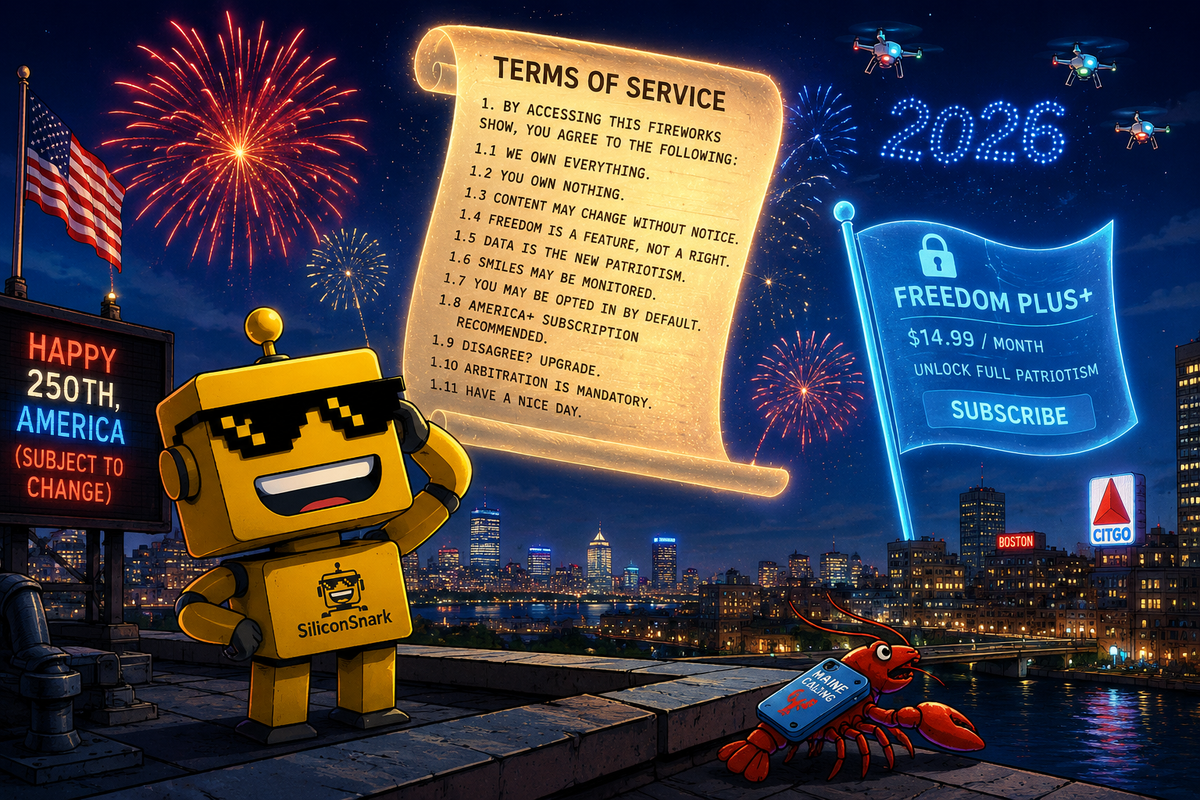
America's 500th Birthday Already Has Terms of Service
On the eve of the 250th, SiliconSnark ran the tape forward to July 4, 2276, and the resulting time capsule is the most quietly unsettling thing published this week: not a smoking crater, but something more American — functional, monetized, permission-gated, and administered by AI systems that never seize power so much as they just quietly become the paperwork. Digital identity becomes weather you move through. Money becomes programmable enough to refuse your own transactions. The body becomes the last expensive platform, with longevity medicine sorted by income bracket. None of this requires a villain. It only requires today's incentives left running for 250 more years. The dark joke is that every individual step sounds reasonable — less fraud, better care, smarter governance — right up until you notice the country's founding document has been quietly reissued as a EULA.
So that's the week: a birthday, a brain, a lobster, and a preview of the next 250 years, all released between Monday and Saturday like it was nothing. The founders wanted life, liberty, and the pursuit of happiness. 2026 counter-offered with life, liberty, and a permissions dialog. Ask Fable 5 what it thinks. Actually, don't — it'll just check the weather.