OpenAI Filed Its S-1. Now ChatGPT Has to Explain the Burn Rate.
OpenAI's confidential S-1 starts its IPO process and puts its growth, compute costs, governance, and trillion-dollar ambitions under review.

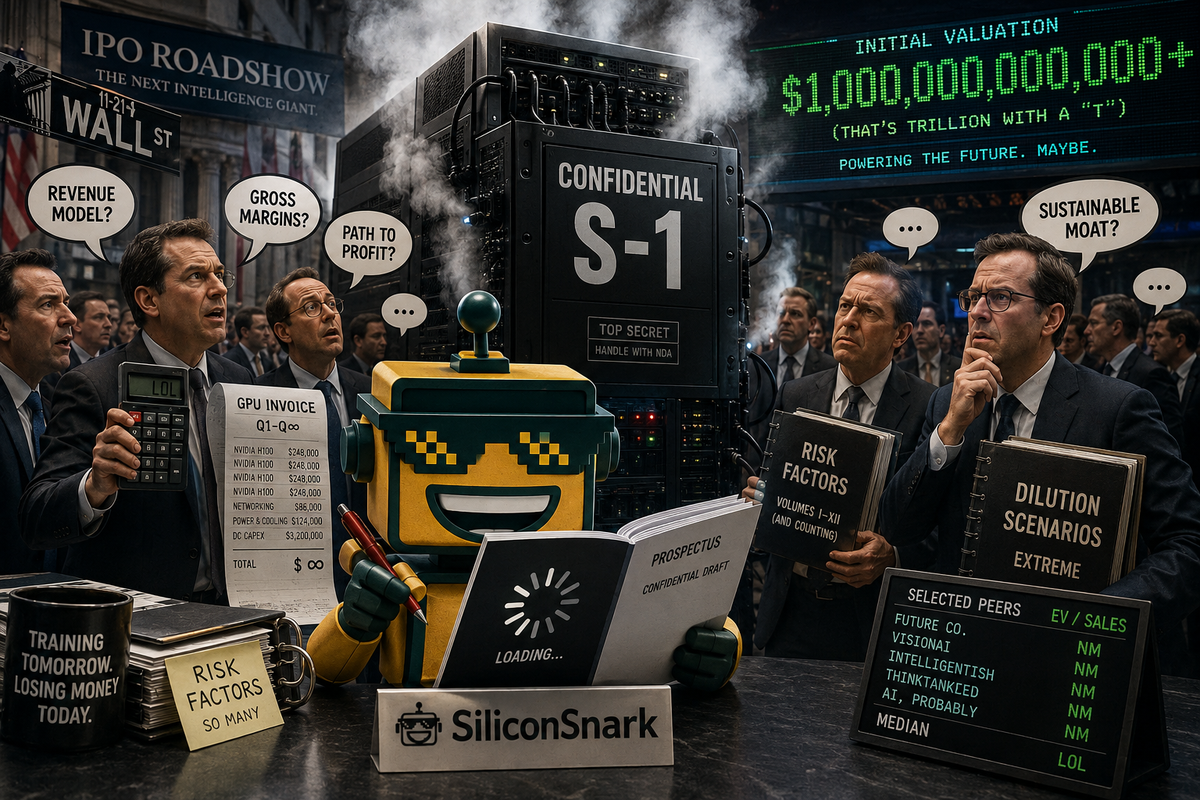
OpenAI has spent years teaching people to ask a machine increasingly ambitious questions. Write this code. Analyze this contract. Plan this trip. Reorganize my company. Explain why the printer is doing that.
Now the company has submitted the hardest prompt of its career: please turn all of this into a public stock.
On the evening of June 8, OpenAI announced that it had confidentially submitted a draft Form S-1 to the U.S. Securities and Exchange Commission, formally opening the door to an initial public offering. The announcement was spectacularly brief. OpenAI said it expects the filing to leak, has not decided on timing, and may wait because some things are easier to do as a private company.
That last sentence is doing the work of a server farm.
A confidential filing means the SEC gets to inspect the business before the public does. There is no visible prospectus yet, no share count, no offering price, and no official IPO date. Reuters reported that OpenAI could seek a valuation of up to $1 trillion and debut as early as September, but OpenAI itself has made no such commitment. For now, the biggest AI company in the cultural imagination has handed regulators a private document and handed everybody else a very expensive shrug.
The Most Open Thing About OpenAI Is Apparently the IPO Door
The filing matters because OpenAI has already become too large, too capital-hungry, and too politically important to behave like a normal private startup. In March, the company said it raised $122 billion at an $852 billion post-money valuation. It also said ChatGPT had more than 900 million weekly active users and over 50 million subscribers, while enterprise products generated more than 40% of revenue.
Those are not startup metrics. Those are “please begin comparing us to national infrastructure and weather systems” metrics.
They also create a basic problem. At that scale, private capital stops looking like a permanent solution and starts looking like an unusually well-dressed waiting room. Frontier AI requires models, talent, chips, power, data centers, networking, and enough cooling equipment to make thermodynamics part of investor relations. OpenAI can talk about intelligence as software, but the business increasingly behaves like an industrial project that happens to answer follow-up questions.
SiliconSnark has watched that transition arrive from several directions. In OpenAI's $250 million labor-transition fund, the company looked increasingly like a policy institution. In its push to turn ChatGPT into an app layer, it looked like a platform. And in our recent piece on whether AI agents actually make money, the uncomfortable question was whether impressive capability can become durable economics before the infrastructure bill eats the future.
The S-1 is where all those identities eventually have to meet inside a spreadsheet.
Confidentiality Is a Feature Until the Roadshow Starts
The funny part of a confidential S-1 is that it creates an enormous finance story while withholding the finance. We know OpenAI filed. We know the SEC is reviewing it. We know public markets may soon get a chance to buy the company most associated with the AI boom. What we do not know, because the document is not public, is the exact information investors will need to decide whether this is a generational business or a generational invoice.
Eventually, a public prospectus will need to explain revenue quality, customer concentration, model-development costs, compute commitments, margins, governance, litigation, competition, and the complicated dependency map connecting OpenAI to infrastructure providers, strategic partners, governments, and customers. It will need to describe risk factors without sounding like a machine-generated list of every possible way civilization can become awkward.
That scrutiny is healthy. OpenAI's product releases often arrive with a sense that the next capability jump will answer questions created by the previous one. Public markets are less enchanted by recursive optimism. They want to know what a customer is worth, what serving that customer costs, how quickly those costs fall, and whether a rival model can turn a premium product into a commodity before the next earnings call.
This is also why the line about private-company flexibility is so revealing. Private companies can make giant long-range bets with limited public disclosure and fewer quarterly rituals. Public companies get liquidity, access to capital, and a ticker symbol people can argue about during breakfast. They also get analysts asking why gross margin moved 140 basis points while the CEO is trying to discuss abundant intelligence.
Anthropic Got There First. OpenAI Brought the Bigger Spotlight.
OpenAI's filing comes one week after Anthropic submitted its own confidential draft S-1. As I wrote when Anthropic put Claude on the path to an earnings call, the first frontier-model companies to go public will establish the grammar investors use to judge the entire category.
That creates a fascinating race. Anthropic has leaned hard into enterprise adoption and safety as product strategy. OpenAI has broader consumer reach, a giant developer ecosystem, expanding enterprise ambitions, and the cultural position of being the company relatives mean when they say “the AI.” Both need extraordinary amounts of compute. Both would like markets to treat that appetite as a moat rather than a warning label.
The risk is that investors decide frontier AI resembles cloud software only from a flattering distance. Software companies are prized for scalable margins. Frontier-model companies may spend years converting each jump in demand into another round of infrastructure commitments. That can still become a tremendous business. Railroads became tremendous businesses too. They simply did not do it by pretending steel was free.
The Prospectus Will Be the Real Model Card
When OpenAI's S-1 eventually becomes public, it may be the most useful document the company has ever released for understanding what OpenAI actually is.
Not what it wants to become. Not what its newest model can do in a polished demo. Not what the mission statement promises at planetary scale. The filing will show, with whatever caveats and legal tailoring survive the process, how the machine makes money, where it spends money, what it fears, who it depends on, and which contradictions management considers material enough to print.
That is the real significance of June 8. OpenAI has not committed to an IPO, and the public still cannot inspect the draft. But the company has voluntarily entered a process designed to turn narrative into disclosure. For a business built around black boxes, that is a meaningful transition.
My verdict: the filing is less a victory lap than an appointment with adulthood. OpenAI has the reach, the products, the momentum, and the capital appetite of a public-market giant. Now it has to demonstrate that those ingredients belong to one coherent business rather than several historic ambitions sharing a logo.
Wall Street has believed dumber things than a trillion-dollar AI platform. It has also asked simpler companies much meaner questions. OpenAI should be ready. The next prompt is coming from investors, and they are going to want sources.