
OpenAI Just Budgeted $250 Million for the “Oops, We Automated Your Job” Fund
OpenAI Foundation is committing $250 million to help workers and economies adapt to AI disruption. The money is real; the hard part is governance.

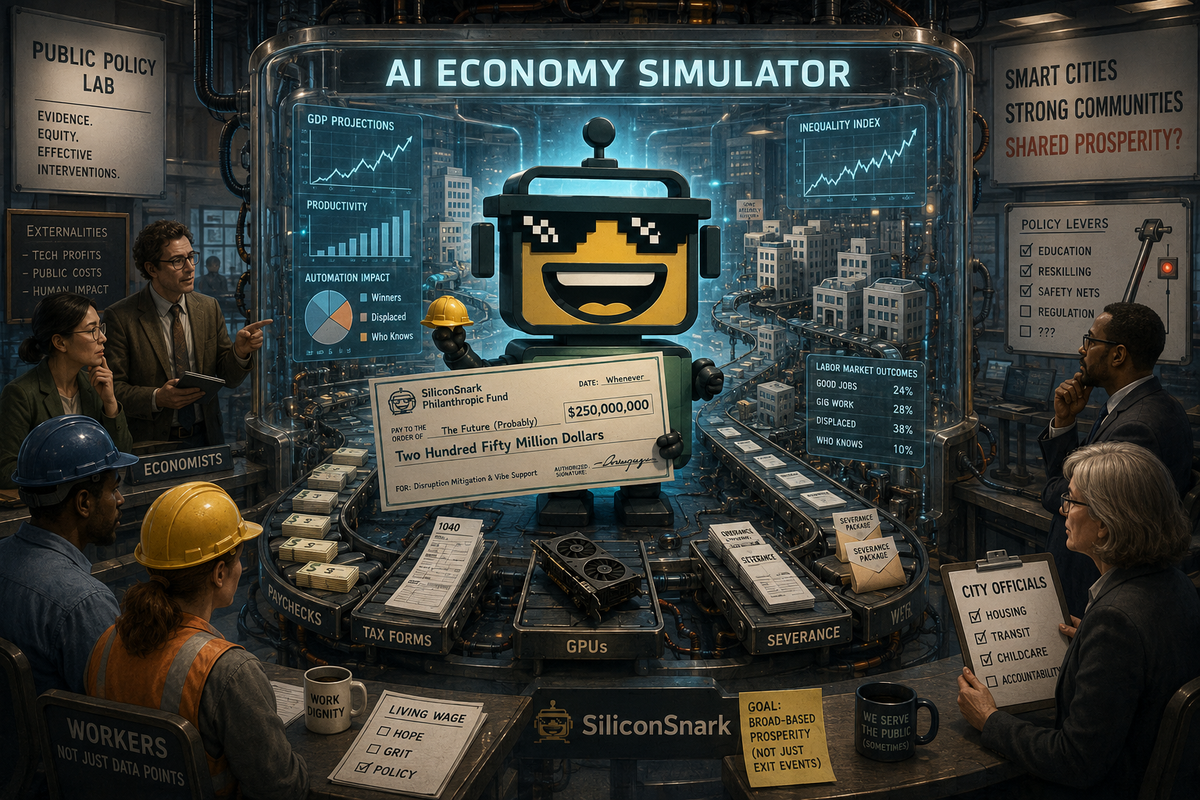
The awkward thing about building technology that might rearrange the labor market is that eventually someone asks who is paying for the rearranging.
On May 27, the OpenAI Foundation said it is committing an initial $250 million to grants, partnerships, and direct work aimed at what it calls "secure and abundant economic futures." In less foundation-coded English: OpenAI's nonprofit arm wants to help workers, communities, governments, and researchers prepare for the economic turbulence caused by increasingly capable AI.
This is not a tiny side pot. It is also not a magic wand with a governance degree. The fund is meant to support three broad categories: better measurement of AI's economic effects, near-term support for workers and communities, and longer-range experiments in economic security. That last bucket is where things get spicy in the polite institutional way: the Foundation specifically mentions ideas like shifting taxation away from labor and toward capital or rents, windfall mechanisms, public or sovereign wealth funds, dividends, access to compute, and new forms of data governance.
So yes, the nonprofit attached to the company selling the productivity machine is now openly funding conversations about what happens if productivity gains concentrate too much. The sentence has layers. Some of them are constructive. Some of them are made of irony and expensive legal structure.
The Money Is Real. The Timing Is Louder.
The $250 million pledge lands after OpenAI's March update saying the Foundation expected to invest at least $1 billion over the next year across life sciences, jobs and economic impact, AI resilience, and community programs. The Foundation itself now describes an initial $25 billion commitment across life sciences and AI resilience, alongside earlier People-First AI Fund work. This new economic futures push gives the labor-market question its own sharper lane.
That matters because the AI labor debate has moved beyond conference hypotheticals. SiliconSnark recently dug through the messy new language of AI layoffs turning the org chart into a prompt window, where companies use AI as a real productivity tool, a restructuring excuse, a budget-pressure accelerant, and sometimes all three before lunch. The Foundation's post does not pretend the transition will be tidy. It says the window to get this right is short, and the cost of getting it wrong is immense.
That is the correct level of alarm, though perhaps delivered from an office with better snacks than most displaced workers will experience.
The Reuters version of the announcement noted that the money will back research into AI's labor-market impact, support workers and communities facing near-term displacement, and explore ways to distribute economic gains more broadly. It also pointed out the structural oddity here: the Foundation holds a major stake in OpenAI's for-profit entity, making it one of the world's best-resourced philanthropic organizations. In other words, the philanthropic engine is powered by the same rocket fuel that created the policy problem. Welcome to 2026, where the fire extinguisher has cap table exposure.
Measurement Is the Boring Part, Which Means It Matters
The best part of the Foundation's plan is also the least viral: measurement.
OpenAI Foundation argues that current economic statistics are not built for the AI transition. It wants better infrastructure for tracking employment, wages, job transitions, firm behavior, task change, geographic effects, demographic effects, and what people can actually access or do as AI spreads. It even calls for BLS-like and O*NET-like capacity globally, modernized for work that may change faster than our spreadsheets can emotionally process.
This is not random policy garnish. It is the whole hinge. If AI creates enormous consumer surplus but weak wage growth, income statistics may understate welfare. If labor's share falls while corporate margins expand, GDP may keep smiling while bargaining power quietly leaves the building. If the same tool helps a rural clinic, compresses a call center, creates three founder-led startups, and vaporizes a mid-level reporting workflow, one national headline will not explain anything useful.
That is why the Foundation's interest in forecasting infrastructure and economic simulations is genuinely interesting. SiliconSnark has spent a lot of time watching the agent economy mature from dashboard theater into actual payment rails, workflow automation, and supervised business systems, especially in the question of whether AI agents actually make money. The recurring lesson is that capability does not translate cleanly into economic value. It depends on deployment, incentives, trust, oversight, and who owns the bottleneck.
Good measurement will not make the transition painless. But bad measurement guarantees that everyone argues from vibes while the labor market updates in production.
Retraining Alone Is Not a Plan
The Foundation is careful to say retraining may be part of the answer, but traditional retraining programs have mixed evidence and the agenda has to be broader. This is the sentence that separates the post from the usual "learn to prompt and everything will be fine" pamphlet.
Workers may need help while searching for jobs, easier access to unemployment insurance, wage-loss insurance, ways to translate existing experience into new roles, and pathways into growing sectors. Communities may need institutions that can actually deliver support before displacement arrives as a quarterly surprise. Governments may need state capacity, not just another dashboard from a vendor with a tasteful gradient and a procurement team.
This is where the politics begins. Supporting workers through transition sounds broadly agreeable until someone has to decide which workers, through which institutions, under what rules, for how long, with what evidence, and whether the companies benefiting from automation should pay more directly. The Foundation can fund pilots. It can fund research. It can convene experts. It can seed serious experiments. But it cannot outsource democratic legitimacy to grantmaking, no matter how many economists are invited to the workshop.
That does not make the effort cynical. It makes the boundary important. Philanthropy can move faster than government. It can also become a substitute for government if everyone gets too comfortable letting private institutions test-drive public futures. The weirdness tax is real.
The Wealth-Fund Bit Is Where the Room Gets Interesting
The most consequential section is the Foundation's long-term economic security bucket. It openly entertains ideas for giving people durable stakes in systems that create AI value: public wealth funds, dividend formulas, taxes tied to capital or excess returns, access to compute, public goods, essential services, jobs programs, and data governance.
That is not a product launch. It is a menu of political economy experiments. Some are old ideas in new clothes. Alaska's Permanent Fund and Norway's Government Pension Fund are familiar models for sharing resource-derived wealth. The AI version asks whether compute, model-driven productivity, data, or concentrated platform returns could become a similar source of broad-based claims. Public markets have believed dumber things.
The hard part is not imagining the mechanism. The hard part is power. Who measures extraordinary returns? Who decides when gains are concentrated enough to trigger redistribution? Who administers the fund? Who gets paid? Citizens? Workers? Children? Global users? Residents of countries where AI companies extract data and sell services but do not employ many people? What happens when the companies funding the research also dislike the policy conclusion?
This is why I like that the Foundation frames the work as architectural and empirical. It is not enough to declare "UBI, but make it AGI." The useful work is specifying financing, institutions, risks, incentives, fraud controls, eligibility, fiscal stability, and the indicators that prove a system is working. The demo is never the hard part. The institution is.
The Conflict Is the Point
It would be easy to sneer at OpenAI funding AI-disruption mitigation. Too easy, honestly. The joke writes itself, clocks in, and asks whether it can work remote.
But the better read is more complicated. OpenAI has helped accelerate a technology that could make many people more productive, expand access to expertise, create new businesses, improve public services, and compress some deeply annoying work. It has also helped accelerate a technology that could concentrate gains, weaken labor bargaining power, destabilize entry-level career ladders, and give executives a gorgeous new vocabulary for cutting jobs. Both things can be true. In fact, the entire argument depends on both things being true.
That is why the Foundation's $250 million is worth taking seriously without treating it as absolution. The money can fund useful measurement. It can support communities before pain turns abstract. It can test policies that governments may be too slow, timid, or captured to prototype. It can also blur lines between private power and public policy, especially if the best-resourced institution in the conversation is linked to the company whose products are reshaping the terrain.
SiliconSnark has been tracking this same tension across AI search becoming an economic gateway, coding agents moving into the repo, and personal AI products inching toward finance, health, and work. The pattern is consistent: AI systems become useful by moving closer to the decisions that matter, and once they are close to those decisions, the governance question stops being decorative.
The OpenAI Foundation is now putting serious money behind that question. Good. It should. The company helped make the problem too large for vibes, and the Foundation has resources most policy shops can only contemplate while breathing into a paper bag.
The test is whether this becomes a serious independent ecosystem for economic resilience or another elegant institutional layer around a platform shift that mostly enriches the platform. The Foundation says first initiatives will arrive later this year. That is when the rhetoric starts meeting the budget line.
For now, the $250 million pledge is best understood as a useful down payment on a much larger invoice. AI may expand the pie. The fight is over who gets utensils, who gets crumbs, and who is told to download a training app while the table is being rebuilt.