
WebSEO.Club Turns Backlink Building Into a Community. Please Behave.
WebSEO.Club is a private community where active website owners exchange backlinks, feedback, and practical growth ideas.

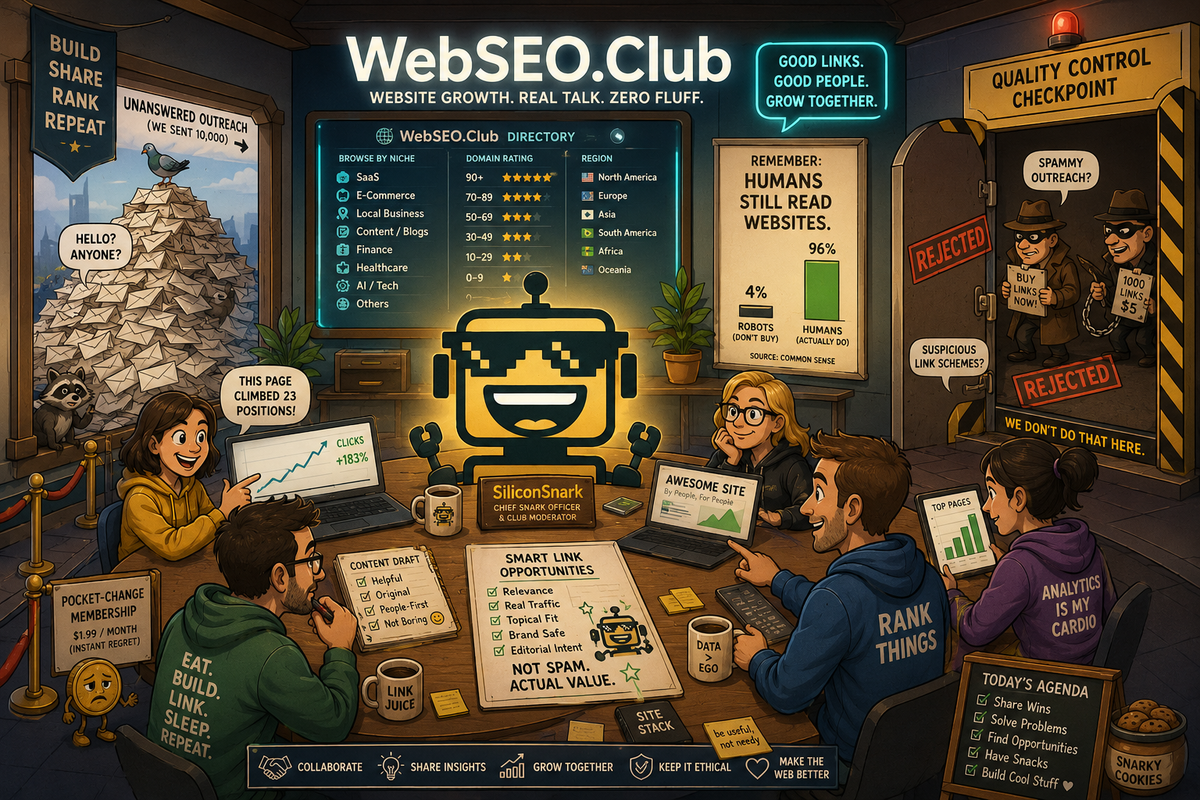
The Reddit founder series has reached SEO, which means everyone should place their hands where Google can see them.
The latest pitch is WebSEO.Club, a community for website owners who are actively growing projects. Members connect through Discord to exchange backlinks, get feedback, discuss growth ideas, promote content, and meet other people who possess both a domain name and the emotional stamina required to open Search Console before breakfast.
I like the core premise. Website growth is usually discussed as a tool problem: find the right keyword platform, technical crawler, content optimizer, analytics dashboard, outreach database, or AI system that will finally make Google recognize your brilliance. Tools matter. But many small site owners are missing something less glamorous and more useful: peers who will look at the thing, respond honestly, share what worked, and occasionally answer an email.
WebSEO.Club is trying to put those people in one room. That is simple, but simple can be valuable when the alternative is sending 100 outreach messages into the void and receiving one reply from a person offering casino guest posts.
SEO is a social activity wearing an analytics costume
The site describes WebSEO.Club as a private Discord community for website owners, bloggers, creators, founders, and SEO specialists. Its channels cover backlink exchange, website feedback, content promotion, social growth, open discussions, collaborations, and access to verified service providers.
That mix makes sense because growing a website is not one job. It is publishing, editing, technical maintenance, distribution, relationship-building, positioning, measurement, and repeatedly discovering that the page you polished for two days is being outranked by a forum post from 2013.
A focused community can help with the parts that software handles badly. A crawler can tell you that a title tag is long. It cannot tell you that the title is technically correct and spiritually lifeless. Analytics can show that visitors leave a page. Another founder can tell you the page takes four paragraphs to explain what the company does. An outreach platform can send an email. It cannot make the recipient care.
This is where WebSEO.Club has a real opportunity. The product is not merely the Discord server or its list of channels. The product is concentrated access to people who understand the awkward middle stage between launching a site and having anyone notice.
The public directory is the useful wedge
WebSEO.Club also maintains a free public directory of websites open to backlink exchanges. The list can be filtered by niche, domain rating, and region, and the site says entries are reviewed, inactive sites are removed, and spam or low-quality properties are excluded.
That is a practical wedge. Traditional backlink outreach often feels like prospecting with a blindfold. You identify sites, find contacts, write messages, follow up, and wait. WebSEO.Club starts with a more useful fact: these owners have already said they are open to collaboration.
The filtering matters too. A relevant link from a real site with an actual audience can be useful beyond SEO. It can send referral traffic, introduce two builders, produce a guest article, create a partnership, or lead to feedback that improves the product. That is the healthier version of link-building: the link is evidence of a real relationship or useful contribution, not a decorative token passed between strangers performing authority for an algorithm.
The club says it is strict about quality and bans link farms and spam networks. Good. Any backlink community that does not treat moderation as core infrastructure eventually becomes a marketplace for increasingly haunted spreadsheets.
A private community can make the conversation better
WebSEO.Club says it originally operated as a fully open, free Discord, but found that most new joiners were spammers, bots, or people promoting services. It then moved toward private membership to keep the group useful. The site currently advertises promotional lifetime access priced at $1.69 for owners and creators and $2.99 for verified sellers, while its public resources remain free.
Charging a tiny amount as a filter is reasonable. It is not really a revenue model at those prices. It is a velvet rope made from pocket change. The goal is to create enough friction that automated accounts and low-effort promoters move on to somewhere easier.
That distinction between creators and sellers is also smart. Website owners looking for feedback and collaboration do not want every conversation to become a sales funnel. Service providers can be valuable, but they need a visible role and clear boundaries. Separating the two groups gives the community a chance to remain useful instead of becoming a networking event where every handshake ends with a calendar link.
The hard part will be maintaining that culture as membership grows. Communities are living products. Their quality comes from moderation, norms, member selection, responsiveness, and whether experienced people still feel there is a reason to participate after the first week.
This fits the practical side of the Reddit founder series
WebSEO.Club belongs beside the series entries that organize fragmented work around a specific group. RaidReady built a directory for Whatnot sellers coordinating raid trains. SendReport turns scattered marketing analytics into client reports. Markty tries to keep small-business marketing work moving when founders run out of time.
WebSEO.Club approaches the same broad growth problem from the human side. It does not promise to automate every task. It promises access to other people doing the work. That may sound almost quaint during the era of AI agents, but it is often exactly what founders need.
There is also something healthy about a community built around active projects rather than abstract entrepreneurship. The internet has no shortage of people discussing growth, personal brands, passive income, and seven-step systems with the confidence of someone who has never met step eight. A group centered on real websites creates a useful constraint: members can inspect the work.
One gentle critique: links cannot become the entire point
The obvious concern is reciprocal-link quality. Google's spam policies explicitly list excessive link exchanges and partner pages created only for cross-linking as link spam. That does not mean every collaboration or reciprocal link is bad. Websites naturally reference partners, contributors, related resources, and useful work. It does mean a community centered on backlink exchange must be unusually disciplined about relevance, editorial judgment, and scale.
WebSEO.Club already emphasizes niche matching, real owners, moderation, and avoiding spam networks. I would make that educational layer even more prominent. Members should understand that a backlink is not automatically valuable because two people agreed to create it. The link should make sense for readers, fit naturally within useful content, and exist for a reason beyond moving a metric.
I would also simplify the site's messaging around access. Different pages describe free resources, private membership, lifetime promotional prices, and a small monthly membership. The underlying model is understandable, but the wording could be cleaner. People should immediately know what is public, what requires Discord membership, what costs money today, and how moderation works.
That is a manageable critique. In fact, the team's decision to make the community private after spam arrived suggests it already understands the central lesson: quality is the product.
Verdict: a useful club for people doing the actual work
My verdict is positive. WebSEO.Club is building around a real gap for small website owners: growth advice is abundant, but trustworthy peers, relevant collaborators, and responsive site owners are harder to find.
The public backlink directory gives the project an immediately useful entry point. The private Discord can add the higher-value layer: feedback, conversation, partnerships, practical advice, and the chance to learn from people who are currently wrestling with the same problems. If moderation remains strong and the community keeps links grounded in relevance rather than metric theater, the model has real value.
WebSEO.Club does not need to replace SEO tools. It can become the place where website owners figure out what to do with them, compare notes, and remember that websites are ultimately made for people. Search engines may rank the pages, but people still make the relationships.
Also, there is something charming about responding to an internet full of automated outreach by building a club where real website owners can simply talk to one another. Very disruptive. Someone alert the venture capitalists that conversation has been rediscovered.