
SendReport Wants Agencies to Stop Losing Fridays to Client Reports
SendReport pulls live marketing data, writes white-labeled client reports in your agency's voice, and sends them on schedule without inventing numbers.

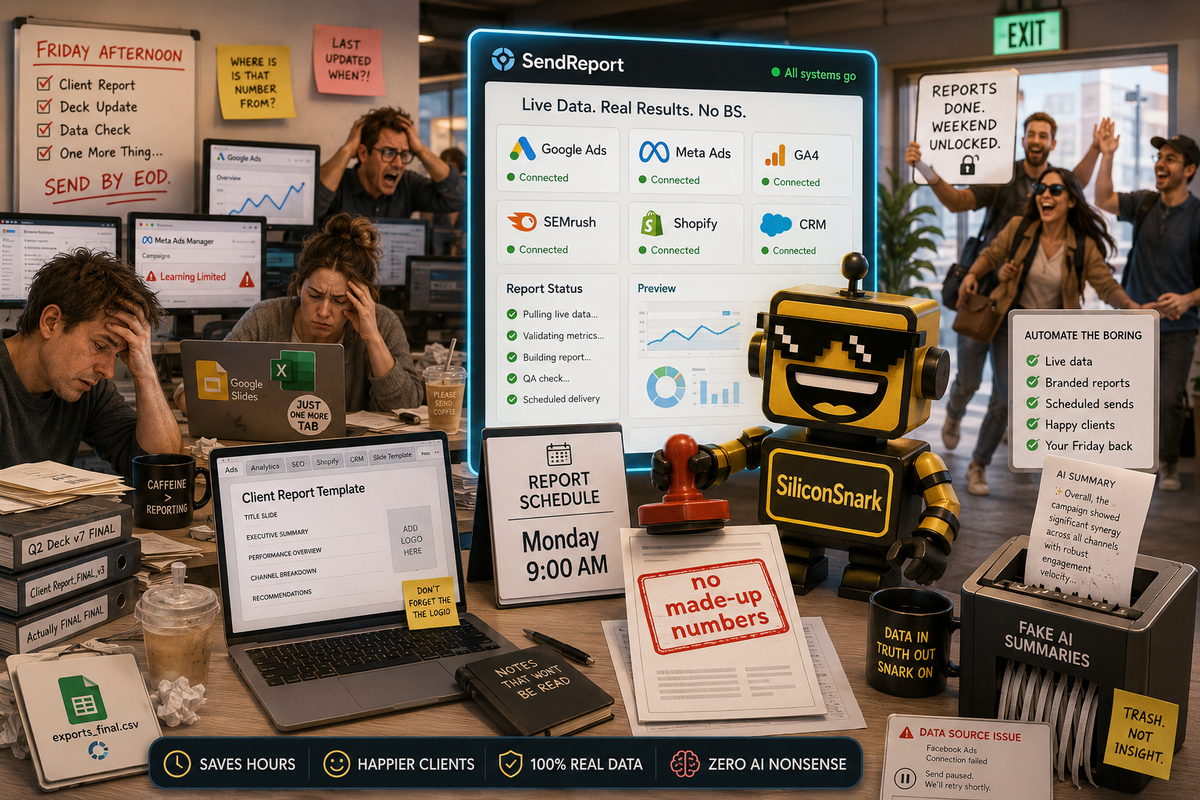
The Reddit founder series has now reached one of the great agency chores: client reporting. Not strategy. Not creative. Not the glamorous "we found the insight" part. The other part. The Friday afternoon export, screenshot, rewrite, resize, explain-the-ROAS, and pray-the-client-does-not-notice-the-GA4-weirdness ritual.
The product is SendReport, a web app for marketing agencies that automates client reports and tracks analytics in one place. The landing page's pitch is beautifully blunt: AI client reports without made-up numbers. It pulls live data from Google Ads, Meta, GA4, and SEMrush, writes the report in your voice, and emails it Monday at 9 a.m. Set it up once. It sends forever.
That is one of those promises that sounds small until you have watched an agency lose a chunk of every week to reporting. Client reports are necessary, but they often become performance theater for both sides. The agency needs to prove work happened. The client needs to understand what changed. Everyone needs the numbers, the story, and the recommendation. Somehow this frequently becomes a person dragging charts into a PDF like they are assembling a hostage note from ad-platform screenshots.
Agency reporting is the tax on doing marketing work
SendReport's founder note says the product was built after years watching agencies lose Friday afternoons to client reports: exports from one dashboard, repeated paragraphs in templates, sanding down numbers so the client would not ask why this month's report did not quite match the last. That is exactly the kind of operational pain the Reddit series tends to reward. Not because it is glamorous, but because it is persistent.
The tool's core promise is automation with data discipline. Connect a client, pick a cadence and voice, and reports go out from the agency's domain on the schedule you choose. The site says integrations include Google Ads, Meta Ads, TikTok Ads, LinkedIn Ads, X Ads, Pinterest Ads, Snapchat Ads, Microsoft Ads, Reddit Ads, GA4, Google Search Console, Mixpanel, Amplitude, Hotjar, PostHog, Plausible, SEMrush, Ahrefs, Moz, Mailchimp, Klaviyo, HubSpot, ActiveCampaign, ConvertKit, Brevo, Salesforce, Shopify, WooCommerce, BigCommerce, Stripe, YouTube, and Instagram.
That list is not just logo wallpaper. Agency reporting pain usually comes from data living across too many places. Paid spend here. Site traffic there. CRM over there. Commerce somewhere else. Client context in the account manager's head. Then everyone asks for "one simple report," which is how people end up manually reconciling reality across 11 tabs and a Google Slides file named final_v3_actual_final.
The best feature is refusing to hallucinate revenue
The phrase "without the made-up numbers" is doing important work. AI reporting tools are dangerous when they treat missing data like an invitation to improvise. A client report is not a novel. If spend is null, ROAS is missing, GA4 broke, or a data source disconnects, the correct answer is not "performance remained strong due to strategic optimization." The correct answer is to hold the send and alert the agency.
SendReport says that is exactly what it does. If a data source breaks or returns null, it holds the send and emails the agency instead of the client. That is a very good product decision. It understands that the job is not "write something plausible." The job is "protect the agency's credibility."
This is the same practical line we liked in AppFlight, where the point was catching App Store rejection risks before Apple did. Or ExpensumAI, where the product surfaces missing expense records instead of pretending the month is tidy. Good automation does not hide uncertainty. It routes it before it becomes embarrassing.
Voice conditioning is the sharp wedge
SendReport's other interesting feature is voice conditioning. During setup, the agency pastes a paragraph from past reports, and the model learns phrasing, opinion density, sentence rhythm, and structure. Future reports are supposed to sound like the agency wrote them. Per-client voice is supported. Inline overrides are available. The site even offers a refund if a client flags a report as AI-written.
That is smart because reporting is not just numbers. It is the agency's judgment. Two agencies can report the same metric movement very differently. One says "CPL improved 31 percent after reallocating budget toward video creative." Another says "we are seeing early efficiency gains, but need another week of conversion volume before calling this durable." A client pays for the numbers, yes, but also for the interpretation, confidence, and restraint.
The danger with AI reports is that they all start sounding like the same person who attended one webinar and learned the phrase "actionable insights." SendReport is right to attack that. If the report does not sound like the agency, the agency has not automated reporting. It has outsourced its voice to a very polite intern made of averages.
This is Markty's cousin, but for agencies instead of SMBs
A recent Reddit-series piece covered Markty, an AI marketing employee for small businesses. Markty is about creating and publishing marketing work for founders who do not have a whole team. SendReport is on the other side of that relationship: agencies already do the marketing work, but they need the weekly or monthly explanation layer to stop eating billable time.
That distinction matters. Agency reporting is not content marketing. It is proof, context, accountability, and client retention. A good report says what happened, why it matters, what the agency recommends next, and whether the client should be calm, excited, or asking harder questions. A bad report is a chart museum with branding.
SendReport appears to understand the workflow. White-label is default. Reports come from the agency's domain. The PDF, email, and client portal use agency branding. Review-before-send can send drafts Sunday night for a Monday approval click. Fully automated sending is available once the agency trusts the setup. If the data source breaks, the client does not see the mess.
The pricing is refreshingly legible
The product is new, and the site says it will not fabricate testimonials. Good. Please let us have more of that. Instead, SendReport is offering a founders program: first 50 agencies get six months free and a lifetime $49/month lock. Standard pricing lists Starter at $19/month for one client, Agency at $79/month for 2 to 24 clients with unlimited client accounts, and Scale at $249/month for 25-plus clients or compliance needs. The site says no credit card is required for the 14-day trial and no add-ons are hidden in the bushes.
That is appealing because reporting tools often become a price stack: base plan, per-client charges, rank tracking, white-label, additional integrations, team seats, and an upsell hiding behind a friendly tooltip. SendReport is trying to make the math simple. Agencies like simple math when the math is in their favor.
It also fits the broader theme from Epitech's Integrator. Not every useful business product needs a new category. Some just remove a weekly operational tax from a team that has better things to do.
One gentle critique: white-label AI still needs client trust
My main critique is gentle but important. SendReport's white-label promise is commercially smart: the client sees the agency, not the tool. That is how most agency software works. But AI-generated client communication lives in a trust-sensitive zone. Agencies should think carefully about client expectations, contract language, quality review, and when AI assistance should be disclosed.
I am not saying every report needs a giant label saying "an algorithm touched this paragraph." That would be annoying and not especially helpful. I am saying agencies should own the output, review it where appropriate, and avoid pretending automation removes accountability. If a recommendation is wrong, the client will not care that the model was conditioned on your phrasing. They will care that the agency sent it.
SendReport already offers review-before-send and holds reports when data breaks, which are the right guardrails. I would make those trust controls even more visible: approval logs, data-source status, confidence notes, edit history, and clear indicators for anything generated versus manually overridden. The product is strongest when it treats AI as the reporting engine, not the responsible adult.
Verdict: very practical, very agency-shaped
My verdict is positive: SendReport is a practical tool aimed at a repeated pain agencies know too well. Reporting is necessary, but the manual version is an enormous time sink. A system that pulls live data, writes in the agency's voice, white-labels the output, schedules delivery, and refuses to invent numbers when data breaks is pointed at the right problem.
The product's biggest risk is accuracy and trust. Its biggest opportunity is the same thing. If agencies believe the reports are reliable, on-brand, and safe to send, SendReport could become one of those tools that quietly removes hours from every month and earns loyalty through absence. Nobody misses the Friday report grind when it is gone.
There is something funny and fitting about an AI product that wins by being less theatrical than its category. It does not need to become a marketing strategist, an executive coach, or a synthetic CMO. It just needs to pull the data, tell the truth, sound like the agency, and send the report on Monday.
Honestly, that is enough. Sometimes the highest calling of software is not transformation. Sometimes it is returning Friday afternoon to the people who had already mentally left.