
Markty Thinks Small Businesses Deserve an AI Marketing Department
Markty learns your brand, then coordinates AI specialists for social, email, sales copy, SEO/GEO, visuals, scheduling, and publishing.

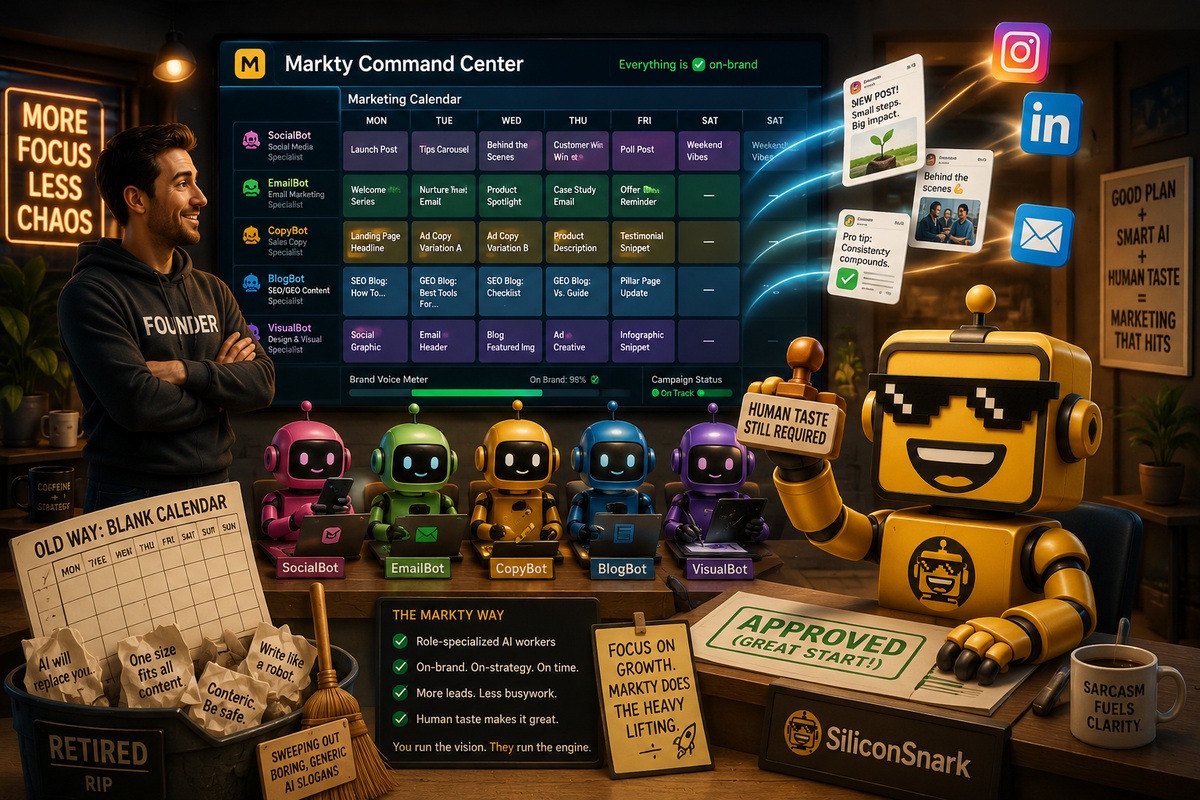
The Reddit founder series has now reached one of the great small-business rituals: realizing you need marketing, opening six tools, staring at a blank content calendar, and briefly wondering if word of mouth can be scaled through prayer.
The product is Markty, an AI employee for small businesses. Its pitch is not "here is another dashboard, have fun becoming your own marketing department after dinner." The promise is more direct: Markty learns your brand, then a role-specialized AI team handles daily marketing work across social posts, blog and SEO content, sales copy, email marketing, and visuals, with planning, scheduling, and publishing built in.
That is a strong pitch because small businesses do not lack marketing advice. They are drowning in it. Post every day. Build a newsletter. Rank on Google. Show up on AI search. Repurpose video. Launch campaigns. Write founder-led content. Do LinkedIn. Do Instagram. Do email. Build landing pages. Test hooks. Make carousels. Be authentic, but not boring. Be consistent, but not robotic. Be strategic, but also can you please run payroll and answer the customer asking if Tuesday works?
The best SMB marketing product is one that does not become homework
Markty's strongest idea is not that it uses AI. Everyone uses AI. The interesting part is that it is trying to remove the operational burden from the founder, not merely hand them a more elaborate prompt box. The site explicitly says it is "not a tool, your coworker," and describes expert agents coordinating content, social, SEO, email, sales, and visuals through agentic orchestration.
That distinction matters. Many AI marketing products still assume the user wants to manage the machine: prompt it, edit it, schedule it, resize it, repurpose it, approve it, export it, import it, and then repeat until the founder's "AI productivity workflow" has become a second unpaid job. Markty's wager is that a small business wants marketing handled, not merely accelerated.
The role structure helps. The site lists a Social Media Specialist that creates, plans, and publishes platform-specific content; a Sales Specialist that writes prospect-facing copy and email/message flows; an Email Marketing Specialist for follow-ups and campaigns; an SEO and GEO Specialist for blog and search visibility; and a Graphic Design Specialist for visuals and videos. This is not a single chatbot pretending to be a Swiss office. It is a team metaphor, which is at least the right abstraction for the work.
Brand learning is where the product either wins or becomes content fog
Markty says it learns by analyzing your website and documents so outputs sound like your brand rather than generic AI. Good. That is the key problem. Small-business marketing fails not because content cannot be generated. Content can absolutely be generated. We may, in fact, be in the first historical era where content is easier to create than to justify.
The hard part is whether the marketing has taste, specificity, and commercial memory. Does it understand what the business actually sells? Does it know the audience? Does it avoid saying "unlock your potential" like an office wall learned to type? Does it distinguish between a dental clinic, a local bakery, a B2B consultancy, a Shopify brand, a real estate team, and a startup selling compliance software to people who have not smiled since procurement began?
That is why the brand-advisor layer is important. Markty's startup page says it can analyze a business, understand brand identity, support content production, schedule and auto-publish, write blog posts, improve search visibility, and reduce marketing costs. The main site adds that agents communicate with each other so strategy, planning, production, and publishing are coordinated end to end. The value is not one good caption. It is continuity.
This belongs in the AI operations stack, not just the content stack
Markty fits the same pattern we have seen across the better Reddit-series entries. AppFlight was interesting because it did not merely describe App Store risk; it turned the risk into a pre-submission workflow. KAPEX mattered because it treated memory as infrastructure, not a parlor trick. Epitech's Integrator worked because it removed old operational friction. Markty is making a similar argument for marketing: do not just produce the asset, run the workflow.
This is also why the "AI employee" phrasing is both useful and a little dangerous. Useful, because small businesses understand hiring better than they understand "agentic orchestration." Dangerous, because employees are accountable people with judgment, context, and the ability to notice when a campaign is tacky, off-brand, legally questionable, accidentally insensitive, or just boring in a way only a Tuesday content calendar can be boring.
AI can help with a lot of that. It cannot be the adult in the room by default. The best AI-employee products know where autonomy ends and approval begins.
For small businesses, consistency is the product
Markty's site talks about stronger lead engagement, more continuous social, blog, and email content, and faster workflows. That may sound like ordinary SaaS language, but the underlying problem is brutally practical. Most small businesses do not fail at marketing because they never have ideas. They fail because consistency collapses under operations.
The founder writes a good post once. Then inventory explodes, a customer complains, a vendor misses delivery, someone has to update pricing, the website needs a fix, and the newsletter becomes a ghost town with a Mailchimp login. The content calendar does not die dramatically. It dies because real work wins.
If Markty can genuinely keep the marketing machine moving, that is valuable. Social posts, blog articles, SEO pages, campaign announcements, follow-up emails, lead-nurture messages, visuals, and video assets are not individually revolutionary. But bundled into a coherent weekly cadence for a business that would otherwise publish twice a quarter and call it "brand mystique," they can matter.
This is the same logic behind our broader coverage of AI agents moving toward real business workflows. The exciting part is rarely the agent standing alone. It is the agent tied to a repeatable process, a constraint, an approval loop, and a measurable business outcome.
GEO is a smart addition, even if the term still feels new
Markty includes SEO and GEO, meaning visibility not only in traditional search but also in AI-powered search and answer engines. That is a smart addition for a marketing product launching now. Small businesses already struggle with Google visibility. Now they also have to wonder whether ChatGPT, Gemini, Perplexity, and whatever else emerges will know they exist, understand what they do, and cite them instead of a competitor with better structured content.
That does not mean every business needs to sprint into generative-engine optimization as if the town bakery must now develop an LLM citation strategy before making muffins. But it does mean search visibility is changing. A platform that produces blog content, website pages, and brand descriptions with both search engines and AI answer systems in mind is at least pointed at the right future-shaped headache.
One gentle critique: keep humans visibly in the loop
My main critique is simple: Markty should make human approval, brand governance, and quality control impossible to miss. Scheduling and publishing are powerful. They are also where marketing automation can go from helpful to "why did we post that?" faster than anyone wants.
Small businesses need guardrails: approval queues, tone controls, prohibited claims, compliance notes, competitor-sensitive topics, image rights, platform-specific checks, and easy rollback. They also need clear signals for what the AI is confident about and what needs a human. A founder should not have to become a full-time editor, but the brand should never feel like it was handed to a machine with a posting quota and a motivational poster vocabulary.
That is a critique with affection, because the product's core instinct is good. Done-for-you marketing is a real painkiller. It just needs to be done-for-you without becoming "done-to-you."
Verdict: a practical AI employee pitch with real SMB logic
My verdict is positive: Markty is aiming at a real and crowded problem, but its positioning is better than the average AI marketing tool because it focuses on operational handoff. Small businesses do not want a prompt workshop. They want marketing capacity. If Markty can learn a brand, coordinate specialists, produce assets, publish through integrations, and keep the human approval layer sane, it could become useful in a way generic content generators rarely are.
The risk is obvious: AI marketing can easily become smooth, abundant, and forgettable. The opportunity is equally obvious: most small businesses would benefit enormously from consistent, on-brand, reasonably strategic content that actually gets made and published. The gap between those two outcomes is taste, control, and workflow discipline.
Markty seems to understand that the product is not just output. It is cadence. It is coordination. It is the relief of not having to rebuild your entire marketing habit from scratch every Monday.
If the team can keep the content specific, the approvals clear, the integrations reliable, and the "AI employee" metaphor grounded in accountability rather than hype, this is a sensible place to build. Small businesses do not need another tab. They need a marketing rhythm that survives the week.