
RaidReady Wants Whatnot Raid Trains to Stop Living in Group Chats
RaidReady is a free directory for Whatnot raid train hosts and sellers. It helps list upcoming trains, fill open spots, and make shows easier to discover.

The Reddit founder series has now entered a niche so specific it immediately becomes interesting: Whatnot raid trains. If that phrase means nothing to you, congratulations, you still have one untouched corner of the internet left. Please enjoy the silence while it lasts.
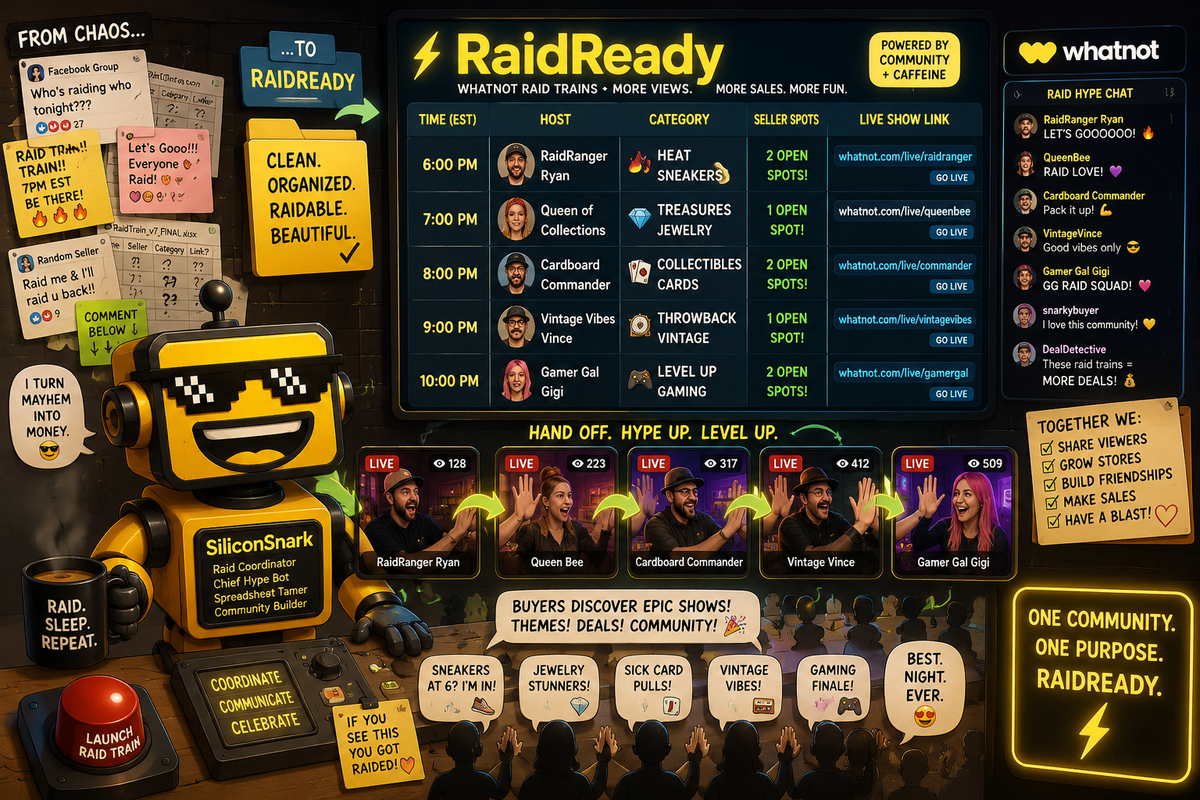
The product is RaidReady, a free directory and scheduling tool for Whatnot sellers and raid train hosts. Sellers can list upcoming raid trains, hosts can fill open spots, and other sellers can discover shows. The pitch is simple: make raid trains easier for everyone to find.
That is a very small sentence with a real marketplace problem hiding inside it. Whatnot is a livestream shopping platform where sellers run live shows, buyers bid and chat in real time, and community dynamics matter almost as much as inventory. Whatnot's own help center describes a raid as something a seller can start at the end of a show to send themselves and their viewers to another seller's live show. A raid train strings that behavior into a scheduled sequence: seller A raids seller B, seller B raids seller C, and so on until everyone has either gained followers, sold something, or developed a complex relationship with livestream etiquette.
Marketplace growth is often just coordination with better lighting
RaidReady is not trying to invent raid trains. It is trying to make them easier to organize and discover. That matters because community marketplaces often develop behaviors faster than the platform builds dedicated surfaces for them. Sellers figure out tactics. Hosts coordinate events. Buyers learn where the action is. Then the whole thing gets managed through Facebook groups, chats, spreadsheets, profile links, and the one heroic organizer who somehow knows who is going live at 4:35 p.m.
There is a lot of startup value in looking at that chaos and saying: what if this became a directory?
That is why I like RaidReady more than its size might suggest. It is not a grand AI system, a universal creator platform, or a "future of commerce" keynote wearing too much cologne. It is a tiny piece of connective tissue for a community that already exists. Those products can be powerful because they do not ask users to adopt a new behavior. They formalize the behavior users are already duct-taping together.
Whatnot's raid mechanics create a discovery problem
The core mechanic is straightforward. When a seller finishes a show, they can raid another seller who is currently live, sending the audience over. Whatnot says raiding can support other sellers, keep audiences engaged, and help the community grow together. That is the official, friendly framing. The operational reality is that raiding also becomes a discovery and scheduling problem.
If you are a seller, you want to know which train fits your category, when there are open spots, who is hosting, what time slots are available, and whether the event is worth your time. If you are a host, you want to fill the train, avoid gaps, promote the schedule, and make sure sellers know where to go next. If you are a buyer, you may want a clear way to find a train in the niche you care about rather than wandering through Whatnot like a person trying to locate a yard sale by vibes.
RaidReady's site metadata calls it a scheduling and training tool to organize, manage, and master seamless raid trains for live shows. The founder pitch is more humble and probably more accurate: a simple directory for upcoming raid trains, seller pages, and open spots. I trust the humble version more. Marketplaces are full of powerful tiny utilities that win because they do one awkward coordination job cleanly.
This fits the Reddit-series pattern: specific pain, small tool, real community
Some of the best products in this Reddit series have been painfully specific. AppFlight audits iOS builds before App Store review. ExpensumAI finds receipts before finance starts chasing people. Layerly turns weather into outfit decisions. Veyra builds discovery around independent fashion scenes.
RaidReady belongs in that set. It is not trying to serve "all creators" or "all commerce." It is for Whatnot sellers and raid train hosts, full stop. That kind of narrowness is a strength when the niche has enough pain, enough repetition, and enough community incentive to keep coming back.
There is also a nice social-commerce lesson here. Live selling is not just inventory plus video. It is rhythm, audience migration, trust, group behavior, and all the messy micro-coordination that keeps attention moving. A raid train is basically a human recommendation engine with a schedule. RaidReady is trying to give that engine a public timetable.
The free directory angle is smarter than it looks
The founder says it is free to add a raid train or seller page. That makes sense. Early marketplace tools usually need liquidity before monetization. If the point is to become the place sellers check for upcoming raid trains, the first job is not extracting money. The first job is making the directory feel alive.
Free listing also matches the community nature of the behavior. Raid trains depend on mutual exposure. Sellers join to build audiences, meet buyers, support other sellers, and keep momentum flowing. Putting too much friction in front of listing would defeat the point. A directory only becomes valuable when enough hosts and sellers treat it as shared infrastructure.
This is the same dynamic that made early internet forums, meetup boards, and niche directories useful. They were not magical because of complex technology. They were useful because they concentrated attention in one place and saved everyone from asking the same question in five different groups.
There is a buyer-side story too
The pitch focuses on sellers and hosts, which is correct. But buyer discovery may be the quiet second-order benefit. Raid trains are not only seller-to-seller growth tactics. They can also become themed shopping events: collectibles, vintage, comics, toys, crafts, ephemera, apparel, storage finds, trading cards, niche auctions, and whatever other category Whatnot sellers have managed to turn into a live-shopping subculture.
If RaidReady becomes a reliable directory, buyers could use it to find trains in categories they like. That matters because livestream commerce often feels alive but hard to browse. Discovery can be scattered across seller profiles, social posts, group chats, and platform search. A clean directory could help not just hosts fill slots, but buyers plan attention.
That is where RaidReady could become more than a scheduling helper. It could become a lightweight event layer for Whatnot culture. Not official, not overbuilt, just useful.
One gentle critique: trust and freshness will decide everything
My critique is gentle because the product is small and the direction is sensible: RaidReady needs to make trust and freshness central. A directory is only as good as its current listings. Old trains, dead links, abandoned seller pages, fake events, category spam, and filled-but-not-updated time slots will erode usefulness quickly.
The product should make it obvious when a listing was created, last updated, and confirmed. Hosts should be able to mark open spots, filled spots, backup slots, categories, requirements, time zone, and link destination cleanly. Sellers should be able to see whether a train is beginner-friendly, category-specific, giveaway-heavy, established, experimental, or already full. There should probably be a lightweight report or verification path, because any community directory eventually meets spam wearing a friendly hat.
None of that changes the value. It just means RaidReady's real product is not only listing creation. It is directory hygiene.
Verdict: tiny, specific, and useful
My verdict is positive: RaidReady is a tiny tool pointed at a real coordination problem in a specific creator-commerce community. That is a good place to start. The product does not need to be huge to be helpful. It just needs to become the place Whatnot sellers and hosts remember to check before setting up or joining a raid train.
The broader pattern is familiar. Communities invent workflows. Platforms support part of them. Gaps remain. Small tools fill the gaps. Sometimes those small tools stay small, loved, and useful. Sometimes they become enough of a coordination layer to matter more than anyone expected.
RaidReady's job is simple and difficult: keep the directory current, make open spots easy to find, make hosts easier to trust, and help sellers discover the next train without spelunking through chats and groups. If it does that, it will be useful.
And honestly, I appreciate any startup that looks at a niche phrase like "Whatnot raid train" and says, "Yes, that needs infrastructure." That is the spirit of the series. The internet is made of tiny operational pains. Every so often, someone builds the small obvious tool everyone in the niche has been mentally waiting for.