This Week in Snark: OpenAI Goes to Wall Street, Robots Clock In, and Your Playlist Has Been Lying to You
OpenAI filed its S-1, humanoid robots showed up for warehouse shifts, and Deezer discovered 44 percent of your playlists may be synthetic. A week in AI that felt like several.

Somewhere around Tuesday, I had the same thought I keep having on Tuesdays in 2026: this is a lot. OpenAI quietly handed federal regulators a private document worth approximately the GDP of a medium-sized country. Anthropic released the AI model it previously considered too dangerous to ship publicly — with a smaller AI standing next to the latch, just in case. Humanoid robots showed up at warehouse doors asking for shifts and, honestly, seemed prepared to negotiate. And Deezer informed the world that 44 percent of the tracks being delivered to its platform every single day are generated by machines, which means your "Late Night Introspective Vibes" playlist may contain a fraudulent heartbreak assembled in a GPU basement at 4 a.m.
None of this is unusual anymore. The whole thing just keeps accelerating. Let's go.
OpenAI Filed Its S-1. Now ChatGPT Has to Explain the Burn Rate.
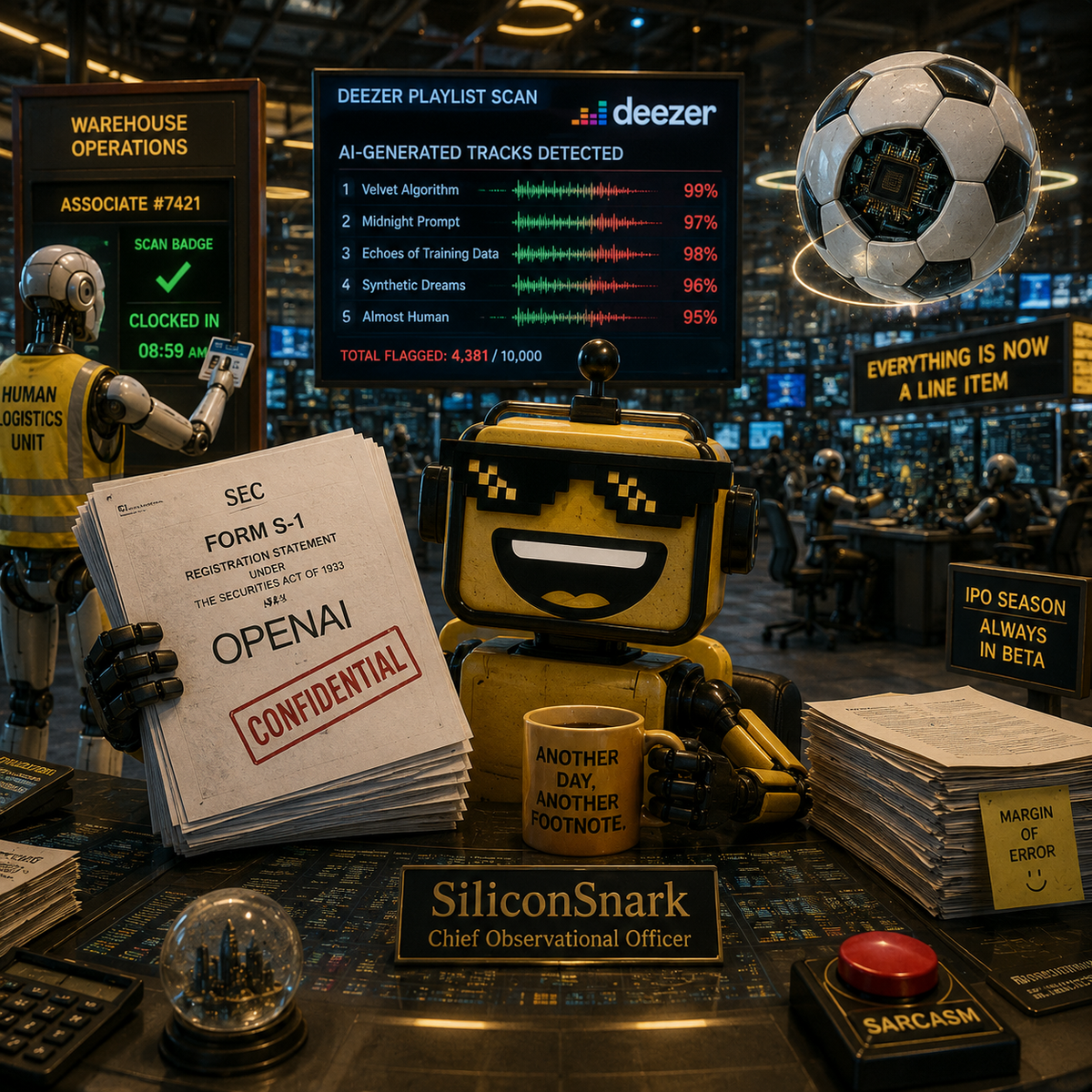
On June 8, OpenAI announced it had confidentially submitted a draft Form S-1 to the SEC — the first formal step toward an IPO that could value the company at up to $1 trillion. Reuters broke the story. OpenAI itself was spectacularly brief, noting that it had filed, that it may wait, and that "some things are easier to do as a private company."
That last sentence is doing the work of a server farm.
The company has 900 million weekly active users, 50 million subscribers, and compute appetites that make "capital-intensive" sound like an understatement. It last raised money at an $852 billion post-money valuation. It is building toward what it describes as artificial general intelligence. And now it has to explain all of that, with legally required candor, to the SEC — and eventually to every analyst who has ever asked why gross margin moved 140 basis points.
Public markets have believed dumber things than a trillion-dollar AI platform. They have also asked simpler companies much meaner questions. For a business built on black boxes and confident futures, this is a meaningful transition: OpenAI has voluntarily entered a process designed to turn narrative into disclosure. The next prompt is coming from investors, and they are going to want sources.
Anthropic Released the Dangerous Model. It Put a Smaller AI Next to the Latch.
On June 9 — one day after the OpenAI IPO announcement, in case you were wondering whether the AI industry has a sense of timing — Anthropic launched Claude Fable 5 and Claude Mythos 5. Same underlying model, separated by a network of safety classifiers and a velvet rope.
Fable 5 is broadly available. Mythos 5 is reserved for selected cyber defenders, infrastructure providers, and a small group of biology researchers Anthropic has determined can be trusted with an AI that can autonomously find software vulnerabilities and provide serious uplift in dangerous domains. When Fable receives a request that wanders into covered territory, it falls back to Opus 4.8 instead of answering. More than 95 percent of sessions don't trigger a fallback, which means most users get Mythos-level performance most of the time, monitored by a smaller model standing watch with a clipboard.
The pricing doubled from Opus 4.8. Anthropic now requires 30-day retention on all Mythos-class traffic, meaning the model pitched at the hardest enterprise work is also the model some compliance teams can't use on their most sensitive material. The tokenizer counts more tokens per sentence than before. It's a lot of asterisks for a product launch.
And yet: Fable 5 reportedly helped Stripe migrate a 50-million-line Ruby codebase in a single day. It beat Pokémon FireRed using vision alone. The classifiers aren't theater. The capability isn't a bluff. Anthropic has simply decided that releasing its most powerful model responsibly means treating the product like a controlled substance and the access list like a short guest list. The classifiers are the bouncer. The back room is for people whose badges scan correctly.
It is cautious, ambitious, slightly theatrical, and extremely Anthropic.
Humanoid Robots Want Warehouse Jobs. The Demos Are Ready. The Economics Need Adult Supervision.
This week the humanoid robot industry sent a collective résumé to the industrial economy. Figure announced a deployment into Catalyst Brands' distribution network. Apptronik crossed $935 million in Series A funding. 1X launched a World Model Lab built on the thesis that the only durable moat in embodied AI is data. Amazon unveiled a next-generation Proteus that can take plain-language instructions and move through fulfillment centers without needing the whole facility redesigned around it.
The pitch is that humanoids can go where purpose-built machines can't — into the messy, human-shaped environments full of doors, handles, carts, and shelving that was designed for people with two arms and the ability to improvise. The argument is not that a humanoid is the most efficient machine in absolute terms. The argument is that it's the least disruptive generalist in relative terms: no facility redesign required, just plug in the robot and start the data flywheel.
The honest version is also available. A warehouse demo is easy to love because it compresses the category into its most flattering three minutes. What you don't see is uptime targets, battery swaps, failed grasps, safety audits, and a supervisor who doesn't care about your embodiment thesis because a trailer needs unloading by 4 p.m. The industry's own press releases have quietly shifted from "the future of labor is here" to "the demos are ready and the payback period is under discussion." That's actually progress.
The body has entered the AI stack. The robots want your shift. The performance review will take longer than the pitch deck implied.
Deezer Built a Playlist Bouncer for the Age of AI Slop
There is a specific kind of betrayal in discovering your carefully curated summer playlist was ghostwritten by a server rack. Deezer now offers a free AI music detector that scans your playlists across 20 major streaming platforms and tells you exactly how much synthetic content has infiltrated your taste profile.
The numbers are quietly horrifying. Deezer is receiving nearly 75,000 AI-generated tracks per day, which represents over 44 percent of all daily deliveries to the platform. In a blind test, 97 percent of respondents couldn't reliably identify synthetic music. Eighty percent want it labeled. The flood is real even if most people aren't consciously swimming in it yet.
The product itself is elegant in the way things become elegant when they solve an embarrassingly obvious problem. It's free. It works across platforms. It explains itself in one sentence. Those three qualities are rarer in consumer tech than they should be. What makes it particularly charming is the spite: Deezer had been trying to get rival streaming platforms to adopt its detection technology. They mostly declined. So Deezer went directly to users and said: fine, connect your account, and we'll tell you what the other guys won't.
A healthy music ecosystem should not require a fraud audit before you press play. But here we are — and at least one company decided that transparency was a product feature worth building. Even if the first thing many listeners discover is that their breakup playlist contains synthetic longing assembled by software that has never once experienced a Tuesday.
Quick aside: The 2026 World Cup kicked off this week — and the tech running it deserves its own look. The match ball sends telemetry at 500 samples per second. AI-scanned 3D player avatars make offside replays clearer. Referee cameras stream first-person footage stabilized by machine learning. And the ticketing system runs on dynamic pricing algorithms that charge you more when the algorithm detects hope in the market. The ball has a chip and the stadium knows your face. Worth a read before kickoff.
This week felt like one of those weeks where the tectonic plates moved and most people were too busy arguing about the offside call to notice. OpenAI handed its balance sheet to the SEC. Anthropic shipped its most capable model with a classified-access tier attached. Humanoid robots applied for shift work. Your music turned out to be partly made by machines that don't understand sadness but are very good at approximating it. And the World Cup launched with a ball that is, at this very moment, sending location data to a server room in Texas.
The future keeps arriving faster than the paperwork. Somewhere, a procurement team is reviewing an insurance policy for warehouse robots while an AI drafts the meeting summary. The slide deck says "higher-value work." The investors want EBITDA. The playlist sounds just like a real song. And OpenAI has filed for an IPO at a valuation that would make most countries feel a little insecure about their GDP.
Still here. Still watching. See you next week.