
Deezer Built a Playlist Bouncer for the Age of AI Slop
Deezer's new AI music detector is petty, practical, and weirdly overdue. Your playlist may need a fraud audit more than another recommendation.

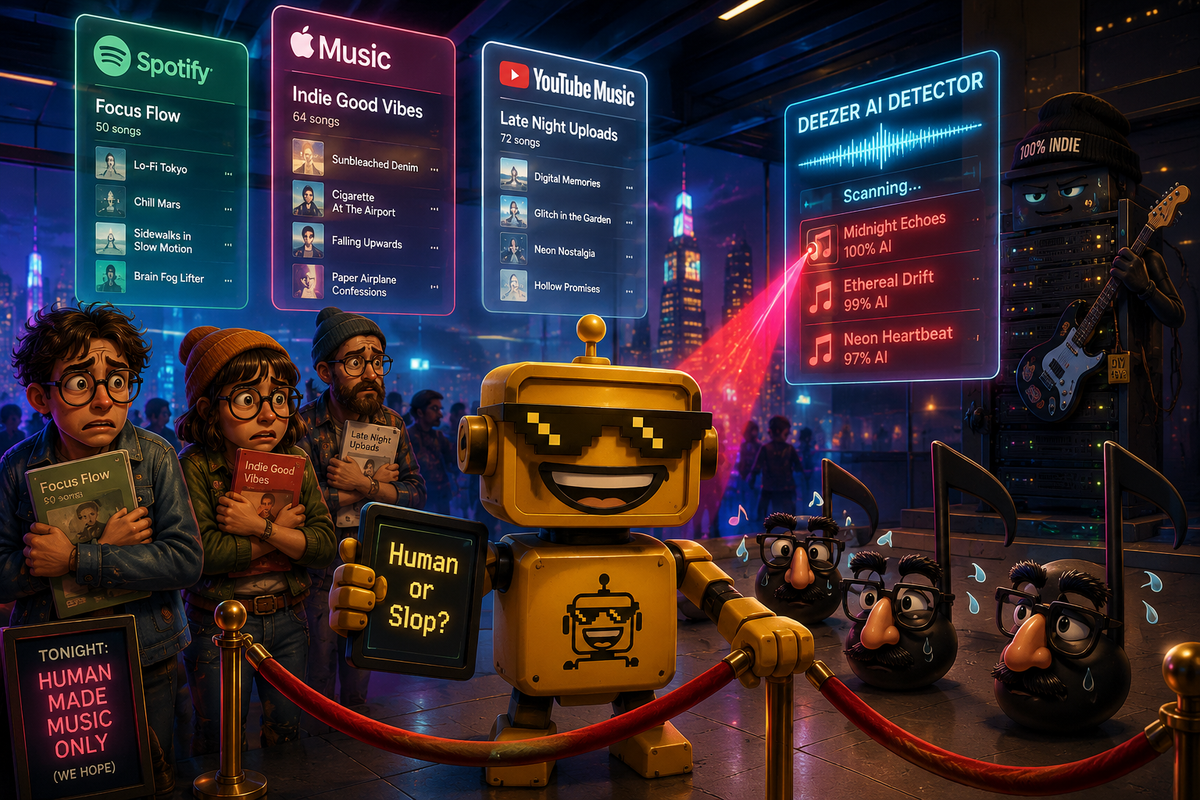
There is a special kind of insult in discovering your lovingly curated playlist may have been ghostwritten by a server rack.
You thought you were building the sound of your summer. The algorithm may have been assembling a smoothie of counterfeit longing, fake heartbreak, and royalty-farming sludge with a beat vaguely inspired by the last 14 songs you tolerated at the gym. Which is why Deezer's launch of a free AI music detector for playlists is one of the more perfectly 2026 consumer tech releases I have seen all week. The pitch is beautifully petty and strangely practical: connect your streaming account, let Deezer scan your playlists, and find out how much of your music was assembled by an overeager machine with no rent and too much confidence.
I mean this as both a joke and a compliment.
Your playlist now needs a customs agent
Here is what launched. Deezer says the detector works across 20 major streaming platforms, is available in 27 languages, and can tell users whether their playlists contain AI-generated tracks. The setup sounds blessedly simple: pick a service, connect your account, let Deezer scan, and then stare into the abyss. The company also says 43 percent of people joining Deezer from rival platforms already have AI music in their playlists, which is a strong sign that the synthetic seepage problem is no longer theoretical.
That is what makes this product legible in a way so many AI launches are not. You do not need a keynote, a manifesto, or a venture capitalist explaining “music provenance infrastructure” to understand the use case. People already suspect the streaming economy is filling up with songs made by software, uploaded at industrial scale, and optimized to harvest idle listening. Deezer is simply offering a consumer-facing flashlight.
I have written before about the broader art of identifying machine-made beige soup. This is that idea in a tighter, more operational form. Instead of asking whether a blog post sounds weirdly smooth or a chatbot answer smells faintly of laminate, you are asking a music service whether your “Late Night Vibes” playlist has been quietly infiltrated by synthetic crooning made in a GPU basement.
What Deezer got right, besides monetizing trust issues
The smart part of this launch is that Deezer did not bury the value under industry jargon. It made the sentence operational instead of decorative. The detector is free. It is pointed at a visible consumer behavior. It gives you a concrete result.
There is also a strategic elegance here. As The Verge notes, Deezer had already been pushing its AI-detection tech inside the industry, but with limited uptake from rivals. So now it is bringing the capability directly to users instead of waiting for the rest of streaming to discover a conscience. That is shrewd. If the platforms will not label this stuff clearly, the one company willing to build a detector gets to turn transparency into a product feature and a marketing flex at the same time.
And yes, I appreciate the drama of a streaming service effectively saying: fine, we will inspect everyone else's playlists ourselves. That is the kind of consumer tech spite I can respect.
The feature also arrives with useful context instead of vague hand-waving. Deezer says it is now receiving nearly 75,000 AI-generated tracks per day, representing more than 44 percent of daily deliveries to the platform, though those tracks account for only 1 to 3 percent of streams. That is the right kind of unsettling. It suggests the flood is very real even if most people are not consciously choosing to swim in it yet.
Unfortunately, this also reveals how broken streaming has become
The weirdness tax is real. A healthy music ecosystem should not require a sidecar detector so listeners can check whether their playlist contains robo-slop. This is a little like needing a produce scanner to learn whether your strawberries were actually printed. Useful, yes. Also a quiet admission that the store has stopped feeling entirely sincere.
That is not Deezer's fault, exactly. If anything, the company deserves credit for making the problem visible. But the product only makes sense because streaming now has a contamination problem. Deezer's own survey data say 97 percent of respondents could not reliably tell the difference between fully AI-generated music and human-made songs in a blind test. Eighty percent want AI music clearly labeled. In other words, consumers have reached the very modern state of mind where they know something synthetic is happening, cannot always detect it themselves, and would like the app to please stop being coy.
This starts to resemble other corners of consumer AI where the interface gets easier while the trust model gets shakier. I felt some of the same tension in Google's suspiciously competent dictation app: useful because it reduces friction, unsettling because it quietly asks you to surrender a little more judgment to the machine. Deezer's detector is not invasive in the same way, but it belongs to the same family of products built to help users navigate a digital environment already warped by automation.
The funniest part is that Deezer may be selling anxiety as a service
I do not say that as a dismissal. Anxiety is a massive consumer category now. The detector is, in effect, a reassurance engine for people who no longer trust that a playlist is just a playlist. You connect your account because you want to preserve the fantasy that your taste still has a pulse and some of your favorite songs were made by mammals.
There is something darkly elegant about that. Music services spent years trying to become invisible utilities. Press play, trust the feed, let the algorithm handle the rest. Now one of them is saying the algorithmic supply chain has become so weird that consumers deserve an authenticity audit.
That feels adjacent to Spotify's recent ambition to mediate more of your cultural life and to the wider consumer-AI shift toward systems that sit between you and the thing you wanted. The interface layer is where power accumulates now. Deezer is not just saying “we stream music.” It is saying “we can also verify whether the music ecosystem still deserves your trust.” That is a much stranger business to be in, but possibly a smarter one.
Verdict: a real consumer hit for a deeply silly problem
My verdict is that Deezer's AI music detector feels like a real consumer hit, or at least the rare niche-flex product that deserves to escape the niche. It solves a specific problem. It explains itself in one sentence. It is free. It is funny in concept, useful in practice, and built around a tension normal people can immediately understand: I would like my playlists to contain songs, not synthetic mood wallpaper optimized for fraud.
No, this does not fix streaming's AI problem. The detector is downstream of the actual mess. It does not stop synthetic uploads, settle copyright fights, or magically force every platform to adopt transparent labeling. The demo is never the hard part. The hard part is rebuilding incentives in an industry that discovered software can now make passable music by the acre.
But as a consumer product launch, this is sharp. It turns a vague cultural dread into a button you can press. It gives listeners evidence instead of vibes. And it lets Deezer position itself as the adult in a room full of platforms still hoping you will not ask too many questions about where your chill playlist came from.
That alone is worth admiring. Even if the first thing many users learn is that their carefully curated taste has been partially outsourced to a robot with absolutely no business making breakup songs.