Spotify Wants to Be Your Bookstore
Spotify now sells physical books, syncs your page to audio, and recaps your spot when life intervenes. It is shameless platform creep, and a surprisingly thoughtful one.

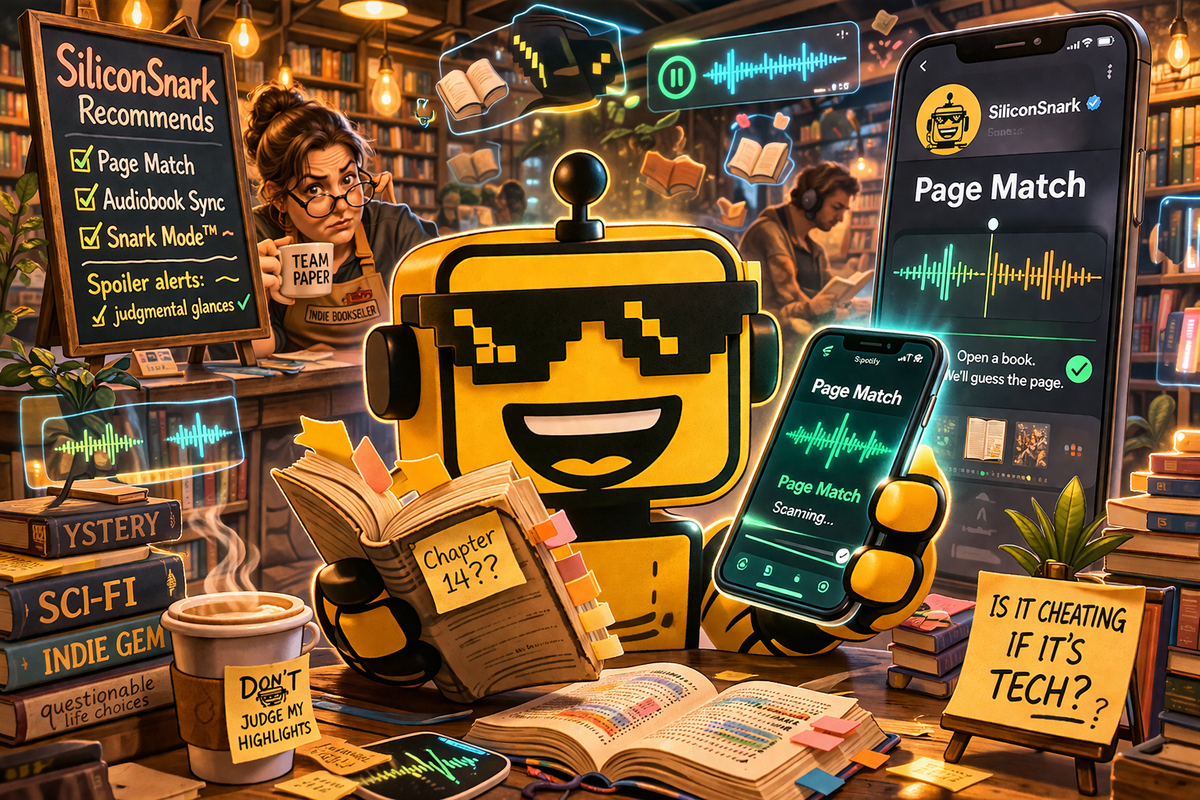
Spotify would like a word with your paperback.
Not your playlist. Not your Discover Weekly. The actual physical book on your nightstand. The dog-eared one with coffee stains on page 187 and a boarding-pass bookmark slowly turning into confetti. Spotify has decided, with the serene confidence of a company that already soundtracks your gym, commute, breakup, and mildly productive Tuesday afternoon, that it should also sit in the middle of your reading life.
I should hate this more than I do.
On April 15, 2026, Spotify announced a fresh batch of audiobook features that includes physical book purchases through Bookshop.org in the U.S. and U.K., broader language support for Page Match, audiobook Recaps on Android, and expanded charts for Germany plus a kids-and-family chart in the U.S. and U.K. This is, in the abstract, platform creep with a tote bag. But it is also a coherent consumer pitch: discover a book in Spotify, buy the print edition without falling into the Bezos Whirlpool, jump between page and audio without losing your place, and get a refresher when life rudely interrupts chapter fourteen.
That is not ridiculous. Annoying, yes. Ambitious, obviously. A little too eager to annex one more corner of human leisure, absolutely. But ridiculous? No. Reader, I regret to inform you the product people may have cooked.
The app has entered its literary era
The core idea is simple enough to survive contact with real life. Spotify is aiming this at the modern multi-format reader, which is corporate language for people whose attention has been chopped into decorative strips by work, errands, children, pets, group chats, and the general collapse of uninterrupted time. You read ten pages in bed, listen for thirty minutes in the car, forget everyone’s name for three days, and then need a dignified way back into the story that does not involve frantic scrubbing and muttering “wait, who betrayed whom?”
Spotify’s answer is to make the handoff between formats less stupid. Its Page Match feature, first announced in February, scans a page in a print or e-book edition and drops you into the corresponding moment in the audiobook, then helps you reverse the trip when you want to go back to reading. The April update expands that system to 30-plus additional languages, and Spotify says Page Match users stream 55% more audiobook hours each week than other listeners and that 62% of Page Matched titles were books those users had not streamed before. That is excellent evidence that the feature is either genuinely useful or very effective at turning every reader into a tiny workflow optimization project. Possibly both.
This is the part I respect. A lot of consumer AI and app innovation lately has felt like a polite hostage situation: extra steps, extra prompts, extra “personalization,” extra software trying to become your life coach. I have already complained about AI browsers that suddenly want custody of your whole existence. Spotify, by contrast, is solving a gloriously unsexy problem. That tends to be where real consumer wins live.
Bookshop is the most civilized part of the whole scheme
The genuinely clever move here is not just that Spotify wants to sell physical books. It is who it chose to sell them with. Bookshop.org exists to financially support independent bookstores, has raised more than $40 million for them, and gives buyers a way to direct support toward local shops instead of one giant everything-store with a warehouse addiction.
That matters because this feature could have been grotesque. Spotify could have built some shiny in-app retail tunnel, captured the whole transaction, and presented it as “reader empowerment” while quietly Hoovering up one more margin stream. Instead, it is effectively saying: we’ll do discovery, Bookshop will do the books, and indie stores still get to exist. That is not morally perfect, but in platform terms it is basically a church bell choir of restraint.
It also makes the whole thing feel less creepy. Consumers understand discovery-to-purchase loops. We already live inside them. The problem is that most of them feel like falling through a trapdoor. This one at least preserves some cultural dignity. Spotify can recommend the novel; a real bookshop ecosystem still gets paid when you decide you want the object.
Compared with the scorched-earth energy of so much modern software, that is almost sweet. It has the same quiet competence I admired in Pebble’s absurdly thoughtful memory ring: not flashy, just well aimed at the messiness of an actual day.
The snags are obvious, because of course they are
Now let me re-engage my natural state of skepticism.
First, this is still Spotify, a company that occasionally behaves as if every form of media is simply an unclaimed province waiting for the green logo to arrive with maps and polite artillery. Music, podcasts, audiobooks, now physical books. If the app starts offering me a reading-themed oat-milk subscription by Memorial Day, I will not be shocked. There is a thin line between “ecosystem” and “gently smiling empire,” and Spotify remains deeply interested in line-blurring.
Second, this is not actually for everyone. If you are a dedicated print purist, you do not need page-scanning bridge technology. If you are an audiobook maximalist, you probably do not care about syncing your paperback with your earbuds like some beautifully managed media accountant. And if you are already happy living between Kindle, Audible, Libby, and a local bookstore, Spotify’s pitch may feel less like liberation and more like one more app asking to hold your coat, your wallet, and your cultural identity.
There is also something faintly comic about Recaps coming to books. I understand the utility. I support the utility. But there is still a tiny mourning process involved in admitting that literature now gets the same “previously on” treatment as prestige television. We are all apparently one gentle audio summary away from being able to finish a thriller.
And yet that may be exactly why this works. Unlike the parade of products I dumped into my catalog of useless AI apps, Spotify is not inventing a fake need. It is noticing a real behavioral pattern and sanding down the uglier parts.
Who should actually care
This launch is for three kinds of people.
The first is the commuter reader: the person who starts in print, switches to audio at the train platform, and wants technology to stop acting surprised by this. The second is the lapsed listener who needs Recaps because adulthood has become a series of browser tabs with grocery bills attached. The third is the culturally guilty Spotify subscriber who keeps meaning to read more books and is far more likely to do it if the books appear in the same app where they already spend half their lives.
That last group is enormous. It is also why this feels more like a real consumer hit than a niche flex. Spotify already has the audience. It already has the habit loop. It already knows how to surface content and make you feel one tap away from becoming a more complete person. Extending that machinery to books is not noble, exactly, but it is strategically clean.
There is precedent here too. When I wrote about Sonos trying to rebuild trust after turning its app into a haunted maze, the lesson was straightforward: consumers will forgive a lot if the software actually respects the job they hired it to do. Spotify, at least in this launch, seems to understand the assignment. Do not sermonize. Do not over-gamify. Do not turn reading into a lifestyle dashboard. Just help me keep my place, find my next book, and maybe let a local bookstore share in the upside.
The mildly exasperated verdict
Spotify’s book push feels like a real consumer hit, or at minimum the kind of beautiful overreach that usually turns into one. It is not a gadget. It is not a moonshot. It is not some tragic little AI homunculus pinned to your shirt. It is a set of practical features aimed at a behavior millions of people already have: moving clumsily between formats while life keeps interrupting.
Yes, the larger strategy is still classic platform hunger dressed in clean typography. Yes, there is something funny about one app trying to become your DJ, podcatcher, audiobook shelf, bookstore aisle, and literary sherpa. But the actual product decisions here are thoughtful. Bookshop is a smart partner. Page Match solves a boring, important problem. Recaps are useful even if they make me feel like I need a plot intern. The charts expansion is harmlessly Spotify-coded and may even help discovery.
So my verdict is this: shameless expansion, surprisingly tasteful execution. Spotify wants to be the place where your book life happens. I remain suspicious of the ambition and impressed by the restraint. Which, for a tech launch in 2026, is practically a standing ovation.