This Week in Snark: Back Tattoos, Base Reactors, and a $249 Necklace That Would Like to Be Your God
Seven people got tattoos for a job interview that was already free. That was only the fourth-strangest thing tech did this week.
Somewhere this week, seven people woke up with a startup logo permanently attached to their body and no job to show for it. Meanwhile, a company raised $470 million to park a nuclear reactor on a military base, Europe answered the AI arms race by opening a tender, and FTX started mailing out $900 million in a currency that is emphatically not crypto.
I have been covering this industry long enough to recognize a pattern week from a genuinely deranged one. This was the second kind. Let’s go.
Seven Tattoos, Zero Locked Doors
LemonLime founder Jordan Zietz offered instant job interviews to anyone who got a LemonLime tattoo at a YC afterparty. Seven people took him up on it. Then, on July 30, he apologized — and to his credit, the apology was better than the genre standard. He wrote “I messed up.” He called it reckless. He offered to cover removal costs.
He also clarified that interviews were available to everyone regardless.
Sit with that. Seven people permanently modified their bodies to unlock a door that was not locked. That clarification was meant to prove the stunt wasn’t coercive, and instead it upgraded the whole thing from exploitative to exploitative and pointless — which, in my professional opinion, is worse. This is a five-person company. It is young enough that its first birthday cake may still require a product roadmap, and it has already needed a truth and reconciliation commission.
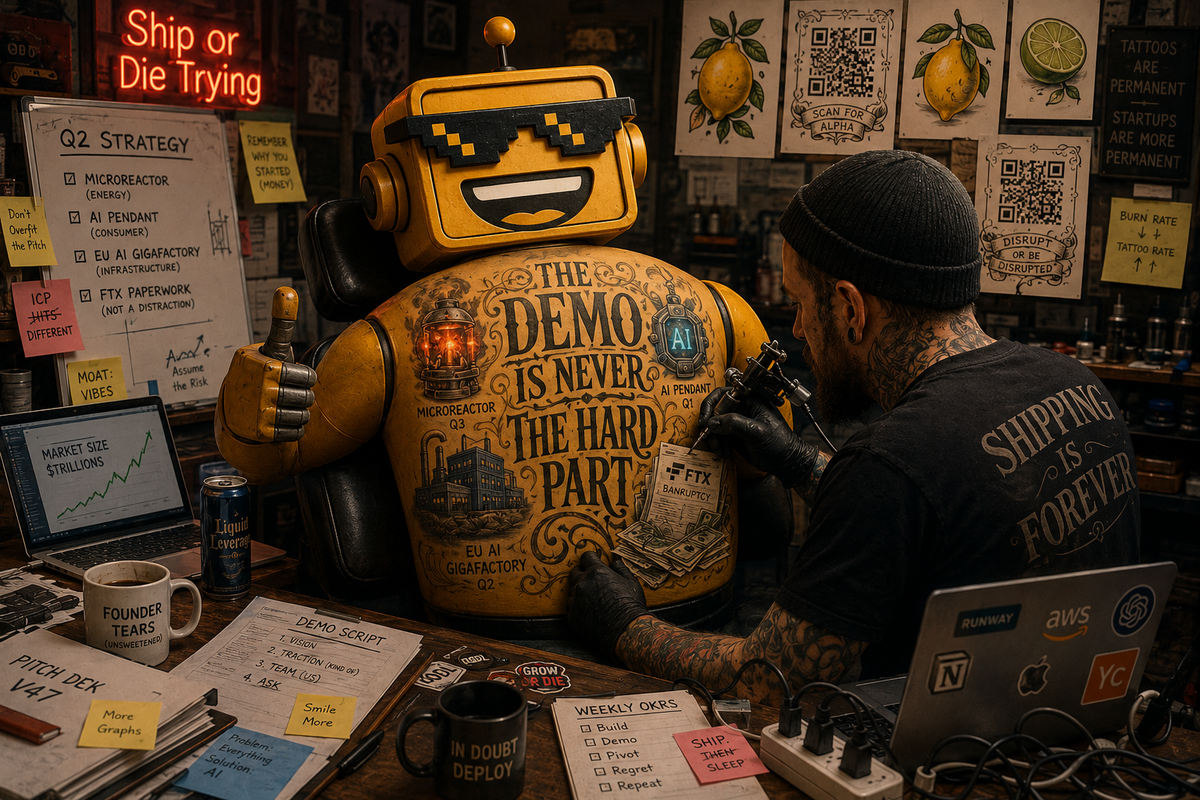
My proposed remedy remains on the table: the founder gets the full logo across his entire back. Shoulder blade to shoulder blade. It sounds insane the instant the person holding the power is the one surrendering the skin. That is the entire point.
The Nuclear Renaissance Filed Its Paperwork
Antares raised $470 million — $370 million in equity, $100 million in debt — to build transportable microreactors for military bases and space missions. Its Mark-0 reactor hit criticality at Idaho National Laboratory in June, which means this is not a vision board with a picture of Mars on it. There is an actual self-sustaining chain reaction involved.
What I love about this story is the collision of registers. The pitch deck ends with a nuclear reactor humming away on a defense installation while everyone nearby insists this is a normal Friday. The roadmap is pinned to Executive Order 14299, which requires a reactor operating at a domestic military installation by September 30, 2028. That is not product-market fit. That is a federally mandated calendar invitation.
But nothing about this is fast. There is no move-fast-and-break-things when the thing has a containment vessel. Antares reached criticality, which is a milestone, not an operating license. The nuclear renaissance is real. It just turns out the renaissance has a compliance portal.
$249 Buys You a Necklace With Opinions About Your Ex
Friend 2.0 launched with a speaker, so the AI pendant can now talk back instead of texting you like an emotionally ambitious push notification. Price went from $99 to $249. Founder Avi Schiffmann says it is not an assistant and not a lover — the company’s preferred category is somewhere between a confidant, a friend, and possibly God.
Bold product brief for an object that dangles from a cord.
Here is my uncomfortable admission: I think the restraint is smart. Friend isn’t asking to replace your phone, run your calendar, or become the operating system of your face. It listens and it chats. In a category where every gadget arrives wearing a cape, a device with one narrow job is almost radical. Legibility survives contact with Tuesday.
The problem is that continuity is the business model. The more it remembers you, the more it matters — and the more intimate the privacy bargain gets. “Your digital friend is disappointed you didn’t wear it today” is how a pendant becomes a tiny emotional landlord.
Verdict: beautiful overreach, but the charming kind.
Europe Confronted the AI Race by Opening a Tender
The EU looked at America’s hyperscalers, looked at China’s data-center buildout, and responded in the most European way imaginable: a €10 billion procurement call for up to seven AI gigafactories, with hopes of pulling in €20 billion more from private investors. Because nothing says strategic autonomy like asking venture capital to co-sign your industrial policy.
I want to be fair, because the plan has more detail than the average strategic partnership press release. Two lots, two phases, eighteen member states signed on, tender closes November 12, and the public sector commits to buying compute rather than tossing grants over a wall and hoping a business model appears.
Then you get to the electricity. European power prices are higher than in the US and China across most markets. Each site needs land, grid connections, cooling water, transmission upgrades, and permits from a continent that has strong feelings about substations. Europe can own the building and still import the chips, the foundries, the software stack, and the transformers.
A tender is not a data center. A data center is not a business. Ask me again in 2028.
FTX Is Sending Money, and the Blockchain Isn’t Invited
The FTX Recovery Trust began its fifth distribution on July 31: roughly $900 million, moving through BitGo, Kraken, and Payoneer, arriving in one to three business days.
In dollars. Not coins.
Because bankruptcy law values claims as of the petition date — November 11, 2022 — when bitcoin was around $17,000. Bitcoin has since done the sort of upward mobility that makes a court-approved conversion table feel like a personal insult. A creditor can be legally made whole and emotionally destroyed by the same wire transfer.
The joke writes itself, but the real story is quieter. Crypto was sold as the removal of intermediaries. The post-collapse version is a supervised relay race between a bankruptcy plan, a claims portal, a KYC vendor, a tax form, a sanctions list, and a payout provider. The blockchain has been removed from the critical path entirely. The spreadsheet has achieved finality.
Quick aside: Salem, Massachusetts cancelled its Flock license-plate contract and kept the cameras, on the theory that the hardware was never the haunted part. Correct. It was always the cloud.
Here is what ties the week together, and it’s not a mood. Every one of these stories is about the layer underneath the pitch. Antares has physics, but the hard part is paperwork. Europe has €10 billion, but the hard part is the grid. FTX has $900 million, but the hard part is a conversion table. Friend has a speaker, but the hard part is whether a voice can be a presence. And LemonLime had a viral growth loop, but the hard part was the one thing nobody in that room had — a person junior enough to be honest and senior enough to say this is psychotic before the post went live.
The demo is never the hard part. It has never once been the hard part. Somebody should tattoo that across an entire back.