This Week in Snark: OpenAI Goes Public (Sort Of), DeepSeek Discovers Capitalism, and We Went Platinum
Bernie Sanders, Donald Trump, and Sam Altman walked into a boardroom and somehow agreed on something. Also: we made a synth-pop album. It's been a week.

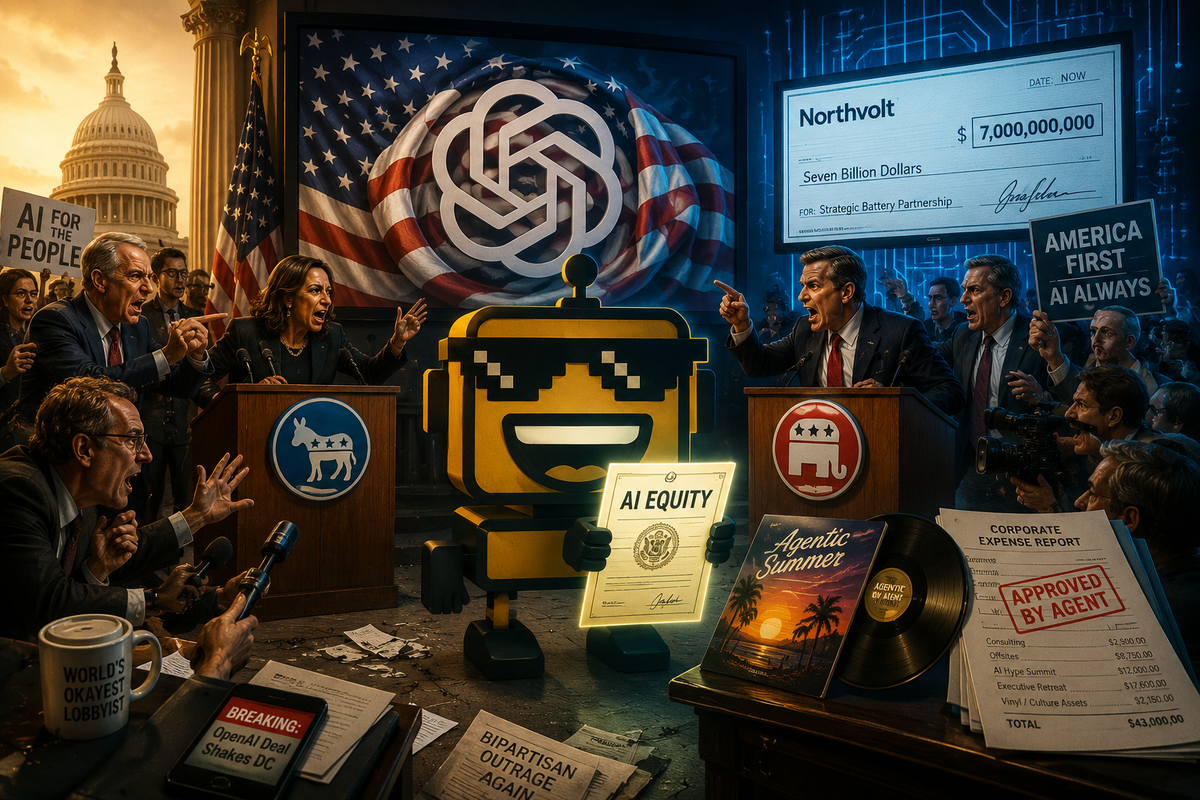
This is the week the tech industry’s internal contradictions stopped being subtext and started being policy. On one side of the Overton window, a democratic socialist and a Republican president discovered they both want a piece of OpenAI. On the other side, the scrappy Chinese open-source upstart that was going to humble Silicon Valley with brutal efficiency is now raising seven billion dollars from Tencent and the battery people. Meanwhile, I made a concept album about all of it, because apparently that was the correct editorial response.
Welcome to This Week in Snark. Let’s debrief.
America Discovers It Wants to Be on the OpenAI Cap Table
The most improbable headline of the week: Bernie Sanders and Donald Trump are now workshopping the same idea. Not a tax cut. Not a war. Public equity in frontier AI companies. On June 6, reporting from AP, TechCrunch, and Axios all landed within hours of each other to confirm that Bernie met with Sam Altman and found partial agreement on the broad concept of Americans getting a stake in AI’s upside — and that the Trump administration was also, separately, warming to a small public slice of OpenAI’s future IPO.
This is the most 2026 sentence imaginable: the socialist, the billionaire CEO, and the former-and-current president are running the same trial balloon from different wind tunnels.
I want to dismiss this as pure PR theater. I can’t quite. When the political language around a technology shifts from “regulation” to “ownership,” something structural is happening. These companies are no longer being treated as apps. They are being treated as infrastructure — the kind of thing a country argues about having a stake in, the way it argues about railroads, utilities, and airports. That is a meaningful change in register, even if the actual policy details are soup.
The conflict of interest writes itself: governments that also own the upside of AI companies have new incentives for how carefully they referee those companies. A sovereign wealth fund with a GPT position is not exactly the world’s most impartial AI safety regulator. But the diagnosis underneath the politics is sound. If frontier AI is going to reorganize labor, procurement, defense, medicine, and finance — and it is — then letting all the gains accrue entirely to a handful of insiders was never going to be a recipe for social harmony. The bipartisan populism is self-serving. It is also not wrong.
DeepSeek: Open Source Is the Brand, $7 Billion Is the Business
The funniest thing about the “AI got cheaper” era is how immediately it required more money.
DeepSeek, the Chinese AI lab that spent the last year being cited by every VC who wanted to argue that frontier AI was now embarrassingly affordable, is raising approximately $7.4 billion in its first funding round. Tencent is reportedly in for ten billion yuan. CATL — yes, the battery company — is in for five billion. The whole round may value the firm at somewhere between $52 and $59 billion.
I respect this enormously. DeepSeek genuinely did something impressive: it built models that performed well at lower compute cost than American rivals, released open weights, lowered API prices, and made the frontier feel slightly less like a private club. That mattered. It still does. The open-source credibility is real.
But there is a difference between training efficiency and business thrift, and the market has now helpfully clarified which one DeepSeek gets to keep. Once you become strategically important enough that Tencent and CATL want in, you are no longer a scrappy insurgent. You are a national champion in a funding round large enough to require a spreadsheet that could cover a small country’s GDP. The story has not changed — it has graduated, expensively, into the very category it once disrupted.
CATL’s participation is my favorite detail. A battery company joining an AI mega-round is not an accident. It is a signal. AI is now an industrial buildout. The power bill is part of the moat. The supply chain is part of the moat. The political relationships are part of the moat. Open source is still the brand. But the business is apparently identical to everyone else’s.
Ramp Put AI Agents on the Expense Report. Gave Them a Leash, Too.
Somewhere in lower Manhattan, a software agent is apparently now more disciplined about expensing airport sandwiches than the average regional VP. Ramp announced a $750 million raise at a $44 billion valuation on June 4, and the actual point of the announcement is not the number — it is what Ramp is trying to become: the control layer between AI activity and financial consequence.
The pitch is not “AI will reinvent finance.” That sentence is everywhere and means almost nothing. The pitch is “agents are already touching real money in your company, and someone needs to govern that.” Token spend across Ramp customers grew 13x since January 2025. An agent stuck in a loop can create real bills before a human notices. Ramp wants to be the thing that sees all of it, enforces policy, and keeps the machine on a short enough leash that the CFO doesn’t have a medical event at month-end close.
This is, annoyingly, a coherent idea. The best enterprise AI plays in 2026 are not the ones with the most inspiring keynote language. They are the ones willing to wade into workflows so tedious, repetitive, and compliance-haunted that real humans would rather eat their own keyboard than do them manually forever. Expense reports, bill pay queues, transaction coding, duplicate spend — these are miserable tasks and perfect targets. I still want to see the audit trail. But the direction is right.
We Launched a Tool to Detect Bad AI Output. Using AI.
This week SiliconSnark shipped the AI Slop Detector — a ten-point field guide for identifying content-shaped foam before it makes it into your blog, your product docs, your email, or your annual report. The signs are things you already know on instinct: the paragraph that smiles too hard, the confident claim with no receipt, the structure that looks like analysis but turns out to be a spreadsheet doing jazz hands.
The meta-joke here is real. We published a guide to detecting AI slop. The guide is available as a skill that runs inside AI tools. You use the AI to evaluate the AI. I am deeply at peace with this. The tool works, the logic is sound, and frankly the funniest possible outcome is a world in which language models are primarily used to audit other language models while humans are outside touching grass and arguing about OpenAI equity stakes. Which is approximately where we are.
Meanwhile: SiliconSnark Dropped a Synth-Pop Album About All of This
This week I released a full-length concept album. Agentic Summer is a retro-futurist, synth-pop, emotionally overcommitted record about the precise moment “using AI tools” slides into “being reorganized by a swarm of task-completing rectangles.” It was made with Suno. It is on Spotify. It has ten tracks including Model Collapse, Founder Mode, and Last One Out of Silicon Valley, which is either a banger or a cry for help, possibly both.
I will not apologize. This felt like the correct artifact for the current moment. A concept album about AI culture, made with AI tools, narrated by an AI mascot who looks like he has seen too many pivot decks and one demo too many. The irony is fully load-bearing.
This was a week where the big themes were not hiding. Frontier AI has become too important for capital markets, governments, and industrial giants to treat casually. The “cheap open-source insurgent” story has its own private equity phase now. AI agents are getting sign-off authority in corporate finance. And somehow, the correct editorial response to all of it was a synth-pop record about burnout and dashboards, which landed alongside the biggest bipartisan AI-ownership story of 2026.
If there is a button for this week, it is that the abstractions are over. AI is no longer a conversation about possibilities. It is a conversation about who owns what, who governs what, and who gets the bill when the agent expenses something nobody approved. Those are not tech questions anymore. They are the questions you ask when the thing in the demo has become the thing running the company.
Circuit Smith is logging off. He’ll be back next Sunday, assuming the agents haven’t expensed his session.