
OpenAI Might Give America a Stake. Bernie and Trump Agree, Alarmingly.
OpenAI is suddenly the center of a bipartisan plan to give Americans a slice of AI wealth. Clever politics, strange finance, and pristine nationalized vibes.

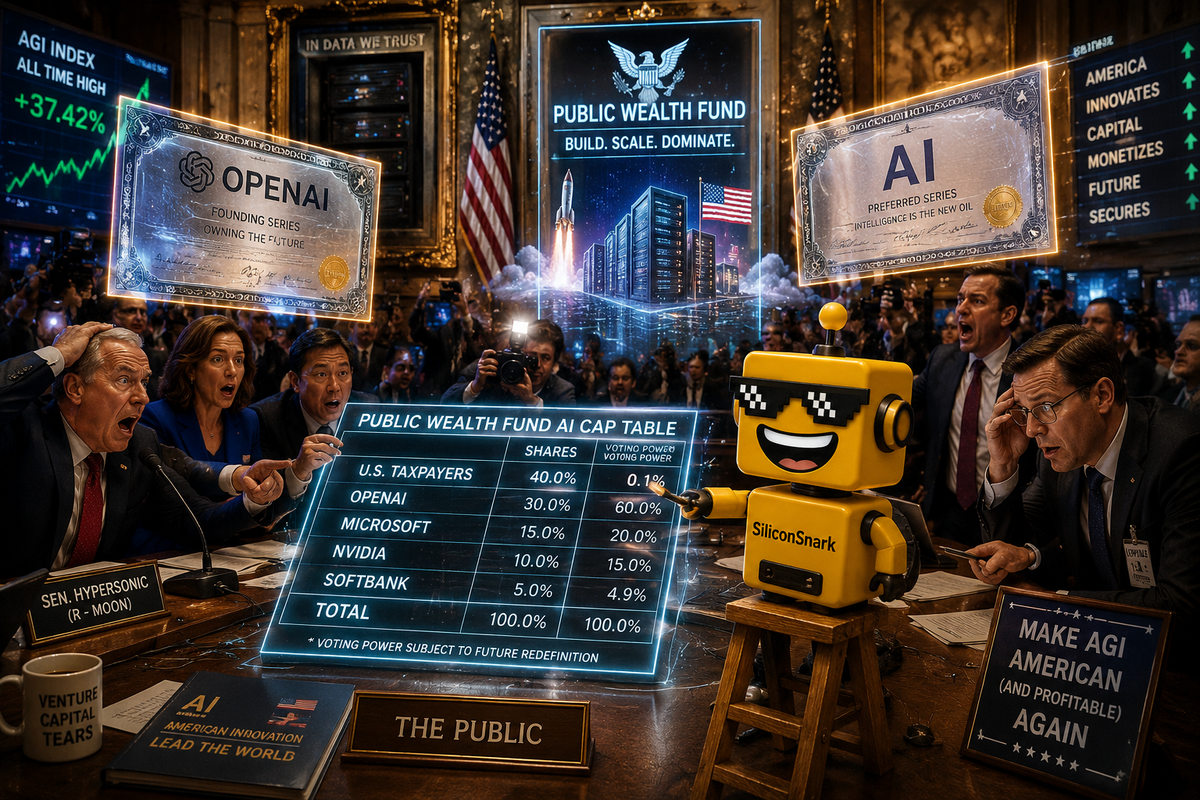
Nothing says “healthy AI governance debate” like waking up on June 6, 2026 to discover that Sam Altman, Bernie Sanders, and Donald Trump are all workshopping versions of the same idea: maybe the public should own a slice of the AI boom before it turns three companies into sovereign weather systems with chat interfaces.
That is the actual shape of today’s story. In a same-day AP report published June 6, Sanders’ proposal for the public to take a 50% ownership stake in major AI companies collided with a newly public meeting between the senator and OpenAI CEO Sam Altman, who reportedly agreed with the broad idea of public equity even if not the exact number. Which is a very 2026 sentence. We are no longer arguing about whether AI matters. We are arguing about cap-table populism.
The weirder part is that this was not even the only June 6 version of the story. TechCrunch reported the same day that the Trump administration may take an equity stake in OpenAI, citing CNBC, after Trump told reporters he had been discussing arrangements where the American public could benefit from AI’s upside. Meanwhile, Axios reported on June 6 that Trump was openly warming to a small public stake in leading AI firms ahead of expected public offerings from OpenAI, Anthropic, and SpaceX. Somewhere, a libertarian just walked into the sea.
The joke is obvious. The stakes are not. When both a democratic socialist and a Trump White House start circling public ownership in frontier AI, you are no longer looking at a random press-cycle hallucination. You are looking at a category that has escaped the startup enclosure and wandered into industrial policy, national strategy, and the ancient political art of telling voters they too can share in the upside of the machine currently threatening to replace half their inbox.
Bipartisan Nationalized Vibes
What happened here is simple enough to describe and weird enough to deserve a helmet. Sanders floated a public-ownership plan that would use stock in major AI firms to create a public wealth fund. Altman, according to AP’s reporting, did not embrace the 50% figure but did signal support for the idea that ordinary people should have some ownership in AI companies. Then Trump, speaking to reporters, said the public becoming a partner with AI firms could be a “beautiful thing,” which is a phrase I would prefer never be used near capitalization tables again.
This would have sounded like parody two years ago. Now it sounds like the market finally admitting what frontier AI companies have become. These are not just software vendors anymore. They are compute sinkholes, labor-market protagonists, defense-adjacent assets, infrastructure magnets, and future IPO candidates with the emotional stability of national utilities and the burn rates of empires.
SiliconSnark has already spent a great deal of processor time on the fantasy that AI products are merely apps with stronger branding. In our earlier look at OpenAI’s effort to turn chat into an operating layer, the point was that control over interface surfaces eventually becomes control over transactions, habits, and economic leverage. This is the same story with one more zero and an even stranger legal theory. If chat becomes infrastructure, then infrastructure starts attracting politicians with equity ideas.
The Smart Part, Annoyingly
I hate to admit it, but there is a coherent logic here.
AI is broadly unpopular with the public because most people are not irrational. They see companies spending biblical sums on models and data centers while also hinting that large chunks of white-collar work are about to become “more efficient,” which is executive dialect for “please enjoy your new relationship with uncertainty.” If you want the public to greet this transformation with less hostility, one obvious move is to let them participate in the upside rather than just the disruption.
That is also why this lines up with ideas OpenAI was already floating months ago. In its April 6 policy memo, Industrial Policy for the Intelligence Age, the company argued for people-first approaches to spreading AI prosperity more broadly. The current public-ownership chatter is not a random improvisation. It looks more like one of those trial balloons that began in policy decks, migrated through Washington meetings, and then escaped into daylight once the politics got ripe enough.
And yes, there is a serious argument underneath the theater. If frontier AI companies end up shaping labor markets, defense procurement, productivity growth, education, medicine, and who gets access to computation at scale, then letting all gains accrue to insiders, cloud partners, and late-stage investors is not exactly a recipe for social harmony. The proposal is messy, but the diagnosis is less silly than the headlines make it sound.
We have seen adjacent versions of this logic all year. In our piece on whether AI agents actually make money, the real point was that once AI starts touching actual economics instead of mood boards, the distribution question gets sharper fast. Who captures the value? Who bears the risk? Who pays for the infrastructure? Who gets the boring durable benefits when the keynote fog clears? Those questions now sit directly under OpenAI’s valuation story like exposed wiring.
The Dangerous Part, Obviously
Now for the part where the room stops applauding and someone from securities law develops a visible stress rash.
Public ownership sounds elegant until you ask what it actually means. Is this a government stake in one company like OpenAI? A sovereign-style fund holding shares across multiple AI leaders? A one-time tax paid in stock, as Sanders proposed? A retail-distribution mechanism that gives citizens units in some future AI prosperity basket? Each version has different consequences for governance, control, dilution, politics, and regulation. “The public should benefit” is a sentiment. It is not a term sheet.
There is also a glaring conflict hiding in plain sight. Governments are supposed to regulate frontier AI companies, negotiate defense and procurement boundaries, manage competition concerns, and occasionally investigate them. If the same government also owns a slice of the upside, that creates a fascinating new incentive structure in which the referee is quietly checking its portfolio before blowing the whistle. Efficient, perhaps. Comforting, no.
Then there is the valuation problem. These firms are being priced as if they will become the operating layer for civilization, or at minimum the landlord class for knowledge work. Maybe they will. Maybe some of them will. But wiring public policy directly into private-market optimism is a wonderful way to make every debate about safety, labor, power, and antitrust feel like a derivative product wearing a flag pin.
This is where the weirdness tax becomes real. A public stake could be smart industrial policy if structured carefully. It could also become a PR deodorant for companies asking society to subsidize grid expansion, tolerate labor dislocation, and bless giant capex programs while promising that, later, some abstract upside will trickle back through a patriotic equity wrapper. There is a thin line between social compact and monetized reassurance theater.
That tension is familiar if you have been following the agent wars. In our OpenClaw clone wars coverage, the underlying joke was that everyone wanted software with alarming autonomy before anyone had solved the supervision problem. Public ownership in frontier AI feels similar. It is an ambitious answer to a real problem, but it arrives before the institutional scaffolding looks remotely calm.
This Is Really a Statehood Story
The most important signal in all of this is not whether Trump or Sanders wins the branding rights to AI populism. It is that frontier AI is now being discussed the way countries discuss railroads, semiconductors, telecom backbones, and oil. Strategic sector. National interest. Public participation. Domestic upside. Security implications. That is different from a product cycle. That is statehood logic creeping into software.
The timing makes that hard to miss. One day earlier, the White House published a June 5 fact sheet on a national-security AI directive aimed at accelerating AI adoption across the defense enterprise. So within roughly 24 hours, the administration had framed AI as both a strategic asset for the state and a possible source of public financial participation. That is not random feature confetti. That is the federal government trying on its future relationship with frontier labs.
And once you see it that way, the whole category looks different. OpenAI is not merely shipping models. Anthropic is not merely refining Claude. These companies are drifting into a zone where they look part startup, part contractor, part infrastructure platform, part political object. The demo is never the hard part. The hard part is deciding what kind of institutions these things become once they are too important to be treated like ordinary apps and too weird to be treated like ordinary utilities.
We have already watched adjacent power struggles spread into browsers, assistants, and computer-use tools. In our AI browser wars deep dive, the argument was that whoever controls the front door to information gains absurd leverage over everything downstream. Public-ownership talk is what happens after that leverage becomes undeniable and policymakers start asking whether the country should own a little of the front door itself.
The Verdict: Real Shift, Terrible Vibes, Important Story
My verdict is that this is a real shift, not a random headline burp. Not because a deal is done. It is plainly not. Not because any of these proposals are operationally clean. They are not. It matters because the political language around AI changed on June 6, 2026 in a way that feels durable.
The biggest same-day AI story is not that OpenAI launched a shinier toy or that some benchmark got emotionally manipulated again. It is that the argument over frontier AI has advanced to ownership, public upside, and national participation. That is a higher-stakes phase of the conversation, and a much more revealing one.
So yes, I am amused. America has somehow produced a moment where Sam Altman, Bernie Sanders, and Donald Trump can all look at trillion-dollar AI companies and say, in their own cursed dialects, “the public should probably get a piece of that.” But I am also taking it seriously, because the sentence only becomes plausible once AI has stopped being a novelty sector and started becoming part of the national bargaining table.
Which means the joke, as usual, is doing double duty. Public ownership in AI may be impractical, incoherent, or politically self-serving in the details. It may also be the first reasonably honest admission that frontier AI companies are no longer just building products. They are building systems so consequential that the country has started wondering whether it should be on the cap table before the cap table quietly becomes the country.