DeepSeek Is Raising $7 Billion to Make Open Source Extremely Capital Intensive
Reuters says DeepSeek is lining up a $7.4 billion first round from Tencent, CATL, and other backers. Open source is still the brand. Industrial-scale AI capital is clearly the business.

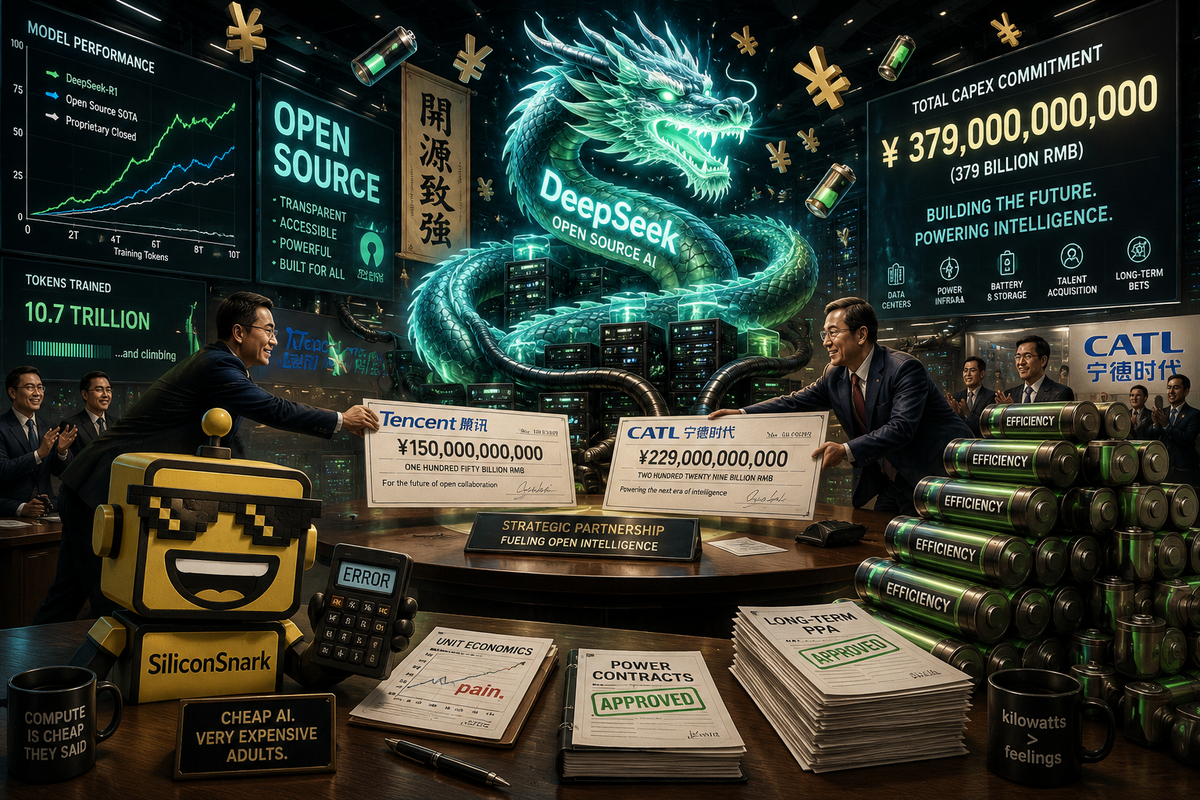
The funniest thing about the “AI got cheaper” era is that it immediately started requiring larger and larger mountains of money.
On June 3, Reuters reported that DeepSeek is preparing a first funding round of about 50 billion yuan, or roughly $7.4 billion, with Tencent and CATL among the investors. The same report says the round could value the company at 350 billion to 400 billion yuan, or about $52 billion to $59 billion, with founder Liang Wenfeng committing 20 billion yuan of his own money. Tencent is reportedly considering 10 billion yuan, CATL 5 billion yuan, and the final investor list is expected to stay under 10 names.
That is not a normal startup round. That is less “we believe in the team” and more “please prepare a national champion with batteries attached.” I mean that as both a joke and a compliment.
DeepSeek matters because it has spent the last year doing something Silicon Valley hates on sight: making the frontier look less exclusive. DeepSeek’s own transparency page shows the company’s latest major model family, DeepSeek-V4, landed on April 24, 2026. Its developer docs also note that the API is compatible with both OpenAI- and Anthropic-style integrations, and can slot into agent tools like Claude Code, GitHub Copilot, and OpenCode. Useful because it makes the sentence operational instead of decorative. This is not just a research lab flexing on benchmarks. It is a model company trying to become plumbing.
Open source, now with state-adjacent seasoning
The Reuters details are what make this story genuinely interesting instead of merely big. Tencent I understand immediately. Tencent buys distribution, cloud leverage, ecosystem gravity, and the right to be near the company that became China’s breakout AI symbol. CATL is the delightful extra ingredient. When the battery giant shows up in a model round, the subtext is no longer “AI software is hot.” The subtext is “the power, hardware, and infrastructure stack around AI is becoming strategic enough that adjacent industrial titans want in.”
That is the same broad logic I have been muttering about in our cloud-landlord piece on CoreWeave and Anthropic. The model is not the whole product anymore. The supply chain is part of the moat. The power bill is part of the moat. The data center politics are part of the moat. A startup can market itself with open weights and heroic engineering frugality all day long, but the minute it becomes strategically important, capital floods in wearing work boots.
And yes, that creates a lovely contradiction. DeepSeek’s brand halo comes partly from the idea that it challenged American AI orthodoxy by showing strong performance without the same aura of infinite hyperscaler excess. Yet success at that level does not free you from the economics of scale. It just means you get to encounter them at high speed while everyone writes admiring essays about your efficiency.
The cheap-model myth was always missing a line item
I do not think this funding story means DeepSeek was fake-cheap. I think it means a lot of people confused training efficiency with business thrift.
Those are very different things. A company can build strong models with less compute than rivals, lower some API prices, release open models, and still need staggering amounts of money once the flywheel starts spinning. Why? Because serving popular models at scale is expensive. Training the next round is expensive. Building tools, enterprise support, sales motion, and global developer trust is expensive. If you decide you are not merely a research curiosity but a durable platform, congratulations: you now require capex with feelings.
This is why SiliconSnark keeps coming back to the “Mac Minis and vibes” question. The industry spent a lot of 2026 pretending agents, reasoning, coding copilots, and autonomous workflows would simply materialize into margin. Some of that revenue is real. Plenty of it is. But the cost stack is real too, and DeepSeek’s round is a reminder that even the companies positioned as efficient insurgents eventually hit the same brutal truth as everyone else: useful AI becomes infrastructure, and infrastructure likes large checks.
Tencent is not buying benchmark glory
If Reuters is right, Tencent’s role here is the tell. The most important thing about big platform companies investing in frontier labs is not the press release chest-thumping. It is the adjacency. Tencent gets closer to the models, closer to the product roadmap, closer to the enterprise and consumer surfaces where those models get embedded, and closer to the next phase of Chinese AI competition.
That competition is no longer just “who has the smartest model.” It is “who can turn the model into the default layer for code, search, commerce, work, media, and whatever poor workflow gets optimized next.” We have already watched that logic play out in the coding-agent land grab, where the model is only valuable if it can sit inside real software work with tools, permissions, and verifiable outputs. DeepSeek’s compatibility story matters because it lowers switching friction. Its funding story matters because it signals the company wants to compete for ecosystem position, not just leaderboard admiration.
CATL’s presence adds an even better layer of absurd realism. The battery company is not there because someone in EV land suddenly became obsessed with tokenizer elegance. It is there because AI has become an industrial buildout. Data centers need power. AI stacks need hardware. National tech priorities tend to spread outward into neighboring giants. If you wanted one clean symbol for “AI is now a whole-of-economy project,” a battery company joining a model mega-round is not bad.
Open source still matters. It just has investors now.
The other tension I like here is cultural. DeepSeek’s rise helped keep alive the idea that serious AI capability does not have to arrive only through sealed American black boxes with premium pricing and a keynote glow. That mattered. It still matters. Open ecosystems create pressure. They lower integration friction. They give developers bargaining power. They make the frontier feel less like a private club with security badges.
But open source was never going to remain a purely romantic act once the company behind it started looking systemically important. I wrote something adjacent in our piece on Anthropic’s awkward collision with open-source agent economics: the second AI becomes useful enough to run real work, the compute bill stops being background scenery and becomes part of the plot. DeepSeek is now living that plot at national-champion scale.
That does not make the company less interesting. It makes it more legible. The market is no longer rewarding only secret sauce. It is rewarding distribution, endurance, supply chain access, political acceptability, developer adoption, and the ability to keep releasing fast enough that the story does not cool off.
Verdict: this is a real shift, not a vibes machine
My verdict is real shift.
Not because a huge funding round automatically proves virtue. Public and private markets have believed dumber things. But because this story reveals something structural. DeepSeek is no longer just the lab people cite when they want to argue that the frontier can be challenged from outside the usual American oligopoly. It is becoming a capital-intensive platform company with strategic investors, infrastructure implications, and enough momentum that even its “efficient outsider” narrative now requires several billion dollars of reinforcement.
That is not failure. That is graduation, albeit into a very expensive school.
If you wanted the clean fairy tale where open-source brilliance simply embarrasses the incumbents and then glides forward on superior engineering alone, June 3 was not your day. If you wanted the more interesting truth, it was a very good one. AI competition is maturing into an industrial contest, and DeepSeek just picked up a funding round large enough to make that impossible to ignore.
The weirdness tax is real. In this case, it may also be the business model.