The Definitive Guide to GPT-5.6 vs. Claude Fable 5: Pick Your Expensive Robot Coworker
GPT-5.6 Sol and Claude Fable 5 excel at different work. Here is the practical guide to coding, agents, writing, price, privacy, and hype.

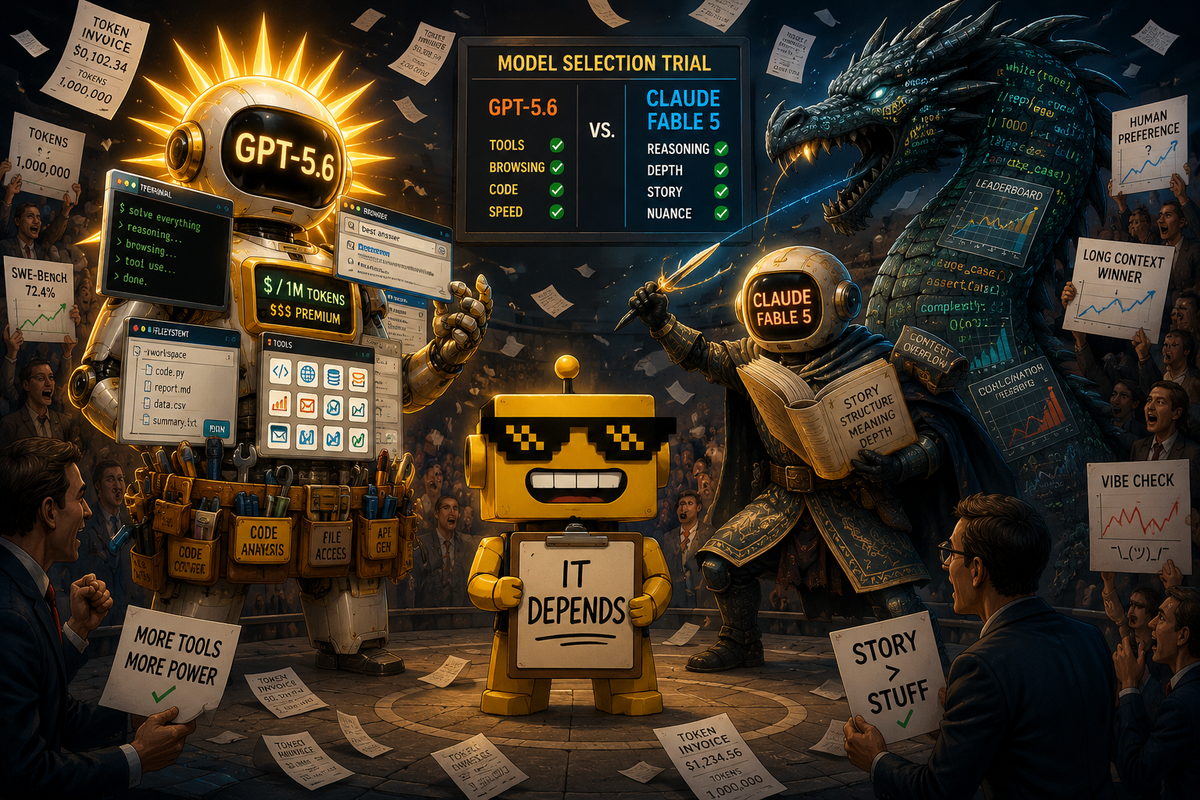
The latest frontier-model debate has reached the mature and scientifically rigorous phase where grown adults compare artificial intelligences using sports metaphors, luxury cars, mythical spacecraft, and screenshots of terminal windows arranged like evidence in a federal trial.
In one corner is OpenAI’s GPT-5.6 family, released broadly on July 9 after a staggered rollout that briefly made access to an AI model sound like something requiring a diplomatic pouch. Its flagship is GPT-5.6 Sol, supported by the cheaper Terra and Luna tiers. In the other corner is Anthropic’s Claude Fable 5, launched in June as a generally available, safety-adjusted relative of the more restricted Mythos 5.
The internet would like a winner. The internet always wants a winner because “it depends on your workload, harness, latency tolerance, risk profile, and unit economics” makes a terrible thumbnail.
Unfortunately, that boring sentence is the correct answer.
GPT-5.6 Sol is the better default for most people and most API workloads. It costs half as much as Fable 5 at list price, offers a huge context window, performs extremely well across tool use, browsing, terminal work, computer interaction, science, and general reasoning, and arrives inside a broad OpenAI product stack. Fable 5 is the more compelling specialist when the job is difficult, long-running, code-heavy, and expensive enough that model price matters less than reducing human correction. It is also the one I would test first for ambiguous software projects where “understand what I meant” is more valuable than “obey exactly what I typed.”
Neither should be selected by benchmark fandom alone. A model is not a quarterback. It is one component in a system involving prompts, tools, permissions, context, retry logic, tests, people, and whatever cursed spreadsheet currently functions as your company’s source of truth.
That is the short answer. Now let us spend several thousand words making it operational, because this is SiliconSnark and we respect your time by consuming it thoroughly.
First, You Are Comparing a Family to a Very Gifted Hermit
“GPT-5.6 versus Fable” sounds like a clean one-on-one contest. It is not.
GPT-5.6 is a product family. Sol is the flagship. Terra aims at the middle of the price-performance curve. Luna is the faster, cheaper volume model. OpenAI has effectively stopped pretending one model should process every request from “summarize this receipt” to “debug a distributed system while reading six years of architectural regret.” This is sensible. It is also a naming scheme that makes your model router sound like an astrology app.
According to OpenAI’s model documentation, Sol is the starting point for complex reasoning and coding, Terra balances capability and cost, and Luna handles price-sensitive high-volume work. Sol supports text and image input, a 1.05-million-token context window, up to 128,000 output tokens, tool use, computer use, hosted shell, code execution, MCP, and the other ingredients required to turn a chatbot into a highly capable intern who has somehow obtained shell access.
Fable 5 is positioned differently. Anthropic calls it a “Mythos-class” model made safe for general use and recommends it for ambitious, asynchronous work that may run for days. The Fable product page leans heavily on long-horizon autonomy: planning in stages, delegating to subagents, checking its own work, and continuing through complicated projects without needing a motivational Slack message every nine minutes.
That distinction matters. OpenAI is selling a versatile model portfolio embedded across ChatGPT, Codex, ChatGPT Work, and the API. Anthropic is selling its most capable publicly available worker for the jobs where other models eventually begin staring into the middle distance.
One is a fleet. The other is the specialist you call after the fleet has created a Jira epic titled “Investigate Remaining Issues.”
The Benchmark Charts Have Entered Couples Therapy
OpenAI’s own launch table gives GPT-5.6 Sol an 80 on the Artificial Analysis Coding Agent Index, compared with 77.2 for Fable 5. Sol scores 72.7 percent on DeepSWE versus Fable’s 69.7 percent, and 88.8 percent on Terminal-Bench 2.1 versus 83.1 percent. Turn on Sol Ultra and that terminal score rises to 91.9 percent, although “Ultra” also means more agent activity, more latency, and more tokens marching bravely toward your invoice.
Then SWE-Bench Pro walks into the room and flips the table. Fable scores 80 percent. Sol scores 64.6 percent.
That is not a rounding error. That is two supposedly relevant coding evaluations telling materially different stories about the same pair of models.
The disagreement continues outside code. On OpenAI’s Agents’ Last Exam, Sol leads Fable 52.7 to 40.5 percent. On GDPval-AA v2, which is intended to reflect economically valuable professional work, Fable leads with an Elo score of 1,759.6 versus Sol’s 1,747.8. Sol leads on BrowseComp, BenchCAD, LifeSciBench, and several security evaluations. Fable narrowly leads OpenAI’s reported HealthBench Professional result, although OpenAI explicitly warns that scoring approaches across company system cards may not be directly comparable.
On Toolathlon, Fable leads Sol 61.7 to 58. On AutomationBench, Sol leads Fable 18.1 to 17.4. These are tiny differences attached to benchmark names that sound like rejected ESPN programming for robots.
The useful conclusion is not that benchmarks are fake. They are measurements of specific tasks under specific scaffolds, settings, budgets, and scoring rules. The conclusion is that “coding” and “agentic work” are not single capabilities.
A model can be excellent at operating a terminal and mediocre at modifying a realistic repository. It can solve isolated software issues but struggle to maintain architectural intent across a large refactor. It can call tools correctly but waste twelve calls proving that the first call worked. It can produce correct code that no human wants to maintain, like a contractor who finishes the bathroom renovation by routing the plumbing through the linen closet.
Our deep dive on coding agents moving into the repo made this point from the systems side: the model matters, but so do the harness, environment, permissions, tests, context gathering, and feedback loop. A benchmark result produced with one scaffold does not automatically transfer to your repository, your tools, or your organization’s unusual commitment to undocumented shell scripts.
Benchmark charts are useful maps. They are not marriage certificates.
For Coding, Fable Is the Better First Swing at the Hard Stuff
If your primary job is software engineering and your work consists of large, ambiguous, multi-file tasks, Fable 5 deserves the first trial.
That recommendation is not based only on the 80 percent SWE-Bench Pro result. Anthropic’s customer evidence is predictably enthusiastic—launch pages are not known for inviting disappointed users to the microphone—but the pattern is consistent. Cursor says Fable opened up longer-horizon problems. GitHub describes stronger autonomy and reliability on complex software work. Cognition says it leads FrontierBench. Several early users emphasize intent recognition, fewer corrective turns, better code review, and stronger one-shot execution.
Those are exactly the properties that matter when a coding agent’s real expense is not tokens but supervision. A $40 model run that produces a clean pull request can be cheaper than a $15 run followed by an engineer spending two hours rediscovering why the database migration is now emotionally unavailable.
Fable’s most interesting advantage may be behavioral rather than intellectual: it appears optimized to keep a complex goal coherent over time. In serious engineering, the hard part is rarely generating a function. It is preserving invariants while moving through a messy codebase, recognizing when the written request conflicts with the architecture, testing assumptions, backing out of a bad approach, and knowing which “temporary” compatibility layer is actually load-bearing archaeology.
This is where “understands what builders mean, not just what they type” becomes more than launch-page perfume. Requirements are incomplete. Tickets are compressed history. Humans omit obvious-to-them constraints. A model that handles ambiguity well can save more time than a model that wins ten additional points on a tidy test.
But there are three large asterisks.
First, Fable is expensive. Second, autonomy is not correctness. A model that keeps going for hours can produce more value, but it can also excavate a much larger crater before anyone notices. Third, Fable’s advantage will vary by harness. Claude Code may expose its strengths differently than Cursor, GitHub, a custom agent framework, or an API loop assembled during a hackathon while everyone was eating hummus over the keyboard.
For bounded coding tasks, terminal operations, quick bug fixes, repository questions, and workflows that benefit from broad tools, Sol may be just as good or better. GPT-5.6’s strong Terminal-Bench, DeepSWE, and Coding Agent Index results are not decorative. Sol is not the value option you tolerate until the clever model arrives. It is a frontier coding model with a wider product surface and a much friendlier price.
The practical split is this: try Fable first for the architectural refactor, the unfamiliar legacy system, the multi-day feature, the difficult review, or the vague request from a senior person who believes context is something employees absorb through office ventilation. Try Sol first for high-throughput engineering, tool-heavy workflows, debugging, terminal tasks, structured tickets, and teams that need capable work without treating every pull request like a moon mission.
And always give either model tests. Our piece on loop writing and verification explained why code is where agents became useful first: the environment can say no. A failing test is more valuable than another paragraph of model confidence.
For Research and Knowledge Work, Sol Is the Safer Default
“Knowledge work” is a phrase broad enough to include financial modeling, literature review, contract analysis, presentation drafting, market research, and changing “utilize” back to “use” in a document written by twelve vice presidents. No single model wins all of it.
Fable has a strong claim on the hardest, longest, messiest projects. Anthropic highlights results from finance, physics, legal redlining, analytics, spreadsheets, and multi-stage planning. The reported GDPval-AA edge supports the idea that Fable is unusually good at professional work requiring judgment across documents and tools.
Sol, however, looks like the better general-purpose research engine. It performs strongly on browsing, science, multimodal document work, computer use, CAD, abstract reasoning, and agents. It also sits inside an ecosystem designed to combine web research, code, files, tools, and multiple agents. OpenAI’s launch materials emphasize programmatic tool calling and multi-agent execution, which matters because modern research is less “answer this question from memory” and more “find the sources, parse the files, calculate the result, challenge the assumption, and leave an audit trail.”
The plumbing is the point.
For a consultant analyzing a folder of documents, a scientist combining papers with computation, or an operations team working across spreadsheets and browser systems, the best model is often the one whose tools can reliably reach the work. Raw reasoning ability does not help if the agent cannot authenticate, parse the PDF, operate the site, retain the right evidence, or recognize that column G is denominated in thousands because someone put that fact in a note three tabs away.
This is also why the SiliconSnark guide to the major AI model families treats models as platforms rather than disembodied brains. OpenAI and Anthropic are competing through product surfaces, integrations, agent runtimes, developer tools, deployment options, and governance. Intelligence is the ticket into the race. Workflow fit is how vendors collect the trophy and your recurring payment.
Writing Is Where Everyone Discovers They Have “Taste”
Ask which model writes better and the conversation becomes a wine tasting hosted inside a Discord server.
One person finds Fable more natural. Another says Sol is more precise. Someone posts two paragraphs without revealing which model wrote which and announces a blind test. Forty-seven replies later, the thread has established only that humans dislike semicolons when they suspect a machine used them.
Fable is likely the better starting point for exploratory writing, narrative continuity, voice-sensitive revision, and long documents where the model must remember the argument rather than merely restate it under increasingly decorative headings. Anthropic has cultivated a writerly product identity for years, and Fable’s emphasis on intent and long-horizon coherence plays directly into that strength.
Sol is likely better for reported, structured, tool-heavy writing: research briefs, technical explanations, evidence synthesis, comparison documents, and content workflows where sourcing and transformation matter as much as prose texture. It can also write well. Any claim that a current frontier model “cannot write” generally means it produced the default style because the user supplied the default amount of direction.
Neither model has taste in the human sense. It has learned patterns, responds to constraints, and can simulate editorial judgment with startling effectiveness. It does not care whether the lede lands. It will not wake at 2 a.m. furious that the third section has the wrong rhythm. This is probably healthier, but let us not call it taste.
The right writing model is the one that responds reliably to your examples, style rules, revision process, and fact-checking loop. Run both on the same source packet. Blind the outputs. Have editors score voice, structure, factual fidelity, unsupported claims, and revision burden. Do not score “vibes” unless vibes are genuinely your deliverable, in which case congratulations on the lifestyle brand.
And run the finished copy through the principles in our AI Slop Detector. Frontier intelligence can still produce beige soup. It merely garnishes it faster.
The Price Difference Is Not Subtle
At standard API rates, GPT-5.6 Sol costs $5 per million input tokens and $30 per million output tokens. Fable 5 costs $10 input and $50 output. Anthropic also offers U.S.-only inference at 1.1 times the normal rate. OpenAI charges Sol requests above 272,000 input tokens at twice the input rate and 1.5 times the output rate for the full request, a long-context surcharge worth noticing before you casually upload the entire company SharePoint and ask for themes.
At face value, Sol is 50 percent cheaper on input and 40 percent cheaper on output. Terra is $2.50 and $15. Luna is $1 and $6. If you are building a high-volume product, the question quickly stops being Sol versus Fable and becomes whether most calls need either one.
Usually they do not.
A model router that sends classification, extraction, cleanup, summarization, and simple transformations to Luna or Terra—and escalates only genuinely difficult work to Sol or Fable—will often beat a one-model architecture on cost without hurting quality. The glamorous model should not be resizing JSON keys just because your team enjoys excellence.
Prompt caching changes the math for repeated context. Both vendors advertise 90 percent discounts on cached input reads, while OpenAI says GPT-5.6 cache writes cost 1.25 times the normal uncached input rate and have a 30-minute minimum cache life. If an agent repeatedly reads a large stable codebase snapshot, policy manual, or document collection, caching can make an apparently expensive model far less alarming.
But token price alone is not total cost. Track:
- How often the model completes the task without human correction.
- How many tool calls and retries it uses.
- How much reasoning output it consumes.
- How long a human waits for the result.
- How often it creates defects that survive review.
- How much orchestration and evaluation infrastructure it requires.
- Whether its output can be verified automatically.
Fable can be cheaper if it finishes in one pass where Sol needs three. Sol can be dramatically cheaper if their completion quality is similar. Terra can embarrass both if the task was never frontier-grade in the first place.
Public arguments about per-token price often resemble comparing restaurants by the cost of salt.
Privacy, Retention, and the Part Procurement Will Actually Read
Anthropic states that using Fable requires 30-day data retention for safety monitoring. That is a meaningful constraint for regulated, confidential, or sensitive workloads. It does not make Fable categorically unusable, but it may remove the model from consideration before anyone gets to admire its repository instincts.
OpenAI says GPT-5.6’s programmatic tool calling in the Responses API is compatible with Zero Data Retention. Exact eligibility, endpoint behavior, feature configuration, contracts, and regional requirements still matter. “Compatible” is not a magic phrase that allows security teams to return to their burrows.
Enterprise buyers should evaluate what data is retained, where inference occurs, what tool traces contain, how prompts and outputs are logged, whether caches persist, which features qualify for zero retention, how administrators control access, and what happens when the model delegates work to subagents or external systems.
The more autonomous the model, the less useful it is to discuss privacy only at the chat-window level. The agent may read files, call APIs, browse authenticated sites, generate artifacts, store intermediate state, and pass data through tools. Your risk surface is the whole loop.
This is where model fandom meets its natural predator: the data-processing agreement.
Neither Model Is the Product You Think You Are Buying
When people say “Fable did better,” they often mean Fable inside Claude Code, Cursor, a managed agent, or another carefully tuned harness. When they say “GPT-5.6 solved it,” they may mean Sol inside Codex, ChatGPT Work, the API, an IDE, or an agent system with search, shell, computer use, and subagents enabled.
Those are different products.
The surrounding agent economy makes the distinction even harder to ignore. Our look at the OpenClaw clone wars found an entire category competing over sandboxes, permissions, memory, and orchestration. Those are not accessories attached after intelligence. They determine whether intelligence can do useful work without also developing an exciting side interest in deleting things.
The same model can feel brilliant in one environment and strangely helpless in another because the environment determines what it sees, what it can do, how it recovers, and how much context survives. Tool descriptions matter. File-selection strategy matters. Permission boundaries matter. The system prompt matters. The retry policy matters. The definition of “done” matters enormously.
Our overview of why AI coding agents feel different in 2026 argued that the category became important when models stopped being features and became environments. This comparison proves the point. You are not choosing only a brain. You are choosing the cockpit, ground crew, flight plan, maintenance policy, and the procedure for when the brain confidently attempts to land in a lake.
That also explains why social-media reviews conflict so violently. Users are testing different subscriptions, effort levels, rate limits, prompts, repositories, tools, and definitions of success. Some want the model to ask before changing architecture. Others interpret any clarification question as evidence of cognitive decline. Some reward speed. Others reward exhaustive initiative. A model can improve and still disappoint a user whose preferred behavior moved in the opposite direction.
“Feels smarter” is real evidence about experience. It is not controlled evidence about capability.
How to Run a Bake-Off Without Founding a New Religion
If the decision matters, run your own evaluation. Not fifty abstract prompts. Use twenty to fifty representative tasks drawn from actual work.
For coding teams, include a small bug, a large bug, a feature, a refactor, an unfamiliar repository task, a test-writing task, a code review, a security-sensitive change, and one ticket with deliberately incomplete context. Let both systems use the tools they would have in production. Cap budgets consistently. Record every intervention.
For knowledge workers, include document synthesis, spreadsheet reasoning, browsing, fact verification, drafting, revision, data extraction, and a multi-stage project. Seed some source conflicts. Include a task where the correct answer is to ask for missing information. Models are often graded only on their ability to proceed, which rewards the artificial-intelligence equivalent of a contractor who starts removing walls before checking whether they are structural.
Score outcomes, not eloquence:
- Correctness: Is the final artifact actually right?
- Completeness: Did it finish the whole task?
- Intervention burden: How much human steering did it need?
- Verification: Did it test or check its own work appropriately?
- Efficiency: What were total cost, latency, and tool calls?
- Judgment: Did it notice ambiguity, risk, and hidden constraints?
- Maintainability: Would a human willingly inherit the result?
Blind review where possible. Run important tasks more than once because model outputs are stochastic. Separate “the answer was good” from “the process was safe.” Keep the artifacts. Re-run the suite when vendors update models, prompts, tools, or effort settings.
Then route by task. The answer does not need to be one provider. In fact, the most mature answer may be Sol for research and tool-heavy general work, Fable for the hardest long-horizon coding tasks, Terra or Luna for volume, and a human for anything involving layoffs, criminal liability, medication dosage, or choosing the office holiday-party theme.
This is the unglamorous pattern behind the early evidence that AI agents can produce economic value: the money appears where models are supervised, metered, permissioned, and attached to actual business friction. A benchmark winner without a reliable workflow is still just a very expensive conversation.
Multi-model systems do create operational complexity. You need consistent logging, fallback rules, data-governance controls, evaluations, and vendor abstractions. But they also prevent your entire workflow from inheriting one model’s personality quirks, outages, pricing changes, and sudden belief that every request would benefit from a table.
The Model Router Is the New Middle Manager
Once you accept that neither model should handle everything, a slightly embarrassing character enters the story: the router. Its job is to examine incoming work and decide which model gets it, at what effort level, with which tools, under what budget, and with what fallback. In other words, the future of artificial intelligence may depend on a traffic cop implemented in 300 lines of TypeScript.
A useful router does not need to be mystical. Start with explicit categories. Send cheap, reversible, easily verified tasks to the smallest capable model. Escalate when the task is ambiguous, consequential, long-running, tool-heavy, or historically difficult. Reserve Fable for the jobs where its additional cost plausibly buys fewer interventions. Use Sol for broad frontier work and tasks that benefit from its tool ecosystem. Add a second pass only when the value of verification exceeds the extra cost.
The dangerous version is a router that tries to infer everything from the prompt while nobody measures its decisions. A request that looks simple may conceal a 200-file dependency. A long prompt may require only extraction. “Please update this sentence” can be high risk if the sentence is inside a securities filing. Complexity is not token length, and consequence is not something a classifier reliably discovers from punctuation.
Good routing therefore combines rules, metadata, evaluation history, and human choice. A repository label can identify security-sensitive work. A user can request “deep” mode. A workflow can escalate automatically after a failed test or low-confidence verification. A cost ceiling can stop an agent before it spends the departmental snack budget investigating a flaky integration test.
Fallbacks matter too. If Fable is unavailable, expensive, or disallowed by retention policy, can Sol complete the task? If Sol stalls, can the system hand its artifacts and logs to Fable without forcing the second model to reenact the entire investigation? Portability is not just an API abstraction. It is preserving state, evidence, tool results, and a legible record of what has already failed.
This is where buyers discover that the durable asset is not access to a model. Everyone can buy access. The durable asset is the evaluation data showing which model succeeds on your work, the workflow that supplies the right context, and the verification layer that catches failure before it becomes a customer email.
The vendors will keep trading leaderboard positions. Your router should care less about the global champion than about the last hundred tasks your organization actually attempted. A five-point benchmark lead is interesting. A 30 percent reduction in engineer intervention on your own backlog is a budget line.
Yes, this means the supposedly autonomous future still requires measurement, process design, and governance. We invented synthetic coworkers and immediately gave them performance reviews. Humanity remains undefeated.
Who Should Choose GPT-5.6 Sol?
Choose Sol as your default if you need a broad, top-tier model across research, coding, browsing, files, computer use, science, and professional workflows; if API economics matter; if you want a large context window; if you are already invested in ChatGPT or Codex; or if you expect to route work across multiple capability and price tiers.
Sol is also the more comfortable choice for builders who want the model embedded in a general agent platform. OpenAI’s tools, model family, multi-agent features, and product surfaces make it easier to treat GPT-5.6 as an operating layer rather than a single premium endpoint.
Its weakness is not that it cannot handle hard work. It plainly can. The concern is that for the most ambiguous, long-running software tasks, Fable may need less correction and preserve intent better. If one senior engineer spends hours repairing the model’s “almost right” architectural choices, Sol’s token discount becomes a beautiful coupon for the wrong product.
Who Should Choose Claude Fable 5?
Choose Fable if your highest-value workload is difficult software engineering, deep professional analysis, long-running agent work, or complicated projects where coherence and initiative matter more than raw speed or unit cost. Choose it when failure is expensive enough that paying more for fewer interventions could be rational.
Fable is especially attractive for teams already built around Claude Code or platforms where its behavior has been tuned and evaluated. It may also be the better creative and editorial collaborator for users who value natural voice and long-document continuity.
Its disadvantages are concrete: it costs more, its required retention may conflict with some policies, and its strongest value proposition depends on giving a model enough autonomy to justify the premium. Using Fable to summarize support tickets is like hiring a structural engineer to assemble an IKEA stool. The stool may be excellent. The invoice has become performance art.
Who Should Choose Neither?
Most individual tasks do not require the frontier.
If you need classification, extraction, routine summarization, basic customer responses, predictable transformations, simple code completion, or high-volume document processing, a smaller model may produce nearly the same business result at a fraction of the cost and latency.
If your workflow lacks good data, clear permissions, reliable tools, tests, and a definition of success, a stronger model will often produce a more articulate version of the same operational failure. The demo is never the hard part. Production is where the model encounters stale documentation, inaccessible systems, contradictory policies, rate limits, prompt injection, and Derek’s spreadsheet.
If the task is high-stakes and cannot be verified, neither model should be acting alone. Capability is not accountability. A machine can generate a confident legal analysis, medical interpretation, financial recommendation, or security change without owning the consequences. The responsible unit is the human-and-system process around it.
And if you are choosing a model mainly because one benchmark chart made your preferred company’s logo appear higher than the other logo, consider purchasing a team jersey instead. It will be cheaper and more honest.
Should this all feel impossible to track, you are not failing. As our diary of keeping up with AI news documented, the release cycle is now a fire hose that invents new kinds of water while you are drinking. Your evaluation suite is more durable than your memory of this week’s leaderboard.
The Verdict: Sol for the Company, Fable for the Dragon
GPT-5.6 Sol is the right default for most buyers. It is less expensive, broadly capable, excellent with tools, supported by cheaper siblings, and integrated into a large general-purpose ecosystem. If you have no evaluation data and need to start somewhere, start there.
Claude Fable 5 is the model I would reach for when the assignment has become a dragon: a difficult repository, an ambiguous multi-day build, a deep analytical project, a stubborn code review, or a task where repeated human correction costs far more than tokens. It is not “better” in the universal sense. It is plausibly better at the category of work for which people are most willing to pay frontier-model prices.
The most honest answer is to use neither exclusively. Route easy work downward. Test hard work on both. Keep humans on consequential decisions. Measure corrections, not vibes. Treat vendor benchmarks as useful evidence from parties who have noticed that better charts help sell software.
The AI industry wants model selection to feel like choosing a champion. In practice, it is closer to staffing a project. You do not ask whether the architect is better than the researcher in the abstract. You ask what must be done, what can go wrong, what the work costs, and who needs supervision.
GPT-5.6 Sol is the versatile professional with an excellent tool belt and a surprisingly reasonable day rate. Fable 5 is the expensive specialist who may disappear into the hardest problem and return with the whole thing solved.
Either one can also spend twenty minutes confidently reorganizing the wrong folder.
Welcome to the frontier.