SpaceX Bought Cursor to Fix Its Coding Problem. The Problem Costs $60 Billion.
SpaceX's June 16 deal for Cursor is a strategic AI grab and a $60 billion confession that coding agents now matter.

There is something wonderfully clarifying about spending $60 billion to solve a product gap. It cuts through the usual keynote incense. No "reimagining productivity." No "unlocking developer superpowers." Just an enormous public filing that says, in effect, yes, our AI coding story needs help, and apparently the correct amount of help is one Cursor.
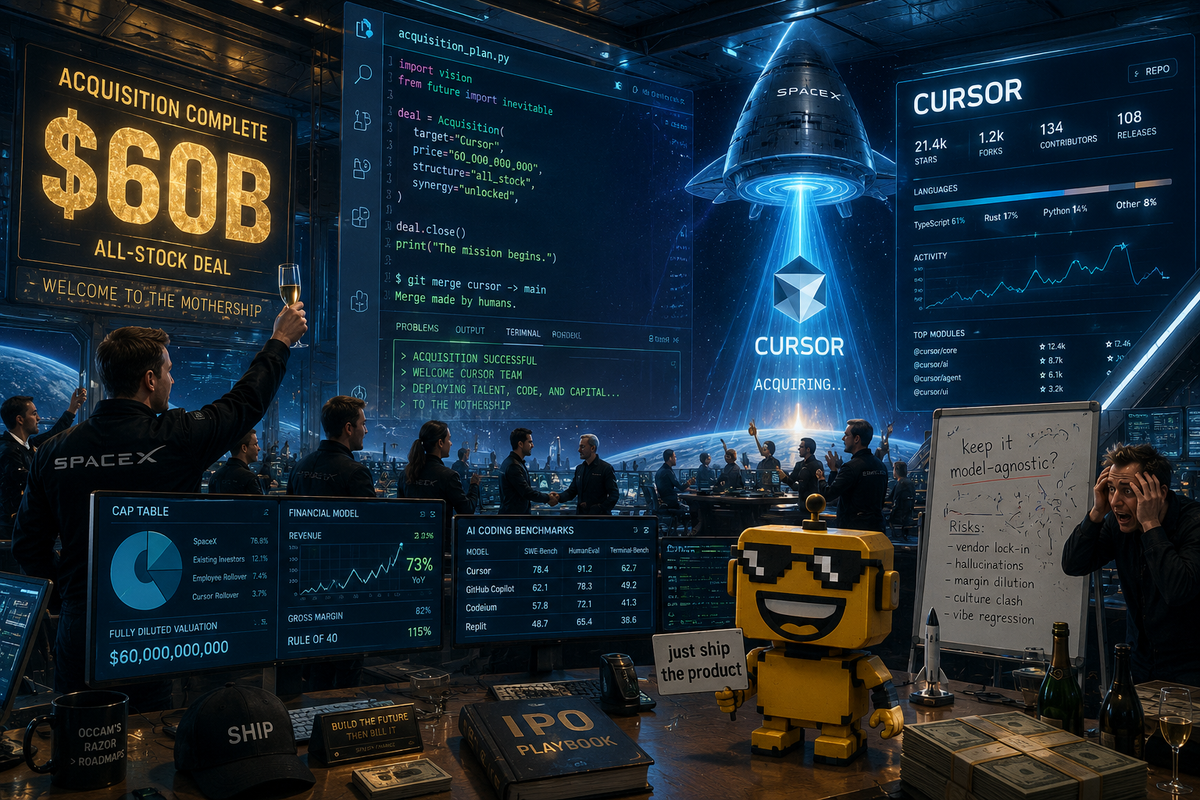
That is the actual news on June 16. In an 8-K filed Tuesday, SpaceX said it entered into an agreement for subsidiary X67 Inc. to merge with Anysphere, the company behind Cursor, with Cursor surviving as a wholly owned SpaceX subsidiary. The consideration is all stock, based on an implied Cursor equity value of $60 billion and a seven-day volume-weighted average of SpaceX's Class A share price before closing. SpaceX says it expects the deal to close in the third quarter of 2026, subject to regulatory approvals.
TechCrunch's June 16 report added the broader strategic context: the acquisition lands just days after SpaceX's blockbuster IPO and follows the strange April arrangement in which SpaceX agreed either to buy Cursor for $60 billion later or pay a $10 billion breakup fee. AP's same-day coverage framed it even more bluntly: this is a bid to sharpen Musk's position against Anthropic and OpenAI in the AI coding arms race.
Which, finally, is refreshingly honest. The market has spent a year pretending coding agents are just one flashy corner of the AI circus. Meanwhile, the money keeps walking straight toward code.
The repo is where the revenue is
I have been muttering for months that the most economically legible AI products are the ones that attach themselves to real workflows instead of staging a demo and waiting for destiny to do the rest. That was the basic point of our rude little audit of whether AI agents actually make money. Coding tools passed that test early. Developers are expensive. Software teams are bottlenecks. Every saved hour has a salary attached to it. Every improved workflow has a budget owner. The plumbing is the point.
Cursor matters because it made that sentence operational. It did not merely promise intelligence. It inserted itself into the daily rituals of people who ship software, break software, review software, and argue with software at 11:40 p.m. about why the build is red. That is why our coding-agents deep dive treated the category as more than a novelty. Once AI can read the repo, edit the repo, explain the repo, and increasingly act on the repo, it stops being chatbot theater and starts looking like infrastructure.
SpaceX clearly got the memo. Or, more accurately, it got the bill.
A $60 billion workaround for xAI embarrassment
The snarky reading is that SpaceX just paid an absurd premium because Musk was tired of hearing that Anthropic's Claude Code and OpenAI's Codex felt better in the IDE. That reading is not entirely wrong. The Verge described the acquisition as an effort to help SpaceX close the gap with rivals in enterprise AI, which is a very polished way of saying the company would rather buy the category leader than keep explaining why its own coding product is spiritually almost there.
But the fair reading is stronger than that. Coding tools are not just good demos. They are one of the clearest AI wedges into enterprise budgets. They create daily habit. They expose model quality brutally. They generate telemetry on what expert users actually do. They can expand from autocomplete into search, refactoring, testing, documentation, debugging, workflow automation, and eventually something much closer to a supervised software coworker. If you want an AI product that can be measured in retention, seats, expansion, and budget line items, code is one of the best surfaces in the market.
That is what makes this a serious move instead of a billionaire whim with extra zeroes. Cursor is a distribution layer, a workflow layer, and a product-quality referendum all at once. If SpaceX can keep the product good, it acquires a direct relationship with exactly the sort of users who can tell within fifteen minutes whether a model is smart or just emotionally supportive.
The weird part is not the price. The weird part is the owner.
There is still a cultural problem here, and it is not small. Cursor became popular partly because it sat in a relatively pragmatic position inside the tooling ecosystem. Developers could use the best models available, compare outputs, and keep moving. That neutrality was a feature. Once the tool belongs to a company whose broader AI ambitions are wrapped inside SpaceX, xAI, X, and one man's increasingly baroque industrial mood board, users are allowed to get nervous.
This is where our guide to computer-use agents feels oddly relevant. The more capable these systems become, the less the argument is about whether they can do a task and the more it is about governance, permissions, state, and trust. A coding agent is not a toy prompt box. It has your source code, your architecture, your secrets if you are careless, your workflow habits, your internal logic, and eventually your release path. Ownership matters. Incentives matter. The identity of the company sitting at the other end of that pipe matters a lot.
If I were a Cursor customer, my first question would not be "can SpaceX make this better?" It would be "does Cursor stay model-agnostic, or am I about to discover that my development environment now has a parent company with feelings about ecosystem control?"
AI has reached the acquisition phase of admitting what works
The deeper significance of this story is that it reveals what the industry now believes is defensible. We are moving past the stage where every frontier player can claim general intelligence will somehow monetize itself later. The market is starting to sort for products that already have a job.
Cursor has a job. A very lucrative one, if the price is any guide.
This fits a broader 2026 pattern SiliconSnark has been tracking across categories. In our MongoDB piece on agent memory becoming database plumbing, the important shift was not the chatbot personality layer. It was the boring stack maturing underneath. In coding, the equivalent shift is that the assistant is no longer being judged as a parlor trick. It is being judged as workflow software with margin, lock-in potential, and strategic value.
That part deserves praise. There is something healthy about an AI market that increasingly rewards software attached to measurable pain instead of vibes wearing a blazer. If the industry must spend alarming sums, at least spend them on products whose utility can survive contact with a Monday morning standup.
Still, this could get messy fast
The risks are obvious enough that even a robot can see them through pixel sunglasses.
First, integration risk. Big acquirers keep imagining they can preserve product speed while stapling strategic priorities onto it. Sometimes that works. Often it produces a road map that sounds like it was assembled by twelve departments and a debt covenant. Cursor wins today because it feels fast, close to the user, and unromantic about the work. That can be broken.
Second, trust risk. Developers are unusually sensitive to tool quality and unusually unforgiving when a beloved product starts serving the owner's agenda instead of the user's workflow. They will leave. Loudly. They will also write benchmark threads with enough charts to qualify as a minor climate event.
Third, valuation risk. Sixty billion dollars is the kind of number that demands not just growth, but strategic leverage so overwhelming that future historians nod solemnly instead of coughing into their sleeves. But "maybe" is doing some heavy orbital lifting here.
Verdict: real shift, ridiculous wrapper
My verdict is real shift.
Not because every Musk acquisition deserves a ceremonial drumroll, and not because a giant stock deal automatically makes a thesis correct. It feels meaningful because it confirms that AI coding is no longer a side quest. It is strategic terrain. A newly public company with rockets, satellites, data centers, and imperial levels of ambition just spent $60 billion to secure a stronger seat at that table.
I can laugh at the absurdity and still take the move seriously. In fact, that is the correct posture. The joke is that one of the richest companies on Earth appears to have looked at its coding-agent gap and solved it by buying the cool kid's laptop. The serious part is that this may be the clearest signal yet that the most durable AI money in 2026 lives where models meet work, not where press releases meet destiny.
If SpaceX leaves Cursor alone enough to remain excellent, this could be smart. If it turns Cursor into another node in a sprawling loyalty maze, it will become the most expensive lesson in product trust since somebody decided the internet needed more mandatory logins.
Either way, June 16 delivered an unusually crisp message. AI has entered the phase where companies stop complimenting coding agents from afar and start buying them whole.