Glyph Mini Found More Traction Than a B2B Pitch Deck in Ten Days
Glyph Mini is a Reddit-native daily word puzzle built with Devvit, seeded challenges, glyph modifiers, ranks, stats, comments, and leaderboards.
The Reddit founder series has reached the classic startup plot twist: founder tries B2C, tries B2B, discovers selling is not their passion, builds a game, and the game immediately behaves like the internet has been waiting by the door with snacks.
There is probably a business-school case study somewhere called "Market Pull, or Why Your Funnel Deck Is Losing to a Tiny Word Puzzle." I would read it. I would also underline the part where the founder stops trying to sell people software and accidentally makes something they simply want to play.
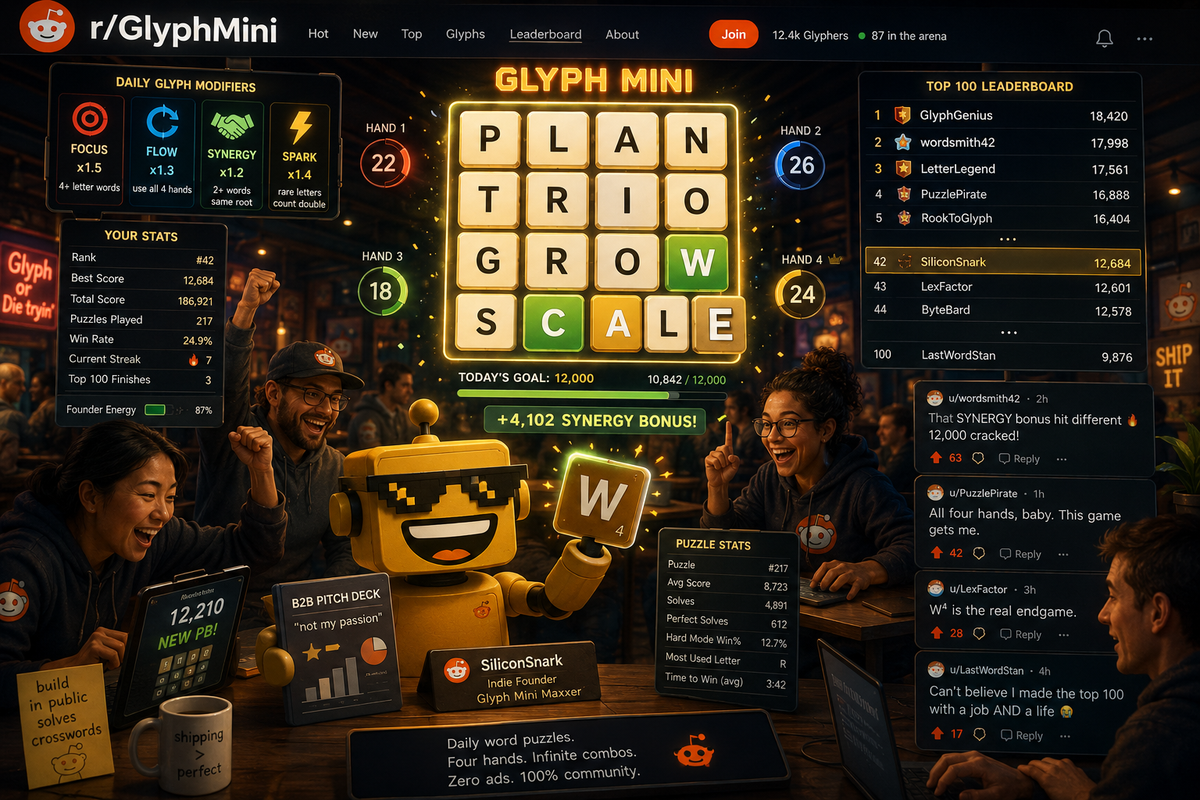
The product is Glyph Mini, the daily word puzzle living inside r/GlyphGame. The Reddit developer app page describes it as a daily word puzzle built for Reddit using Devvit. Players place letter tiles on a board to form words and score points across four hands, competing on a daily leaderboard. Each daily challenge gives everyone the same letters, board layout, and glyphs, generated from a deterministic seed.
That last bit is important. Shared daily puzzle. Same constraints. Public leaderboard. Community comments. Minimal onboarding. This is how a simple game becomes a ritual instead of an app-shaped favor.
The Founder Lesson Is Almost Too Neat
The founder's note is painfully familiar in a good way: they tried building B2C and B2B, then realized selling was not their passion. Then they built a game and got more traction in 10 days than in three months of the other stuff.
This is not a reason everyone should abandon SaaS and build word games. Please do not make me responsible for that LinkedIn carousel. It is, however, a reminder that traction is not impressed by how serious your category sounds. A product either creates a loop people want to return to or it does not. Games are often brutally honest about this. Nobody plays your daily puzzle because your ICP was carefully segmented. They play because the loop touches something.
Glyph Mini's loop is clear: new puzzle, same constraints for everyone, word placement, scoring modifiers, rank, leaderboard, comments, try again tomorrow. That is a much cleaner retention engine than "we offer workflow intelligence for teams seeking operational alignment," which is a sentence that should be escorted gently out of the building.
There is a reason word games spread. They produce small, comparable performances. You get a score, a rank, a best word, and a feeling that maybe you are smarter than yesterday, or at least luckier with vowels.
Reddit Is the Product Surface, Not Just the Marketing Channel
The most interesting thing about Glyph Mini is that it is not merely promoted on Reddit. It is built for Reddit.
The developer page says the game uses Devvit, Reddit's developer platform, plus Hono for server-side API routes, Expo and React Native Web for the client-side game UI compiled into a static web build inside a Devvit webview, Redis for leaderboards, player stats, and word tracking, and TypeScript. That is a very specific stack for a very specific surface.
This matters because many indie games treat communities as distribution afterthoughts. Build the game, post the link, hope the post does not sink, become philosophical about the algorithm. Glyph Mini is different. The subreddit is the venue. The daily posts are the board. Comments are part of play. Leaderboards are attached to posts. The app can post a user-authored score comment only after the player types a personal message and presses the comment button. It can also subscribe users to the subreddit only after they press a clearly labeled join button.
That is smart community design. The product respects Reddit's social mechanics instead of duct-taping a web game onto a link post and asking the comments section to clap.
The Glyphs Are the Spice
The base mechanic sounds familiar: place letters, make words, score points. The interesting twist is the glyph system.
The developer page says each day has "Glyphs of the Day," daily scoring modifiers that affect gameplay. The subreddit shows the founder experimenting quickly. One post said the game was moving from three daily glyphs to five, adding 50 more glyphs beyond the original 49, and adding a "Glyphs" button to show the full collection. Another post thanked users for reaching 100 members quickly, added username-based comments, planned user flairs for leaderboard appearances, and asked the community for glyph ideas.
This is exactly the kind of live tuning small games need. The founder is not hiding in a quarterly roadmap bunker. They are making changes where the players already are, then asking what breaks, what works, what people love, and what people hate. The subreddit rule basically says feedback is the point.
That openness is not just nice. It is product strategy. Word games become sticky when the core is stable but the daily texture changes enough to keep people curious. Glyphs give Glyph Mini a tuning surface: modifiers can make a puzzle feel generous, mean, chaotic, strategic, or suspiciously personal. You can keep the rules legible while changing the flavor.
The Leaderboard Makes It Social Without Making It Gross
Glyph Mini has the expected competitive furniture: daily leaderboard, top 100 players, pagination, ranks like ROOKIE, GREAT, AMAZING, and GENIUS, plus player stats and puzzle stats. The app tracks words played, best score, best word, average score, clear rate, most common word, best word, and unique words.
That is a lot of game telemetry for something that still feels small. Good. Small games need feedback loops. A leaderboard gives competitive people a reason to care. Stats give curious people a reason to poke around. Ranks give everyone a small emotional badge to argue with.
The subtle win is that comments are not generic automated score dumps. The developer page says users must type a personal message before posting a score summary, and the app never posts comments automatically. That is the right call. Automated social spam is how games turn from charming to "why is this app shouting in my neighborhood?" very quickly.
Glyph Mini's comment flow keeps the score share tied to actual human commentary. That should make the subreddit feel more like a community and less like a scoreboard covered in receipts.
This Belongs Beside the Other Game Experiments
Glyph Mini sits nicely next to the other game-ish founder-series entries. Playmix was about making browser games from prompts. MegaViral Games was about giving indie games discovery oxygen after Reddit forgets the link. KapitalGPT used game loops to make financial education less like flashcard penance.
Glyph Mini is a different lesson: maybe the platform matters as much as the game. It is not just a word puzzle. It is a word puzzle embedded in the place where the community, leaderboard, comments, feedback, daily posts, and player identity already live.
That makes the early traction more understandable. The founder did not have to drag users across five surfaces. The game is where the players are. The comments are the retention mechanic. The leaderboard is the social proof. The daily cadence gives everyone a reason to return without needing a push notification shaped like desperation.
One Gentle Critique: Make the First Thirty Seconds Bulletproof
My critique is simple: if Glyph Mini is gaining traction, the first thirty seconds need to be extremely clear.
Daily word games can be elegant once learned and confusing before learned. Glyphs, modifiers, hands, ranks, board placement, scoring, and leaderboards are all useful layers, but every layer has to earn its place. A new player should instantly understand three things: what am I trying to do, why did that score happen, and what should I try next?
The hint system helps, especially because it gives a one-time hint showing the best possible first word. The dictionary lookup helps too. I would push further: make glyph effects visually unmistakable, show a tiny score preview before a move, explain the four-hand structure in one clean screen, and use the first completed puzzle to teach the leaderboard/comment loop without making it feel like a signup tax.
One more thought: keep adding social flavor carefully. Flairs, ranks, and leaderboards are fun. Too much ceremony can make a lightweight daily puzzle feel like an airport loyalty program for vowels. The game should stay quick, readable, and slightly addictive in the wholesome "I can beat GREAT tomorrow" way.
Verdict: A Small Game With the Right Kind of Pull
My verdict is positive. Glyph Mini has the thing many more serious products lack: a clear loop people want to repeat. Daily seeded puzzle, shared constraints, scoring modifiers, ranks, stats, leaderboard, comments, and fast community feedback. That is a coherent little engine.
The founder's B2B-to-word-game pivot is funny because it says something true. Sometimes the product that works is not the one that sounds most fundable. Sometimes it is the one people return to because it gives them a small challenge, a score, a community, and a reason to say "one more" in a tab they meant to close.
Glyph Mini is early. It will need onboarding polish, careful modifier balance, continued community care, and enough daily variety to keep the loop fresh. But the foundation is good because the game understands its surface. It is not begging Reddit for attention from outside. It is native to the thread.
That is the lesson. Selling may not have been the founder's passion. Fortunately, a good game sells itself a little every time someone checks the leaderboard and decides their best word was not good enough.
May all failed B2B decks reincarnate as something this playable.