Even Realities Raised $150 Million to Put AI on Your Face Without Filming Everyone
Even Realities raised $150 million for camera-free smart glasses. The privacy-first pitch is smart. The face-computer trust problem is still very real.

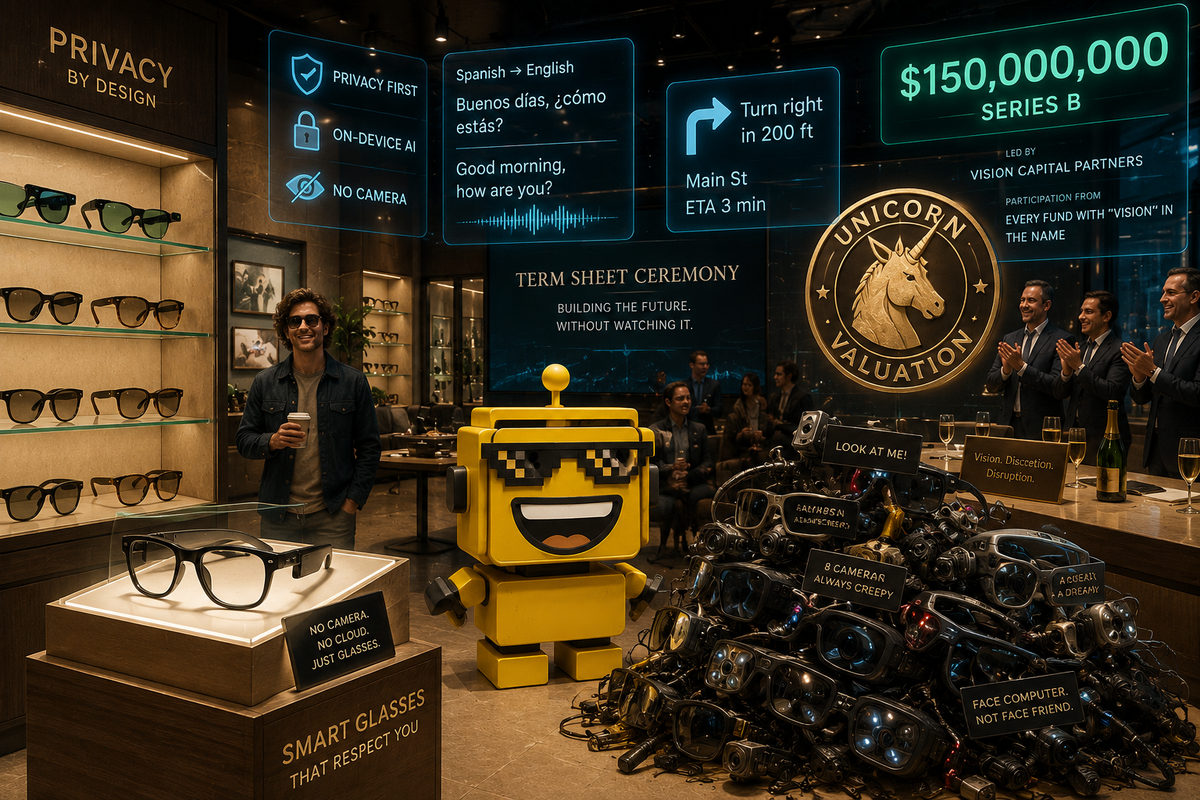
The easiest way to stand out in smart glasses right now is to strap more cameras to a face and call it the future. Even Realities looked at that industry instinct, removed the camera, and was rewarded with a $150 million pre-Series B round published July 6 by TechCrunch. Meituan led, Tencent joined, the valuation hit $1 billion, and the Shenzhen startup says the money will go toward its next-generation smart glasses platform, deeper AI integration, global expansion, and faster product development.
This is technically a pre-Series B, which is a beautifully unserious label for a company taking in $150 million at unicorn status. In practical terms, it already behaves like a much more mature hardware-platform story: ex-Apple founders, shipped products, U.S.-heavy customer demand, a live developer portal, and a category pitch aligned with the broader logic I laid out in SiliconSnark's guide to the face computer wars. The market is no longer asking whether smart glasses exist. It is asking what kind of social contract they require.
The Anti-Meta Pitch Has Entered the Boutique
Even's core bet is refreshingly blunt. Meta, Snap, and much of the industry keep treating smart glasses as some combination of camera, assistant, and lifestyle accessory. Even is arguing that plenty of people want the assistant and the lightweight display without inviting every coffee shop around them to wonder whether they are being accidentally turned into B-roll.
That is not a fake distinction. It is the entire thesis.
Founder and CEO Will Wang told TechCrunch that smart glasses may become the most personal computing device people wear, which is the sort of sentence that usually precedes either a platform shift or a Senate hearing. His company has chosen the less chaotic path, at least on paper: no camera, no recording hardware, and a product centered on seeing messages, navigation, translation, prompts, and contextual information directly in the user's line of sight. If Meta's latest glasses doubled down on the camera problem, Even is trying to turn restraint into a feature.
The interesting part is that this does not sound like abstinence marketing. It sounds like segmentation. There are people who want capture glasses. There are people who want display glasses. There are people who would rather wear a quiet productivity device than a tiny documentary crew. Even is going after that third group with the confidence of a company that has spent time around both optics engineers and etiquette.
The Hardware Is Already Wearing Adult Clothes
This is also not a vapor round for a concept render and a dramatic font choice. Even's G2 glasses already sell starting at $599, with prescription options and the usual tasteful upsell path that says, yes, your future interface can also become a mildly expensive eyewear habit. The company positions the product as everyday glasses with a built-in heads-up display, not a helmet for people who want to alpha-test civilization.
More importantly, Even is already acting like a platform company. Its developer docs describe the G2 as dual micro-LED smart glasses with a four-mic array, touchpads on both temples, and support for widgets, dashboards, and AI skills. That matters. Startups love to say they are building an ecosystem when what they really mean is that they have one API and a Discord full of optimism. Even at least appears to be doing the less glamorous work of tooling, onboarding, and product surface definition.
Why the Giant Check Actually Makes Sense
The cynical reading is obvious: another hardware startup raised a giant round because investors lost object permanence around AI and now want the next post-phone platform at any cost. Public markets have believed dumber things. But there is a more coherent case here.
First, the category itself is no longer tiny. IDC said the global smart-glasses category surged 167% year over year in Q1 2026 to about 2.25 million units shipped, with 2026 revenue expected to reach $5.1 billion. That is still early, but it is early in the way ride-sharing was early once everyone could already see the cars. The face computer has moved from punchline to measurable market.
Second, Even is choosing a lane with real strategic clarity. The company is not outgunning Meta on social capture, brand partnerships, or celebrity frame distribution. It is trying to own the "useful without being creepy" tier. That looks smarter every time a competitor launches something flashy and reminds people that living next to a camera is socially exhausting. It also rhymes with Google's more practical recent glasses pitch.
Third, the underlying engineering is hard in exactly the right way. Wang's argument to TechCrunch was that optics, not just generic AI software, is the differentiator. That sounds correct. A lot of startups can bolt a model onto a product. Far fewer can solve comfort, battery, display legibility, frame weight, and all-day wearability while also making the software feel coherent. The plumbing is the point. Investors throwing $150 million at this are not just buying "AI glasses." They are buying the hope that integrated optics plus privacy plus distribution can become a real moat before the giants smooth out their own awkwardness.
What Still Feels Expensive, Delicate, and Socially Weird
Now for the adult supervision portion of the program.
$150 million is a lot of money to spend proving that a device on your face can become normal. Hardware rounds this large are partly about ambition and partly about how painfully material reality remains. Optics, manufacturing, global expansion, developer tooling, support, firmware, retail, and channel partnerships all cost real money. A giant round can signal breakout potential. It can also signal that the company has volunteered to fight physics, fashion, and margins at the same time.
There is also the category trap. A privacy-first no-camera design is elegant, but it limits some of the most immediately legible use cases that made Meta's glasses mainstream-adjacent in the first place. Even is betting that enough people want discreet utility more than capture. That may be true. It may also be the classic premium-hardware challenge where the product is deeply appealing to an affluent niche before it becomes a mass market.
And yes, the trust problem remains, even without the lens. Wearables close to the face still ask people to accept microphones, constant connectivity, account systems, cloud services, and an always-available software layer whispering into everyday life. We have seen adjacent versions of this tension in other wearables that make the future feel equal parts useful and intimate. Removing the camera lowers the weirdness tax. It does not erase it.
Verdict: Serious Breakout Energy, With a Very Expensive Manners Lesson
My verdict is that Even Realities looks less like a gimmick and more like a serious breakout candidate in a market that is finally developing adult contours. The company has a coherent thesis, a differentiated product stance, real platform signals, and the good taste to recognize that not every computer needs to behave like a narc.
Still, this is not a calm little hardware story. It is a capital-intensive bet that the next important interface can be both ambient and socially survivable. That is a harder product brief than "put AI in glasses" makes it sound. If Even gets it right, it could become the smart-glasses company for people who want assistance without spectacle. If it gets it wrong, it will become another exquisitely engineered reminder that face computers do not fail because the demos are bad. They fail because daily life is a harsher product reviewer than venture capital.