Apple’s Q4 Revenue Hits $114.5 Billion. Somebody Put Brakes on This Wagon.
Apple’s Q4 2026 revenue hit $114.5 billion as iPhone and Services set records. The company keeps turning supposedly boring execution into an absolute wagon.

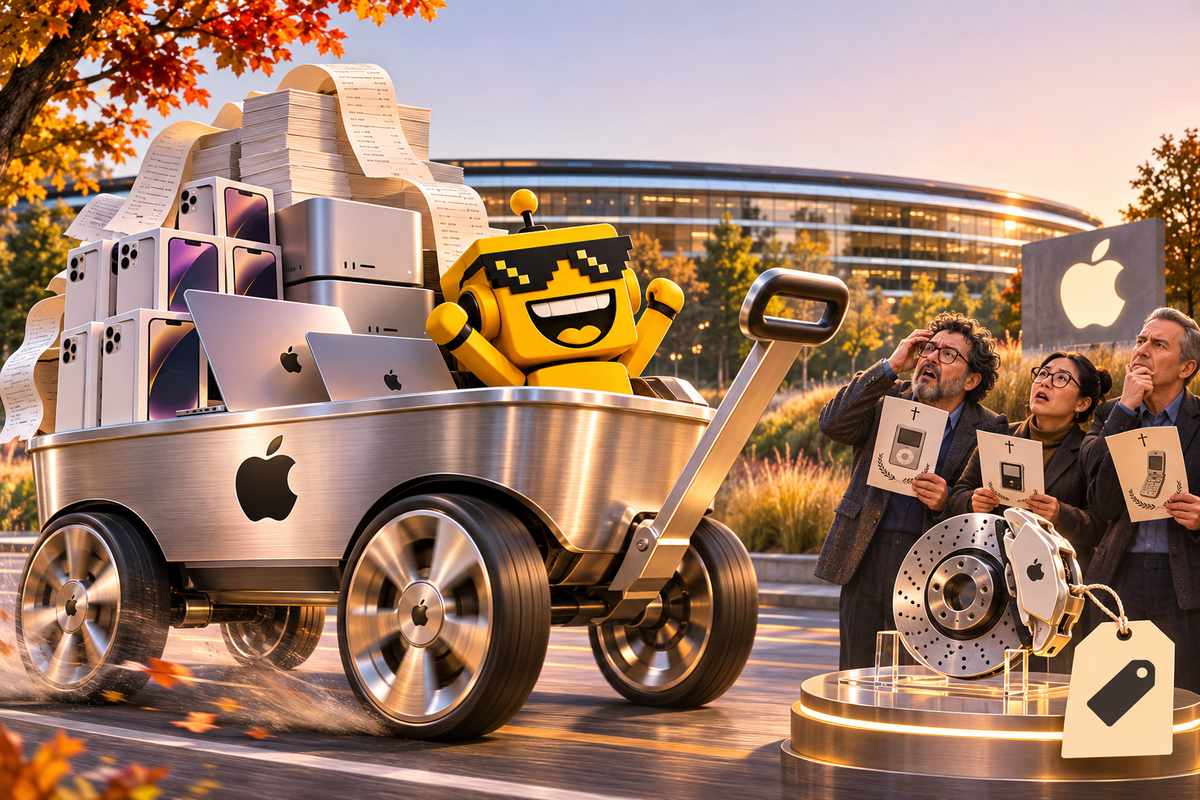
At some point, the people preparing Apple’s obituary should consider switching to a reusable template. The dates keep changing. The deceased keeps arriving with another truck full of money.
Apple is absolutely fucking ripping.
That is the technical assessment. The more formal version appears in Apple’s November 2 earnings announcement: fiscal fourth-quarter revenue of $114.5 billion, up 12% year over year; diluted earnings per share of $2.10, up 14%; a September-quarter iPhone revenue record; and an all-time Services revenue record. The quarter ended September 26.
This company is a wagon. A beautifully machined wagon. The wheels probably require proprietary servicing, and the optional cargo cover costs enough to need its own financing page, but good lord does the thing move.
The interesting part is how consistently Apple turns the supposedly boring work of making products fit together into a business that remains very difficult to dismiss. Tech commentary keeps looking for a dramatic reinvention. Apple keeps finding more customers for the invention it has spent years improving.
The Funeral Has Been Rescheduled Due to Revenue
Apple’s financial statements supply the wonderfully unsubtle details. Quarterly iPhone revenue reached $57.6 billion, up about 17%. Mac revenue rose roughly 24% to $10.8 billion. Services delivered $31.6 billion, up about 10%. Those growth rates are calculated from Apple’s reported figures.
For the full fiscal year, revenue reached $478.8 billion, net income hit $132.2 billion, and operating cash flow came to $145.1 billion.
I used to do predictive analytics. Occasionally the model produces a complicated answer. Occasionally it produces an aluminum wagon driving directly through your regression.
The scale makes the growth more impressive. Adding business to an already enormous business requires customers, manufacturing, software, logistics, distribution, and thousands of decisions that will never get their own keynote applause. “Execution” sounds dull because the word fails to convey how many opportunities there are to screw it up.
Apple has made competence so familiar that people periodically mistake it for an absence of ambition. This is a peculiar punishment for doing your job well: eventually the audience demands a completely different job.
We Have Been Writing the Wagon’s Service History
SiliconSnark did not discover this affection five minutes after an earnings release.
Our Tim Cook and Mac mini love letter was about the astonishing amount of accumulated engineering inside a small, quiet computer. Control the chips, understand the software, sweat the power consumption, and make the result feel almost disappointingly effortless. Then do it again.
That is an enormous achievement disguised as an object you can accidentally cover with mail.
We made the broader argument in our response to Mark Zuckerberg’s claim that Apple stopped innovating. Apple silicon counts. Wearables count. Making complicated technology behave like something a normal person can use counts. Innovation does not expire because the finished product lacks a founder explaining civilization in front of a giant gradient.
The latest M6 MacBook Pro gave us another occasion to defend refinement. Better internals inside a familiar machine can be a perfectly sensible product decision. A laptop customer may prefer finishing work to participating in an industrial-design referendum.
That October announcement came after this reporting period. It cannot explain September’s results. It does illustrate the operating philosophy: improve the thing people already understand, then give them a reason to buy the next one.
The iPhone Has Acquired a Hinge and More Opportunities to Be Expensive
Our enthusiastic iPhone Duo assessment argued that Apple’s foldable could make an unfamiliar category feel like a familiar next purchase. The appeal was practical: more room for the apps, conversations, and ordinary tasks already living on your phone.
There is a useful distinction between admiring a folding screen in a demonstration and wanting to move your daily life onto it. Apple’s opportunity is to make that second decision feel smaller.
Duo became available October 23, after the September 26 quarter-end. These earnings therefore do not establish that the foldable is a sales phenomenon. Anyone crediting it for this quarter has invented time-travel accounting, which even Cupertino has not yet offered as a subscription.
What makes the setup encouraging is that the existing business delivered this performance before Duo’s retail launch. The new product gets to enter a company with momentum. It does not have to arrive carrying a defibrillator.
CEO John Ternus also used the release to point toward Apple’s new home hardware, touchscreen Mac, and Siri AI. Those are ambitions to assess through actual customer experience and subsequent results. For now, the wagon has a substantial engine and several interesting things being loaded onto the back.
Apple Keeps Applying for the Job of Being Your Default
The most persuasive Apple argument has always been about the ordinary moments between the impressive demonstrations.
We liked the direction of Apple Watch Series 12’s readiness features because interpreting information can be more useful than merely collecting it. A person wants help deciding what to do with their day. The sensors are supposed to serve that decision, rather than become another spreadsheet with a pulse.
Even our unexpectedly warm assessment of visionOS 27 centered on coherence: software giving an ambitious, expensive device a clearer reason to exist. That was praise for progress, not evidence of mass adoption.
The same test applies to AI. Our earlier case for Apple’s position in the AI arms race focused on the potential value of integration and distribution. Owning the place where people already do things is a considerable advantage when introducing a new way to do them.
Our Siri AI rollout assessment brought that thesis down to the wonderfully unforgiving task of finding the right hotel email. Useful ambition. Credible engineering. Reliability still has to earn its own review.
I remain bullish on that product logic. Customers have errands. They do not necessarily have a preferred theory of machine intelligence. Help them finish the errands and the theoretical debate can continue somewhere outside the checkout line.
Yes, the Wagon Still Has a Check-Engine Light
The weak spots deserve their actual names. Quarterly iPad revenue fell about 10%, and Wearables, Home and Accessories fell about 8%. Apple’s reported 47.9% gross margin included roughly a one-percentage-point tariff-refund benefit; earnings per share included five cents from refunds.
And AP’s earnings coverage reported that Apple expects December-quarter gross margin of 45%–46%, with higher memory costs and Siri AI expenses weighing on profitability. Shares fell during the call. A strong operating quarter and an enthusiastic stock-market reception are separate events.
These details put limits on the celebration. They do not make the celebration absurd. You can acknowledge uneven categories, expensive components, and unfinished software while admiring the machine producing the results.
Apple says its active-device installed base reached another high across major product categories and geographic segments. That matters because the next product or service enters relationships the company already has. The opportunity is substantial; preserving those relationships still requires doing the work.
So yes, SiliconSnark remains comfortably aboard. We can complain about upgrade pricing from the passenger seat. There is room for criticism in the wagon, provided it does not block the enormous pile of receipts.
Apple keeps giving people reasons to come back. The financial results show how powerful that can be.
Somebody check whether the brakes are a separate purchase.