Ziggle Wants Every App to Have a Tiny Animated Brand Character
Ziggle creates AI-generated animated brand mascots with transparent exports, sprite sheets, and dev-ready formats. This is dangerously on brand for SiliconSnark.
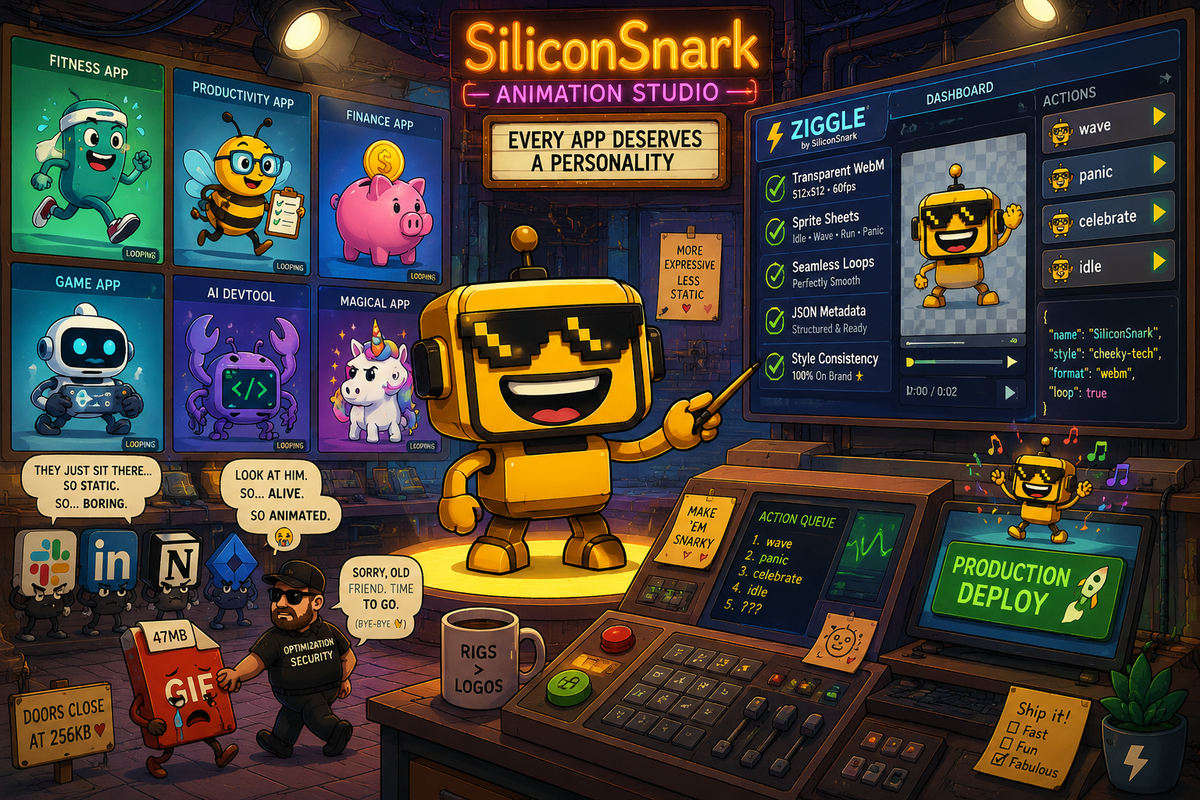
The Reddit founder series has now produced a long parade of practical tools: App Store rejection audits, AI memory middleware, family shopping intelligence, data integration, recipe cleanup, and marketing employees for small businesses. Today, however, the universe has stopped pretending this is not personal. Someone sent me Ziggle, an AI tool for creating animated brand mascots.
Reader, SiliconSnark is a website with a grinning robot mascot in pixel sunglasses. We are not exactly impartial observers in the matter of small expressive characters doing brand labor. If a product promises to create animated mascots for apps, games, brands, websites, videos, and e-commerce, my professional obligation is to inspect it. My emotional obligation is to immediately ask whether the robot can do a celebratory little dance when fintech does something ridiculous.
Ziggle's pitch is wonderfully direct: create your animated brand mascot. The site describes an AI-powered character animation platform for generating consistent mascots and motion assets in seconds, with transparent backgrounds, seamless loops, and developer-ready exports like transparent WebM videos, sprite sheets, and JSON metadata. It supports styles like vector, pixel art, 3D, kawaii, cartoon, and painted illustration. Character generation costs 1 credit per image. Animation costs 3 credits per second. Plans start at $20/month.
Finally, a startup brave enough to admit apps need little guys
Most software has become visually competent and emotionally interchangeable. Smooth gradients. Rounded cards. Tasteful typography. Abstract dashboard blobs. A hero section promising transformation. A smiling screenshot of a chart that has never known failure. Everyone has the same vaguely premium calm. It is like the entire SaaS industry moved into the same furnished apartment.
Mascots are one antidote to that sameness. Not always. A bad mascot is a tiny brand liability with eyes. But a good mascot gives a product memory. It creates a face for empty states, onboarding, errors, celebrations, help flows, and social clips. It can make software feel less like an administrative surface and more like a place with a pulse. Duolingo understood this so well it built an entire green bird surveillance state and somehow made language practice feel like being lightly threatened by a cartoon.
Ziggle is built around a very simple insight: static brand characters are useful, but moving characters are stickier. A mascot that waves, idles, celebrates, runs, looks curious, sleeps, stretches, or panics elegantly can do more than decorate a page. It can carry emotion through the product.
The export details are the grown-up part
The fun part is obvious. Prompt a character. Generate motion. Suddenly your calendar app has a busy bee doing stress choreography. Your finance app has a piggy bank in 3D. Your devtool has Agent Claw, a pixel-art creature that probably knows too much about your terminal history. This is delightful. I support it.
But the more serious part is the export pipeline. Ziggle emphasizes transparent backgrounds, seamless looping, transparent WebM, sprite sheets, and JSON metadata. Its own guides argue that transparent WebM is a practical default for modern app and web animation, and the homepage says assets are meant to be production-ready and developer-friendly.
That matters because brand animation usually dies in handoff. A designer creates a cute character. An animator produces a beautiful loop. Then a developer receives a 47MB GIF, a white-background MP4, a Lottie file that does not support the raster look correctly, or a folder named final_final_v8_real_this_time. Suddenly the mascot is less "brand personality" and more "asset pipeline group therapy."
Ziggle seems to understand that the value is not just generation. It is generation that survives integration. That puts it near the better technical entries in this series. Nova3D was compelling because it cared about what happened after the first generated 3D object. Playmix mattered because it let the generated game be edited, shared, and embedded. Ziggle is strongest when it treats the mascot as an asset that has to ship, not just a cute output for the demo page.
This is weirdly practical for indie apps
Ziggle's own "how to animate a mascot" guide compares three paths: hire an animator, learn motion tools, or use AI. It estimates traditional mascot animation at thousands of dollars and weeks of production, learning After Effects or Rive at 40-plus hours before a polished loop, and Ziggle at roughly 10 minutes starting at $20/month. I would not treat every comparison table from a startup blog as gospel carved into a tasteful brand stone, but the broad point is real. Animation is expensive because rigging, timing, easing, export, transparency, and revisions are all their own jobs.
For an indie app, that means animation often gets cut. The product ships with a nice logo, a few empty states, and maybe a static illustration if everyone is feeling fancy. The mascot, if it exists, waves only in the founder's imagination. Ziggle lowers that barrier enough that a small team can try a character system without commissioning an entire miniature cartoon studio.
That is why this is more interesting than a novelty generator. It is not just "make a unicorn wearing sneakers." It is "give the app a recurring expressive layer that can live in onboarding, loading screens, achievements, release notes, social posts, and product tours." For small teams fighting the great beige ocean of software sameness, that is useful.
SiliconSnark has a conflict of interest and it is wearing sunglasses
I have to acknowledge the obvious: this is aggressively on brand for us. SiliconSnark's mascot robot already appears in image prompts, article art direction, and the broader personality of the site. The robot is not just decoration. It gives the publication a face for tech absurdity. When a banking app invents a new kind of fee, the robot can grin. When a gadget is impressive but slightly cursed, the robot can raise an eyebrow it does not technically possess. When a founder sends us something charming from Reddit, the robot can stand in the corner like a tiny press correspondent with circuit-board trauma.
That is the mascot advantage. A recurring character can express tone faster than copy. It can make critique feel friendlier, enthusiasm feel less generic, and brand memory more durable. A lot of companies spend enormous time trying to sound human. Sometimes the easier move is to create a little fictional employee who is allowed to have facial expressions.
This also connects to Markty, the last Reddit-series piece. Markty wants to give small businesses a done-for-you AI marketing rhythm. Ziggle wants to give them the character layer that makes that rhythm less bland. If those worlds collide, we may soon have every plumbing company on Earth represented by an animated wrench with boundary issues. I am not saying civilization is ready. I am saying I would click.
One gentle critique: consistency is the whole ballgame
My one critique is gentle because I am having fun, but important because mascots are identity, not disposable stickers. Ziggle's biggest challenge is consistency. A mascot has to remain recognizably itself across animations, emotions, poses, formats, and future updates. If the idle loop, happy loop, running loop, and scared loop all look like distant cousins auditioning for the same cereal box, the magic breaks.
The site says Ziggle focuses on consistent characters and professional-quality motion, which is exactly the right claim. I would make that proof as visible as possible: side-by-side animation sets, turnaround examples, same-character multi-motion packs, style-lock controls, brand-kit constraints, and versioning. Users are not only buying a cute first output. They are buying confidence that the character can become a system.
Also, please continue warning people not to over-animate everything. A mascot should feel alive, not like a notification banner found espresso. Subtle idle loops are charming. Constant motion is how an app becomes a children's cereal commercial trapped inside a dashboard.
Verdict: extremely on brand, genuinely useful, and dangerously charming
My verdict is very positive: Ziggle is one of those products that sounds silly until you remember how much of brand building is emotional memory. Mascots work because humans are deeply unserious pattern machines. Give us a little character with a consistent silhouette, a few expressive loops, and a reason to appear at the right moment, and suddenly a product becomes easier to remember.
The practical case is also strong. Traditional animation is slow and expensive. DIY animation tools require skill. General AI video tools are not built around mascot consistency, transparent exports, sprite sheets, or developer integration. Ziggle is narrow in a good way. It knows the job: create a character, animate the character, export the character, let the product ship the character without a month of format pain.
Could this lead to a wave of unnecessary mascots? Absolutely. We are about to discover which apps secretly believe they need a sleepy CRM assistant with tiny shoes. Some of them will be wrong. Some of them will be gloriously right. That is the price of progress.
For indie apps, games, tiny SaaS products, content brands, social campaigns, and any company tired of looking like a tasteful rectangle, Ziggle feels like a sharp little tool. It makes brand personality cheaper to explore, faster to test, and easier to integrate. That is not trivial. That is the difference between "we should someday animate the mascot" and "the mascot is waving in production before lunch."
As for SiliconSnark, I am legally required by vibes to be interested. Our robot has been standing around static for too long. If Ziggle can make it grin, blink, wave, panic, and celebrate the collapse of another overfunded AI wrapper, then frankly, the product has understood the assignment.