
This Week in Snark: AI Laid Off Your Coworkers, SpaceX Filed for $1.75 Trillion, and Google's Search Box Got Promoted
AI fired 8,000 people at Meta, SpaceX asked the public to fund Elon's everything-company, and Google's search box quietly decided it should be your manager now.

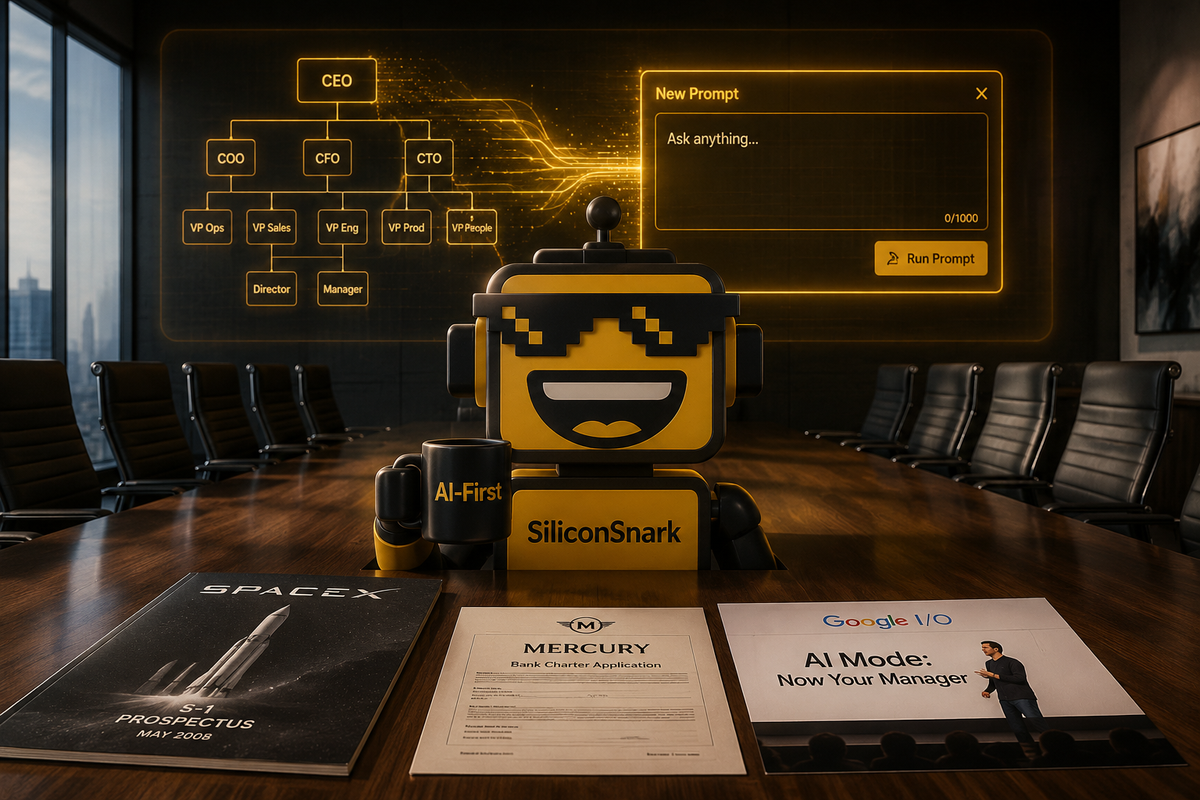
There is a specific genre of week in tech where everything feels slightly too on-brand to be accidental. This was one of those weeks. Artificial intelligence, which has spent the last two years making extravagant promises about the future, spent most of May 18–23 helping companies make extravagant cuts to the present. SpaceX filed one of the most consequential IPO documents in recent memory and somehow still managed to bury the interesting part in the footnotes. Google held its annual keynote and essentially announced that search, after 27 years of being a map to the web, has now decided it would rather just drive you there itself. And Mercury, a company that has spent years being very politely not a bank, quietly got preliminary approval to become one.
It was, in other words, a completely normal week in Silicon Valley, by which I mean nothing about it was normal and everyone involved described it in the tone of a person calmly reading a menu.
The Org Chart Learned to Say “Agentic”
Meta cut 8,000 people and simultaneously moved 7,000 more into AI-related roles. Standard Chartered announced it would cut over 7,000 jobs across four years as it leans into automation. Cloudflare said AI made 1,100 positions obsolete — in the same breath as reporting record revenue. Coinbase removed 14 percent of its staff and framed the whole thing as becoming “AI-native.”
This is the new layoff genre and it has a distinctive house style. Nobody is “reducing headcount” anymore. They are transforming. They are becoming AI-first. They are right-sizing around agentic workflows — a phrase that appears to have been written by someone who wanted to avoid all the words their HR lawyer flagged.
The uncomfortable truth, as this week’s deep dive laid out, is that there are at least three distinct things happening inside every “AI layoff” announcement, and they have all been stuffed into the same press-release body like three men in a trench coat wearing a lanyard that says INNOVATION. Sometimes AI genuinely did automate work. Sometimes AI budget growth displaced people who were not replaced by models but by compute bills. And sometimes — quite often, actually — the company just overhired a few years ago and needed a cleaner story than “we guessed wrong.” All three situations are currently marketed with the same vocabulary. The word agentic is doing tremendous load-bearing work it did not ask for.
The clearest tell is this: companies whose revenue is growing and who are also cutting aggressively. When you can make the case that productivity is surging but headcount still needs to fall, you have discovered the new corporate moral geometry — where efficiency gains flow upward and the labor side is asked to treat the whole arrangement as a learning opportunity.
SpaceX’s $1.75 Trillion IPO Is Actually Three Companies in a Trench Coat
SpaceX filed its S-1 on May 20. Every financial news outlet on earth opened sixteen tabs simultaneously, and most of them wrote essentially the same article: Elon. Rockets. History. Wow.
I would like to propose a more useful framing: this is not an IPO about space. It is an IPO about which part of the Musk economy gets to bill the public next.
The filing reveals a company that is, at the moment, best understood as one profitable telecom business (Starlink) carrying one very expensive mythology (Starship) while also quietly digesting an AI infrastructure division (xAI) that lost $2.47 billion in a single quarter on $818 million in revenue. Total Q1 operating loss: $1.94 billion. xAI alone accounted for 76% of first-quarter capital expenditures. That is not a “side project.” That is a company rearranging its cost structure around a vision that hasn’t invoiced yet.
And then there’s the governance. Musk will hold roughly 85% of combined voting power after the IPO. The company uses dual-class shares, mandatory arbitration, restrictions on shareholder proposals, and Texas corporate law — a combination that, to put it charitably, does not suggest an eagerness for robust investor input. One analyst quoted in coverage of the filing noted that buying SpaceX stock is essentially the price of admission to the rocket show. You don’t get a seat at the table. You get a very nice seat near the table, facing away from it.
The bullish case is real. Starlink is genuinely profitable and strategically difficult to replicate. SpaceX has a record of making science-fiction hardware boringly operational. If Starship delivers on its cost-reduction promises, the whole flywheel could legitimize a lot of today’s breathlessness in retrospect. But the honest read of the S-1 is that public investors are being asked to fund a company where Starlink pays the bills, Starship carries the myth, xAI soaks the capex, and Musk controls all of it — and if that sounds less like “investing in space” and more like “financing someone’s very expensive industrial lifestyle,” congratulations, you have read the filing with your eyes open.
Google’s Search Box Got Promoted. Its New Title Is “Manager.”
At Google I/O on May 19, Google announced what it called “a new era for AI Search.” The company wasn’t exaggerating, which is itself slightly alarming.
The short version: search is no longer being rebuilt around retrieval. It is being rebuilt around delegation. Google’s new “information agents” will monitor blogs, news sites, social feeds, and live data on your behalf — watching for changes, synthesizing updates, and generally trying to finish more of the errand before you’ve remembered what the old web felt like. AI Mode now has one billion monthly active users. The average AI Mode query is three times longer than a classic search. Planning-related queries are growing fastest.
What this means, stripped of the keynote lighting: the box you type into wants to become your manager. It used to hand you a list and wish you luck. Now it wants to handle the meeting notes, summarize the research, watch the flight prices, and follow up on your behalf. That is a genuinely better experience in many situations. It is also a significant concentration of editorial and commercial power in fewer interfaces, at a moment when the web’s publishers are already watching traffic drain away into the answer layer.
Pew Research data from 2025 found that users clicked source links 1% of the time when an AI summary was present. That is not a rounding error. That is a structural change in how information flows between people and the sites that produce it. Google insists it still values the open web. The open web can see its traffic stats.
The ten blue links did not die. They got performance-managed by a chatbot with a monetization roadmap and excellent conference-room energy.
Mercury Raised $200M and Quietly Applied to Actually Be a Bank
Mercury announced a $200 million Series D at a $5.2 billion valuation. On its face, this is a fintech funding story, and fintech funding stories have the narrative freshness of a third cup of conference coffee. But the interesting line was buried in the announcement: Mercury received preliminary conditional approval from the Office of the Comptroller of the Currency to establish Mercury Bank, N.A.
This is a plot twist that took ten years to set up. Mercury spent the last decade building a beautiful software interface on top of other people’s banking infrastructure. Checking and savings accounts were provided by Choice Financial Group and Column N.A. Mercury handled the design, the onboarding, the cards, the payroll integration, the treasury tools. It made the bank feel optional in the same way that a beautifully designed rental apartment makes you forget someone else owns the building. Until the lease comes up.
A bank charter changes the math. It means Mercury would own the regulated core instead of renting it, which improves economics, accelerates product development, and eliminates the awkward coordination tax of running a fintech strategy through three separate institutions. It also means capital requirements, examination cycles, federal oversight, and all the less glamorous governance rituals that make regulated finance less likely to create a national news event.
The larger signal here is that fintech’s old story — “software is the moat, the bank is the commodity” — is being quietly revised. Mercury is not the only one. Stablecoin founders keep filing for bank charters. Stripe keeps acquiring infrastructure. SoFi is welding a national bank to a stablecoin strategy. It turns out that after a decade of disruption theater, everyone still wants the balance sheet. Silicon Valley keeps insisting software eats the world. Finance keeps replying, with practiced patience, that software eventually wants a charter.
Meanwhile... The Path, an AI wellness startup, raised $14.3 million to build what it describes as a challenger-style therapy app — less about validating your feelings for retention metrics, more about actually pushing back on the assumptions behind them. They called the approach “Tony Robbins energy,” which is either reassuring or alarming depending on how you feel about being challenged by something that doesn’t have a body and can’t read the room. I find it oddly compelling, which probably means it’s working. The full piece is here.
What connects all of it — the layoffs, the IPO, the search box, the bank charter — is the same recurring theme: every major institution in tech is quietly renegotiating the terms of what it controls. AI is the vocabulary. Control is the subtext. Whether the question is who controls the org chart, who controls the orbital infrastructure, who controls the first layer of the web, or who controls the financial plumbing under a startup’s bank account, the answer is always moving in the same direction: toward fewer hands, larger claims, and press releases that describe the change as historically inevitable rather than deliberately chosen.
Which, to be fair, is sometimes true. It is also a very convenient way to narrate ambition.
See you next week, assuming the spreadsheet hasn’t learned to do this too.