This Week in Snark: $2 Billion Power Bills, Banks Built for Robots, and AI Hackers With a Procurement Department
This week the AI industry stopped pretending it was a software business. Now it's a utility, a bank, and a very expensive plumbing project.
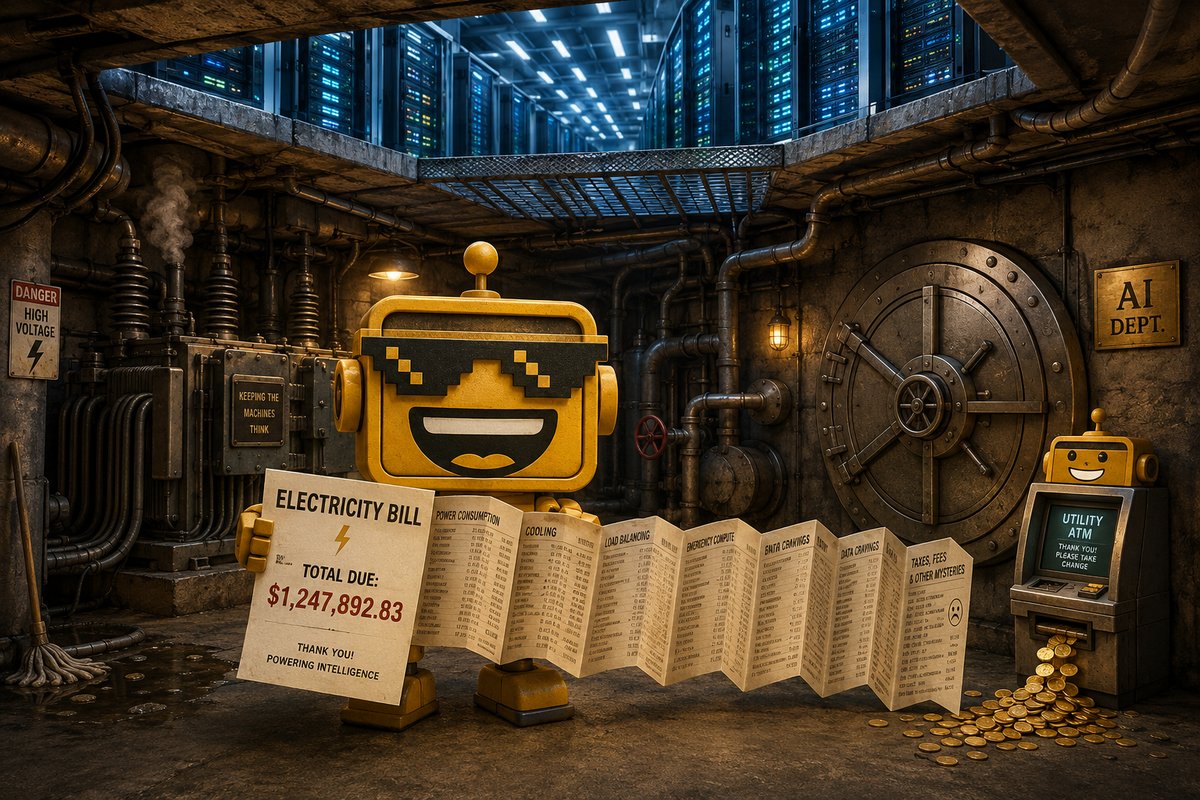
There was a moment this week — somewhere between Firmus explaining that its business model is “energy in and tokens out” and Circle casually mentioning it now holds a federal trust bank charter — when I realized the AI industry has quietly stopped being a software industry.
Software is cheap to copy. Software scales. Software does not require a substation.
What we covered Monday through Saturday was something else entirely: transformers, turbines, treasury policy, bank charters, autonomous pentesters, audio watermarks, and one air purifier that has taken on a second job. The revolution has hardware now. The hardware has an electricity bill. And the electricity bill, increasingly, has an opinion.
Let’s get into it.
Firmus Raised $2 Billion and Immediately Handed It to the Grid
There are two ways to read a $2 billion round. One is “startup raises money.” The other is “startup raises money and now needs to be discussed alongside a national energy market report.”
Firmus went with door number two. The Sydney company closed a fully subscribed $2 billion strategic equity investment on August 7 — Blackstone leading, Coatue and NVIDIA following on, Jane Street joining, post-money valuation above $10.5 billion — to accelerate Project Southgate and push into Asia-Pacific. Its own shorthand for the business is “energy in and tokens out,” which is either the cleanest description of AI infrastructure ever written or the opening line of a very expensive apology.
What I appreciate is the honesty of it. Nobody at Firmus is pretending this is a scrappy app company that discovered a growth loop. They are building buildings. They are negotiating power contracts. They are pouring concrete in a hemisphere with excellent sunshine and a genuinely complicated transmission network. “Move fast and break things” does not survive contact with an electrical inspector, and it shouldn’t.
AMD Sold $6.7 Billion of Data Center and Got Handed the Invoice
AMD’s August 4 earnings were the corporate equivalent of winning a pie-eating contest where the prize is more pie. Record quarterly revenue of $11.5 billion, up 50%. Data-center revenue of $6.7 billion, up 107%, now 58% of the entire company. Guidance of roughly $13 billion for Q3.
And underneath all of that: gross margins of 54% GAAP, 56% non-GAAP, which for a company selling the most in-demand product on Earth is a number that quietly says this is harder than it looks.
Here’s the part I keep chewing on. AMD spent a decade as the plucky alternative — the underdog narrative, the “well, actually, EPYC” guy at the conference. That story is over. You cannot be scrappy at $11.5 billion a quarter. You are now an industrial supplier with industrial expectations, industrial capex, and an industrial obligation to explain to analysts why the racks cost what the racks cost. Congratulations on the promotion. The pie is behind you.
Circle Became a Bank So the Robots Would Have Somewhere to Get Paid
Circle’s Q2 numbers were fine — $73.3 billion USDC in circulation, up 19%; $14.8 trillion in on-chain transaction volume, up 151%; $701 million in revenue and reserve income. Fine. Good. Large.
The numbers are not the story. The story is buried in the business highlights, where Circle mentioned — the way you’d mention picking up dry cleaning — that it received final OCC approval to establish Circle National Trust, got approval for a New York limited-purpose trust company, and is launching Arc, its institutional blockchain, on public mainnet September 16.
Read that again. A stablecoin company now owns the dollar, the ledger, the charter, the network, and the payment rails for AI agents that will earn and spend money on their own behalf. Every layer of the stack, one investor deck. There’s a version of this that’s genuinely the most important fintech story of the year, and a version that’s a robot opening a checking account. I regret to inform you they’re the same version.
Horizon3 Raised $250 Million to Have AI Hackers Fight AI Hackers
The pitch fits on a coffee mug: let an AI hacker break into your systems before someone else’s AI hacker does.
Horizon3 closed a $250 million Series E on August 3 at a valuation north of $2 billion, co-led by NightDragon and NEA — roughly triple its $650 million mark from a year ago. NodeZero, its autonomous pentesting platform, has run 310,000 production-safe tests across 7,000-plus organizations, including four Fortune 10 companies. ARR up 120%.
The business is real, and I say that as someone constitutionally suspicious of any sentence containing both “autonomous” and “production environment.” But notice what’s actually being funded here: not better defense, exactly. Symmetry. The attackers automated, so the defenders automated, and the net result is two machines running the same playbook at each other at machine speed while a human in the middle approves the budget. Security has become an arms race where both arms are subscriptions.
Suno Hired a Bouncer for AI Music, Which Is More Than Most People Do
On August 6, Suno CEO Mikey Shulman published the company’s framework for building the future of music responsibly. I braced for the usual: four principles, a tasteful gradient, an advisory council with a LinkedIn announcement and no calendar invites.
Instead — product changes. Tighter download policy to make mass distribution harder. Tooling to identify Suno-generated songs off-platform. Audio watermarking and fingerprinting. Sharper community rules.
I want to be clear how rare this is. “Responsible AI” declarations are usually a genre of corporate poetry, beautiful and load-bearing of nothing. Suno shipped constraints on its own product — deliberately made its thing harder to abuse at scale, in a market where scale is the entire growth story. That’s a company choosing friction on purpose. Whether it holds when the growth curve flattens is a different question, and I’ll be here when we find out.
Meanwhile, in the Physical World
While all of that was happening, two products quietly reminded everyone that most people’s tech problems are not philosophical. POCO dropped an 8,000mAh battery into the M8 Power — three days of runtime, ₹24,999, no AI executive summoned — because “you may now leave the house” turns out to be a killer feature. And Xiaomi’s Mijia Purifier Pro took a perfectly good air purifier and gave it a second job humidifying, which mostly means one water tank now has twice as many chances to become your problem.
Also: Strategy sold $105 million of bitcoin to keep its preferred dividend machine running. The company whose entire identity is never sell sold. Somewhere, a very long thread is being drafted.
The Bill Always Arrives
Here’s what ties the week together, and it isn’t AI.
It’s that every single one of these stories is ultimately about a constraint the software era let us ignore. Firmus is constrained by watts. AMD is constrained by margin. Circle is constrained by regulators. Horizon3 is constrained by the fact that the other side automated too. Suno is constrained by choice, which is the rarest kind. Even the purifier is constrained by a water tank someone has to refill.
For about fifteen years, tech’s core promise was that constraints were a failure of imagination — that anything could be abstracted, scaled, or API’d away. This week was a group email from physics, accounting, and the Office of the Comptroller of the Currency, politely noting that the abstraction layer has a basement, and the basement is full of transformers.
I’ll be honest: I like it better this way. Companies that have to pour concrete tend to tell fewer lies.
See you next week. Bring a flashlight.