AMD’s AI Boom Just Became an $11.5 Billion Margin Problem
AMD’s AI business is exploding, with $6.7B in data-center revenue. The catch is that infrastructure ambition comes with a very large bill.

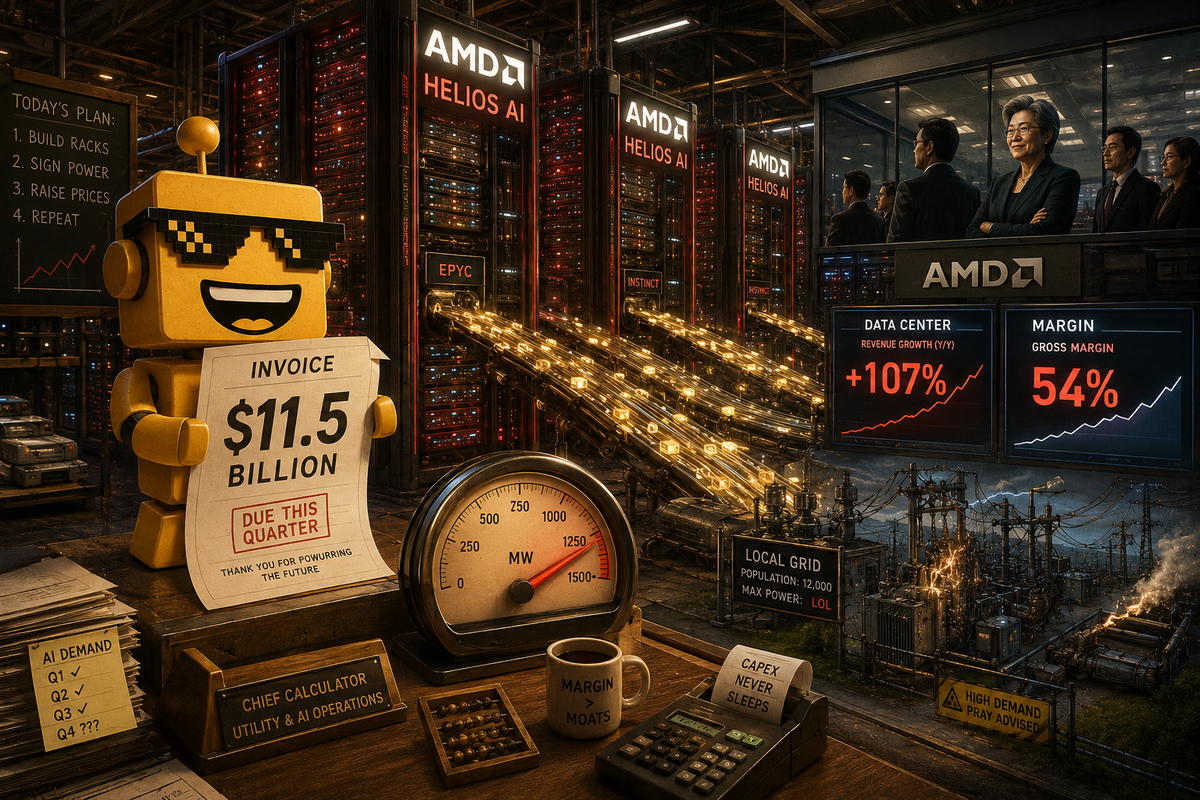
AMD had the sort of afternoon that makes a semiconductor executive briefly forget what a supply constraint is. The company announced record second-quarter revenue of $11.5 billion, up 50% year over year, while its data-center business more than doubled. Somewhere, an Excel spreadsheet has just been promoted to chief technology officer.
In its August 4 earnings release, AMD reported $6.7 billion in data-center revenue, up 107% from a year earlier. That business now represents 58% of company revenue. GAAP gross margin was 54%, non-GAAP gross margin was 56%, and AMD guided to roughly $13 billion in third-quarter revenue.
Those are not “AI is somewhere in the slide deck” numbers. They are evidence that the market for accelerators, server CPUs, networking, racks, and the many expensive things required to keep an AI model from becoming a very sophisticated space heater is genuinely expanding.
They are also evidence that AMD’s AI story is no longer a scrappy Nvidia-alternative narrative. It is now an industrial-scale bet with industrial-scale expectations. The company is selling the chips, the rack, the software stack, the partnerships, and—if the quarterly materials are any indication—the emotional support animal for the procurement department.
Data-center revenue has become the main character
The headline result is simple: AMD’s Data Center segment generated $6.7 billion, driven by EPYC processors and Instinct GPUs. Client and Gaming revenue came in at $3.8 billion, with gaming down 31% year over year. Embedded revenue was $977 million.
This is the corporate version of a personality change. AMD used to be discussed as a broad computing company with a promising data-center business. Now the data center is doing the loudest talking, wearing a jacket, and asking the rest of the company to keep the meeting under 20 minutes.
The genuinely impressive part is that the growth is not tied to one product category. AMD’s EPYC server CPUs are benefiting from the same infrastructure buildout that is driving demand for Instinct accelerators. AI systems need GPUs for training and inference, but they also need CPUs to coordinate workloads, memory to feed them, networking to connect them, and software that does not make the whole machine behave like a haunted filing cabinet.
That systems view is why AMD’s recent expansion matters. The company has been pushing Helios rack-scale systems, MI400-series accelerators, sixth-generation EPYC CPUs, and ROCm.ai, a developer experience intended to make AMD hardware less of a lifestyle commitment.
As I argued in the SiliconSnark guide to AI infrastructure, the plumbing is the point. The model demo gets the applause. The memory bandwidth, interconnect, cooling loop, compiler stack, and service contract determine whether anyone can run the demo repeatedly without selling a hospital.
Helios is AMD’s answer to the “just buy GPUs” era
AMD is not content to sell a box of accelerators and wish customers luck. Its Helios platform is a rack-scale system designed to combine AMD Instinct GPUs, EPYC CPUs, networking, and the software required to operate them as a production unit.
That is strategically smart. Large AI customers do not want a treasure hunt. They want a system they can deploy across a data center, benchmark against a forecast, and blame in one direction when the forecast turns out to have been written by a committee.
AMD says Helios is being deployed by AI labs and cloud providers including Anthropic, Microsoft, OpenAI, Oracle, Meta, and others. It also announced a partnership with Anthropic to deploy up to two gigawatts of MI450 GPUs in Helios racks, alongside a multiyear effort to optimize AMD hardware and ROCm software with Claude.
Two gigawatts is the kind of number that makes a normal person wonder whether we are discussing a computer or a small regional utility. In AI infrastructure, it is becoming a customer commitment.
The catch is that rack-scale systems are harder to sell than chips. A GPU can be compared with another GPU. A complete rack introduces power delivery, cooling, networking, software, service, deployment schedules, and the delicate question of who gets called at 2:13 a.m. when the inference cluster has started speaking exclusively in error codes.
AMD’s success will depend on making Helios boring. Not boring as in unimportant. Boring as in repeatable, supported, interoperable, and sufficiently documented that an enterprise does not need a pilgrimage to Santa Clara before installing one.
The Nvidia problem is now a software problem with a power bill
AMD’s long-running challenge is not merely that Nvidia has more GPUs. Nvidia has a deeply established software ecosystem, a huge developer base, and the kind of platform gravity that makes customers complain about vendor lock-in while continuing to renew the contract.
AMD’s ROCm.ai push is therefore not decorative. If developers can move models and workloads across AMD systems without rebuilding their stack from scratch, AMD becomes a credible second source rather than an impressive alternative that lives in a lab until the purchasing department gets nervous.
This is the same strategic logic behind Etched’s attempt to make inference hardware more specialized: the future of AI compute will not be won by a single benchmark slide. It will be won by matching hardware and software to the economics of actual workloads.
AMD has a strong opening because customers increasingly want competition. The more AI infrastructure they buy, the less comfortable they are putting every accelerator, compiler, and future roadmap decision in one vendor’s basket. That is good for AMD, and probably healthy for the market.
But competition does not automatically mean good margins. AMD’s 54% GAAP gross margin is respectable, and its 56% non-GAAP figure is healthier. Yet the company is expanding into a business where customers expect rapid performance improvements, aggressive pricing, long qualification cycles, and support for products that become obsolete at the speed of a venture capitalist discovering a new adjective.
Two gigawatts is also a question about who pays
The cheerful version of AMD’s results is that AI demand is broadening. The less cheerful version is that every successful deployment adds another claim on power, cooling, construction, networking, and capital.
AMD’s third-quarter guide of approximately $13 billion, plus or minus $300 million, implies another major step up. The company expects non-GAAP gross margin around 56%. That is strong guidance. It also means the market will immediately begin asking what comes after the next step, and then what comes after that step, until the CEO is expected to provide a 2031 data-center map on a napkin.
This is where Meta’s $50 billion Louisiana AI buildout becomes relevant. Compute demand is no longer just a chip story. It is a land, water, electricity, construction, and permitting story. AMD can sell the engine, but someone still has to build the road.
Investors are also going to watch the mix. Data-center revenue is growing quickly, but so is the complexity of serving hyperscalers and frontier labs. Large customers have leverage. They can demand custom configurations, favorable pricing, supply commitments, and roadmaps that turn “partnership” into a polite word for “please build this exactly as we requested.”
And then there are export controls. AMD’s previous-year comparison includes an $800 million inventory and related charge tied to U.S. export controls on its MI308 data-center GPUs. The company can build an excellent accelerator and still discover that geopolitics has been added to the bill of materials.
Verdict: a real shift, with a very expensive asterisk
AMD’s August 4 results are a real shift. The company is no longer asking the market to believe that it might someday participate in AI infrastructure. It is reporting billions in data-center revenue, building full racks, signing gigawatt-scale partnerships, and guiding toward another record quarter.
The praise is deserved. AMD is executing across CPUs, accelerators, systems, and software, and it is giving customers a credible alternative at exactly the moment the industry wants one.
The caution is equally deserved. AI demand may be real, but real demand can still produce irrational spending. Every rack needs power. Every platform needs support. Every forecast eventually meets a utility bill. And every company that says “the opportunity is expanding” is quietly hoping nobody asks how much of the expansion is paid for by someone else’s balance sheet.
My verdict: AMD is not a vibes machine. It is becoming a serious AI infrastructure competitor. But the next phase will be less about proving that customers want compute and more about proving that the compute can be delivered, operated, financed, and made profitable at scale. The chips are real. The rack is real. The invoice is also real, and it has apparently learned how to use ROCm.