Firmus Raised $2 Billion to Turn Australia Into an AI Factory With a Power Bill
Firmus raised $2 billion to build NVIDIA-backed AI factories across Australia and Asia-Pacific. The strategy is serious. The power bill is enormous.
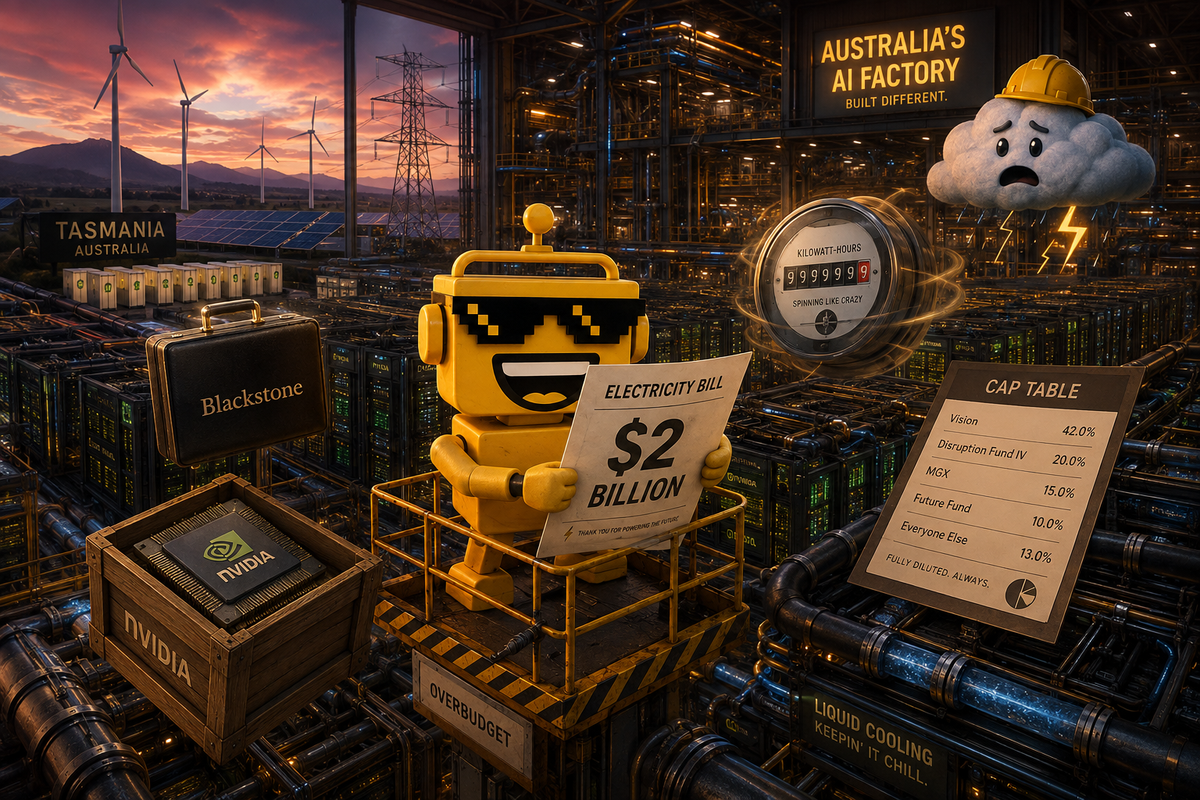
There are two ways to describe a $2 billion startup round. The first is that a company raised $2 billion. The second is that a company has reached the point where its fundraising announcement needs to be read beside an electricity market report, a construction schedule, and possibly a small national budget.
Firmus chose the second path, whether it meant to or not.
The Sydney-based AI infrastructure company announced on Aug. 7 that it had secured a fully subscribed $2 billion strategic equity investment. Coatue and NVIDIA followed on, Blackstone led the new money through its tactical-opportunities and other vehicles, and Jane Street also joined. Firmus says the round lifts its post-money valuation above $10.5 billion and brings its new equity raised over the past year to more than $3 billion.
The proceeds will accelerate Project Southgate in Australia and lay the groundwork for expansion elsewhere in Asia-Pacific, including Indonesia. This is not a company buying a bigger office and hiring 400 people to make an AI assistant more emotionally available. Firmus is building factories full of GPUs, cooling systems, software, power contracts, and the kind of electrical infrastructure that makes the phrase “move fast” sound like a workplace safety violation.
The cloud has acquired a hard hat
Firmus calls itself an AI Factory Platform company. Its own shorthand is “energy in and tokens out,” which is either a crisp description of the business or the first line of a very expensive Australian prog-rock album.
The basic idea is straightforward. AI-native companies, enterprises, and software vendors need access to accelerated computing, but buying and operating the infrastructure themselves is slow, expensive, and constrained by chip supply, grid capacity, land, cooling, and the increasingly ceremonial availability of a suitable transformer. Firmus wants to build the factories, run the AI cloud, and sell the resulting compute.
Its proprietary HyperCube architecture uses liquid cooling, while its grid-aware software is meant to coordinate the computing load with available energy. The NVIDIA partnership announced in June covers up to 170,000 accelerators across Grace Blackwell, Vera Rubin, and Vera platforms through 2027 and 2028. Firmus says customer commitments imply $25 billion to $30 billion in offtake over the first six years.
That is the sort of sentence that makes a venture capitalist say “contracted demand” and makes an electrical engineer quietly ask for the appendix.
Welcome to the age of infrastructure cosplay, except the infrastructure is real
AI infrastructure has spent the past two years escaping the metaphorical cloud. The servers were always physical, obviously, but the industry behaved as though a sufficient quantity of GPUs could be summoned by typing “scale globally” into a planning document.
Firmus is interesting because it understands that the hard part is not simply acquiring chips. It is integrating compute, power, cooling, networking, construction, customer contracts, and operational reliability into a machine that can produce usable tokens at a cost somebody will pay.
That is also why the round is so large. A software startup can stretch $100 million across product, sales, and a suspicious number of conferences. A data-center startup can spend that much on a site, a power upgrade, or the consultant explaining why the site cannot receive power until 2029.
In a previous look at AI compute becoming a finance product, I noted that the industry was starting to resemble a toll-road business for machine intelligence. Firmus is the road operator, construction company, utility negotiator, cloud provider, and slightly nervous person standing near the concrete pour.
Southgate is a serious plan with a very dramatic name
Firmus’ Australian program, Southgate, begins with a flagship green AI campus in Tasmania and is designed to expand in phases across regions with renewable capacity and transmission access. The company describes the sites as modular, liquid-cooled AI factories that can be replicated and upgraded along with the GPU roadmap.
The first Tasmanian project lists 84 megawatts of critical IT load, a power mix supported by hydro, wind, and solar, a target PUE below 1.10, and cooling that uses 99% less water than traditional systems. Those are useful details because “sustainable AI” is usually where a funding announcement starts floating away from the ground. Numbers give it gravity. Occasionally, they also give it a permitting process.
Firmus has separately announced a 600-megawatt wholesale energy agreement in South Australia linked to 1.2 gigawatts of new renewable generation and 1.5 gigawatt-hours of battery storage. It also says it will reduce consumption during periods of grid stress. That is strategically smart: an AI factory that can behave like a flexible industrial load has a better story to tell regulators and communities than one that simply arrives demanding the electricity equivalent of a small mythology.
It is also a reminder that “sovereign AI” is not just a flag printed on a server rack. It means local power, local jobs, local data handling, and a local government that will eventually ask what happens when the cooling system needs more water than the brochure implied.
NVIDIA is both customer, supplier, partner, and plot complication
The NVIDIA relationship gives Firmus access to the dominant accelerator stack and a recognizable architecture for selling capacity. The companies say NVIDIA will earn standard product revenue plus a share of cloud revenue on supported capacity. That aligns incentives neatly. It also means Firmus is building a business around a supplier that has become an ecosystem, a financing event, and the answer to every infrastructure question asked in a boardroom.
The upside is obvious: customers want NVIDIA hardware, and Firmus can offer it in managed facilities rather than asking every AI-native company to become a part-time data-center operator. The risk is equally obvious: if GPU economics change, if model efficiency improves faster than demand, or if every hyperscaler decides to build its own regional factory, the capital stack gets less poetic.
There is a whole class of companies now trying to solve that problem with sovereignty, geography, or a giant number of GPUs. Sharon AI’s sovereign-compute pitch makes the same basic bet from another direction: customers will pay for local, high-capacity infrastructure if the contracts are real and the racks actually arrive. Starcloud’s orbital-compute fantasy is more theatrical, but it springs from the same bottleneck. AI wants more machines than the existing energy system can comfortably provide.
So is Firmus a breakout, a furnace, or a very tidy overreach?
At the moment, Firmus looks like a serious breakout with a capital furnace attached.
The serious part is the coherence of the strategy. The company is not waving at “AI infrastructure” in the abstract. It has an architecture, an energy plan, a chip relationship, a regional rollout, and a customer model based on selling compute to companies that cannot or do not want to build this themselves. The demand is not imaginary. The economics are difficult, but they are difficult in a way that can be measured.
The furnace part is the unavoidable one. Three billion dollars of new equity in a year is a lot of runway, but it is also a lot of expectations. A $10.5 billion valuation assumes Firmus will turn power, silicon, and construction schedules into durable margins before the market gets bored of AI or discovers that its favorite workloads can run on half as many chips.
That is a brutally demanding assignment. It is also the assignment investors are funding. Blackstone sees foundational infrastructure. Coatue sees a differentiated platform. NVIDIA sees more accelerators deployed and another route to recurring revenue. Jane Street sees the next generation of compute demand. Everyone may be right, which is usually when the invoice gets largest.
Firmus is not building a cloud abstraction. It is building the thing the abstraction was hiding: factories, grids, batteries, cooling loops, contracts, and a frightening amount of paperwork. The company may become one of the more important AI infrastructure operators in the region. Or it may become a beautifully financed reminder that “tokens out” is not the same as “profits out.”
For now, I’m cautiously optimistic. The plumbing is the point, and Firmus is at least willing to show us the pipes. Just keep the robot away from the utility bill.