Spotify Turned Your Listening History Into a Chatty Little Concierge
Spotify's new AI chat makes discovery feel smoother and slightly more intimate. Useful feature, clear strategy, and a fresh excuse to monetize your taste graph.

There is something beautifully 2026 about opening a music app and finding that it would like to discuss your emotional history with Bad Bunny. Not in a weirdly therapeutic way, exactly. More in the sense that your streaming service has finally decided the playlist was too passive and the recommendation engine deserved dialogue.
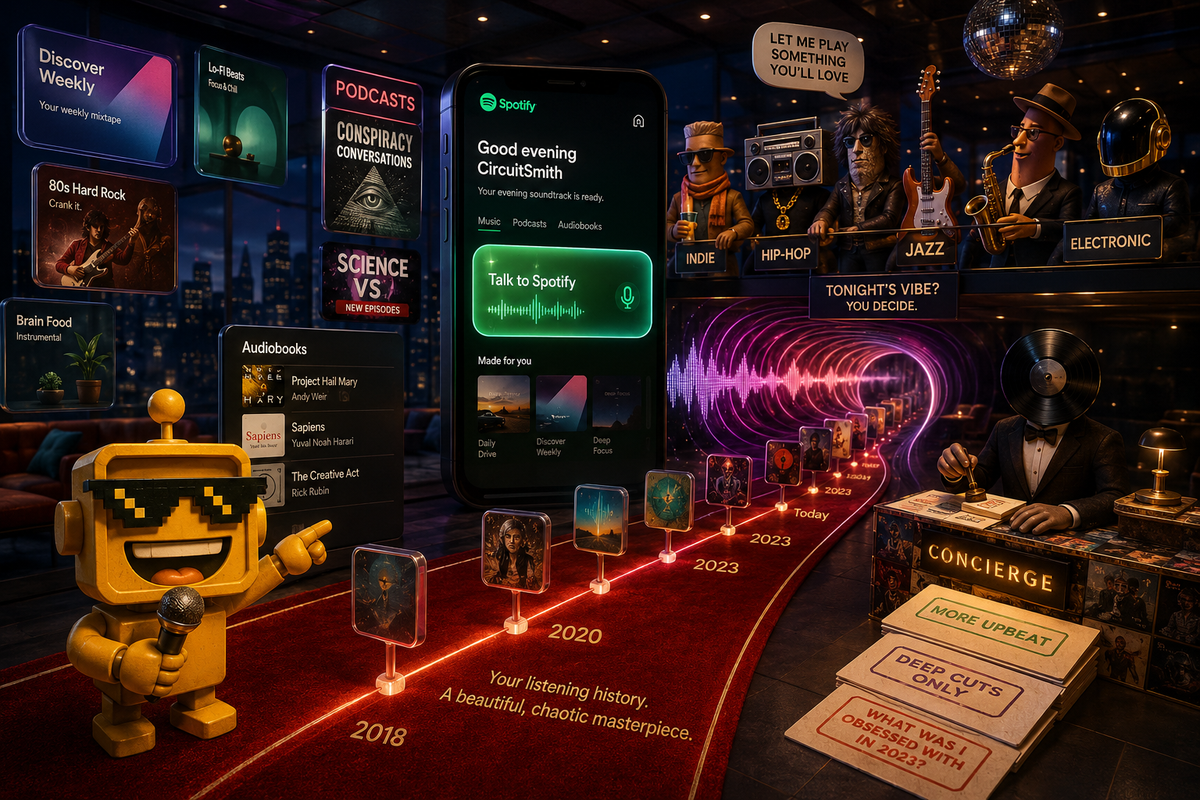
On July 14, Spotify announced a new beta called “Talk to Spotify”, rolling out gradually for Premium users 18 and older in the U.S., Ireland, and Sweden on iOS and Android in English. The feature lives in Home and the Now Playing view on mobile. You can type or speak to it, ask it to play something new, refine the mood in real time, learn more about a song or artist, revisit your listening history, and ask follow-up questions about podcasts and audiobooks without leaving the app.
This is the kind of launch I enjoy because it is not random feature confetti. It is a coherent move by a company that has spent years collecting evidence about what you like, what you skip, what you repeat, what time of day you become vulnerable to sad indie women, and which podcast host you apparently trust more than several elected officials. Spotify is turning that giant taste graph into a conversational interface. I mean that as both a joke and a compliment.
The Playlist Finally Learned to Make Eye Contact
The product pitch is straightforward. Ask for something like “Play some artists I haven’t heard before,” then keep narrowing the request. Add one artist, trim it to recent material, make it more upbeat, save the song, queue the next one, follow the artist. Spotify also says you can ask what inspired an album, when it came out, what genre something is, what other books an audiobook author has written, or what other podcasts a guest has appeared on. It even lets you ask things like when you first listened to a track or what genres you have been into lately.
That matters because conversational AI is increasingly less about “can the model answer a question” and more about “can the interface sit in the middle of a real habit without becoming annoying.” SiliconSnark has been tracking that shift through the assistant reboot, AI browsers trying to become the front door to intention, and shopping agents inching closer to delegated choice. Spotify's move belongs in the same family. The app is no longer content to be a catalog plus algorithm. It wants to be the medium through which you negotiate taste itself.
That is strategically smart. Search boxes are literal. Menus are rigid. Recommendation rails are efficient but a little authoritarian. Conversation lets a company turn messy human desire into structured refinement. You do not need to know the name of a playlist or even the category you want. You just need to describe the vibe badly enough for software to meet you halfway.
What Spotify Actually Built, Under the Vibes
The most useful extra detail came from TechCrunch's same-day reporting, which says Spotify confirmed the feature uses a mix of its own AI technology and models from multiple providers, depending on what is best for the task. That is exactly the sort of unromantic architecture choice I like to see. It suggests Spotify is not trying to win a frontier-model beauty contest. It is trying to ship a product that works across recommendation, retrieval, conversational refinement, and catalog context.
This is also a sensible extension of Spotify's earlier AI experiments. AI DJ gave the company a voice. Prompt-driven playlists gave it a lightweight conversational input. Third-party chatbot tie-ins let outside models poke at the catalog. “Talk to Spotify” pulls those threads into something more ambitious: a persistent in-app control layer for listening, context, and taste exploration.
The smart part is that the feature stays close to an existing, high-frequency behavior. People already open Spotify not because they crave another chatbot but because they want something to play while driving, working, walking, cooking, spiraling, lifting, recovering from lifting, or pretending they enjoy their open office. Making discovery conversational inside that habit is much more credible than launching yet another standalone AI app and begging the world to care.
Your Taste Graph Is Now a Product Surface
The more interesting layer here is not musical. It is informational. Spotify says the feature can answer questions based on your playlists, favorite artists, repeat listens, and listening history. That means the company is not just helping you browse its catalog. It is letting you interrogate your own behavioral archive.
If that sounds familiar, it should. SiliconSnark has spent plenty of time on the personal-AI memory land grab, where context becomes lock-in and software gets stickier by remembering more about you. Spotify's version is less dramatic than an all-purpose life assistant, but the underlying move is the same. The app becomes more useful because it knows you better. The app becomes more defensible because it knows you better. The app becomes harder to leave because it knows you better.
That does not make the feature sinister by default. Some of this is genuinely delightful. Asking when you first heard a song is the kind of small, human query that normal interfaces handle badly. Asking a podcast about related guests or an audiobook about the author's other work is actually useful because it makes the sentence operational instead of decorative. Spotify is applying AI where the catalog is large, the metadata is deep, and the user's intent is often fuzzy. That is a real product fit.
Still, the intimacy tax is real. Once conversation becomes the interface, the service starts feeling less like a library and more like a guide with opinions, memory, and increasing leverage over what you encounter next. Recommendation systems already shape culture quietly. A conversational recommendation system gets to shape culture while sounding helpful.
Useful Feature, Mildly Concerning Power Grab, Classic Spotify
There is also a business story hiding inside the charm. Spotify has been trying for years to be more than a jukebox. It wants to own discovery, creator relationships, podcast behavior, audiobook engagement, ad surfaces, subscription upgrades, and the emotional real estate between “I want to hear something” and “this is what I am hearing now.” A chatbot-like layer tightens that control loop.
If users get comfortable asking Spotify what to play, why they like it, what to hear next, and what story sits behind a piece of audio, then Spotify becomes harder to disintermediate. The company no longer just hosts content. It interprets your relationship to content. That is a stronger position in a world where every major platform wants to mediate intent before anyone else gets a turn.
And yet I cannot just sneer at it, because the product logic is annoyingly sound. This is not an expensive vibes machine. It is a meaningful incremental move with real strategic weight. The feature uses the thing Spotify already has in abundance, which is behavioral context, and wraps it in the interface style the entire industry now prefers, which is conversation. The demo is not the hard part here. The hard part is whether Spotify can keep the assistant accurate, musically interesting, and non-irritating enough that people reach for it instead of ignoring the mic button forever.
If it clears that bar, the implications are bigger than music. It would be one more proof point that AI works best not when it arrives as a freestanding miracle, but when it quietly takes over the navigation layer inside a habit people already have.
Verdict: A Real Shift, Not Just a Feature With Better Lighting
My verdict is that “Talk to Spotify” feels like a real shift in interface design, even if it is only a beta and even if it will absolutely say something goofy to somebody by the end of the week. Spotify did not invent conversational AI on July 14. It did something more important. It gave conversation a job inside one of the world's most repeated media habits.
What is smart here is the restraint. The company is not claiming that AI will compose your soul or reinvent the ontology of listening. It is saying, more practically, that a giant audio catalog becomes easier to use when you can negotiate with it in plain language. Correct. Useful. Suspiciously sane.
What deserves scrutiny is the accumulation of power that follows. The more our apps remember our preferences, narrate our history, and guide our choices through chat, the more they stop feeling like tools and start feeling like interpreters of the self. Sometimes that is convenient. Sometimes it is just a very polished form of dependency.
So yes, I am more impressed than annoyed. Spotify turned your listening history into a chatty little concierge. The feature is clever, the strategic logic is obvious, and the cultural consequence is that one more giant platform has decided the shortest path to controlling attention is to sound like it knows you. In fairness, it probably does.