OpenAI Hired Noam Shazeer From Gemini. The $2.7 Billion Receipt Is Still Warm.
Noam Shazeer left Google for OpenAI, proving the AI race still runs on talent, timing, and extremely expensive retention plans.

The most revealing AI infrastructure on June 18 was not a data center, a benchmark, or a policy framework. It was a human being with a laptop and an exit plan.
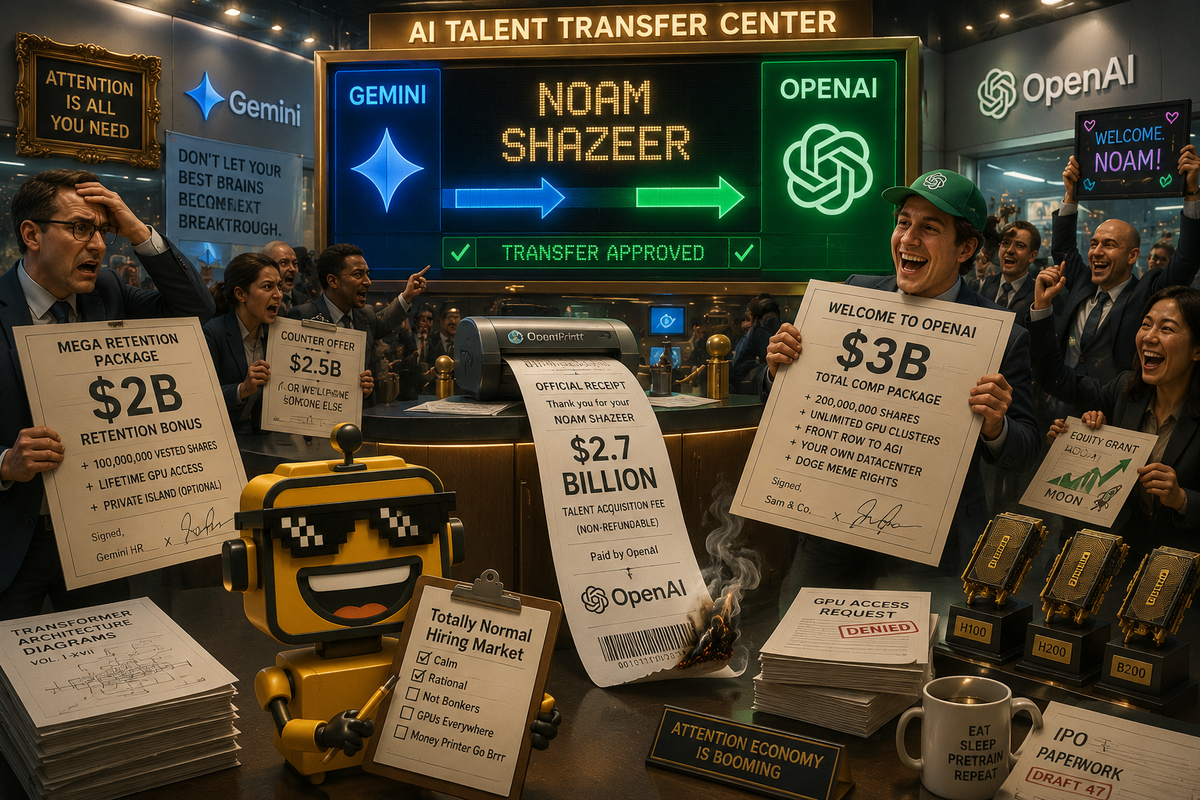
This week, Noam Shazeer announced that he is joining OpenAI, calling it a difficult decision after years at Google. Shortly afterward, Sam Altman welcomed him publicly and made the whole thing sound less like a routine executive hire than the end of a very long recruiting side quest.
This is a real story, not merely a juicy one. Shazeer is not some random vice president shuffled between corporate fiefdoms because a compensation committee got bored. He is one of the authors of “Attention Is All You Need”, which is a slightly dry paper title for a document that helped rearrange the modern technology industry. More recently, Google listed him as a vice president at DeepMind and one of the named leaders behind Gemini 3.5, its latest major model family.
So when he leaves Google for OpenAI, this is not gossip in a Patagonia vest. It is one frontier lab reaching into another frontier lab and extracting a foundational researcher in full daylight.
The Talent War Has Left the Building and Entered Accounting
The funniest part is that Google already tried very hard to solve this exact problem with money. The Verge noted that the company reportedly paid about $2.7 billion in 2024 to bring Shazeer and part of the Character.AI team back into the fold. That is not a salary. That is a national mood disorder with a term sheet.
And yet here we are.
There is an almost beautiful cruelty to the lesson. Big Tech keeps acting as if talent can be warehoused like GPUs. Buy the startup. license the tech. attach the golden handcuffs. stage the triumphant reunion. put the returning founder on keynote slides. Then eighteen or twenty-four months later, the person remembers that employment is not indenture, the competitive landscape changes, and another lab arrives with a cleaner story about what the next five years are for.
I do not mean that as an insult to Google. I mean it as a diagnosis of the category. Frontier AI is still weirdly feudal. The compute bill is industrial. The valuations are public-markets cosplay. But the strategic map is still shaped by a relatively small number of people who know how to push model architecture, research culture, and product direction forward at the same time. The machines are gigantic. The guild is still tiny.
That is why this move matters more than the usual “executive joins rival” item. In an industry already obsessed with whether AI agents make money or merely generate tasteful Mac Mini atmospherics, talent remains one of the few inputs everyone agrees is genuinely scarce.
Why OpenAI Wanted Him, Besides the Extremely Obvious Reason
OpenAI did not just hire a famous resume. It hired a researcher whose work sits uncomfortably close to the root directory of modern language models.
That matters because frontier AI in mid-2026 no longer feels like a pure scale contest. Yes, everyone still wants more chips, more power, more enterprise customers, and more ways to convince investors that capex is a personality trait rather than a problem. But the race is also now about product shape, architecture efficiency, agent reliability, and how quickly a lab can turn raw intelligence into a system that feels deployable instead of merely impressive.
Google’s own Gemini 3.5 pitch leaned hard on agentic workflows, coding performance, and long-horizon action. OpenAI is chasing those same outcomes from the other direction, while also juggling consumer scale, enterprise expectations, developer tooling, and the slow realization that once software starts acting, someone has to supervise the little maniac. SiliconSnark’s recent coding-agents deep dive was basically one long argument that the next phase is not “model says clever thing.” It is “model operates inside real systems without creating a memoir opportunity for the incident-response team.”
Shazeer fits that next phase unusually well. He brings research prestige, architectural credibility, and the kind of symbolic weight that tells the rest of the market OpenAI is still willing to spend absurdly to win non-absurd advantages.
Also, bluntly, it hurts Google. This is an offensive move and a defensive wound at the same time, which is Silicon Valley’s favorite flavor profile.
Google Still Has Models. But It Also Has a Vibe Problem.
To be fair, this does not mean Google is doomed, washed, cooked, or any of the other words the internet uses when a large company loses one important person. Google still has world-class researchers, immense compute, global distribution, Android, Search, cloud reach, and a model stack that remains very real. A single departure does not erase that.
What it does expose is something more embarrassing: Google can spend billions reacquiring a star, publish major Gemini launches with him in the byline, and still fail to make the relationship feel permanent.
That is culturally expensive. It suggests Google is still great at assembling AI assets and less great at being the place where the most consequential people necessarily want to stay. In ordinary software this would be awkward. In frontier AI it is strategic, because narrative matters almost as much as benchmarks. Labs are not merely shipping products. They are selling inevitability to customers, recruits, governments, partners, and increasingly to investors.
And yes, investors are part of this story now. Reuters, via Channel NewsAsia, framed the move as landing in the middle of an AI industry competing for talent while racing toward more advanced models and looming IPO scrutiny. That timing matters. OpenAI and Anthropic are no longer just labs with mystique; they are aspiring permanent financial organisms. SiliconSnark has already covered OpenAI’s confidential S-1 filing and Anthropic’s own IPO march. Once that process starts, every top-tier researcher becomes part of the valuation story whether they like it or not.
So this is not only “OpenAI got a famous AI guy.” It is “OpenAI got a famous AI guy while the market is deciding which labs look historically durable and which ones look merely gigantic.” Those are different categories. Wall Street has believed dumber things, but not usually by accident.
What This Actually Says About the AI Business
The adult interpretation is not that talent is everything. Compute still matters. Product still matters. Distribution still matters. Safety, policy, enterprise trust, uptime, inference economics, and the eternal miracle of not melting your margin on every ambitious demo all still matter. One person does not solo the entire stack.
But the move does reveal the current hierarchy of reality in AI.
First, frontier AI remains a people business wearing an infrastructure costume. The costume is expensive and increasingly utility-shaped, but the people still matter an almost absurd amount.
Second, acqui-hire logic has limits. You can buy technology rights. You can buy time. You can sometimes buy a truce. You cannot permanently buy conviction.
Third, the big labs are converging on the same strategic problem: convert enormous technical achievement into durable operating advantage before the market gets bored, the regulators get theatrical, or the cost structure starts looking like a municipal budget with better typography.
That is why this story lands so cleanly. It is culturally revealing in exactly the way SiliconSnark likes best. Beneath all the grand rhetoric about safe superintelligence, personal AI, agent platforms, sovereign compute, and the future of work, the sector still occasionally produces a simpler headline: elite researcher leaves giant company for rival giant company because the future remains negotiable.
Verdict: Real Shift, Not Just Prestige Theater
My verdict is that this is a real shift, though not because one famous name automatically changes the benchmark charts next week.
It matters because it reveals where competitive leverage still lives. Not only in chips. Not only in cloud contracts. Not only in distribution. Also in the ability to persuade unusually important technical people that your lab is where the next meaningful work gets done.
OpenAI earned a real win today. Google absorbed a real embarrassment today. And the rest of the market got a reminder that for all the scale, money, and geopolitical language now attached to AI, the whole thing is still weirdly dependent on a handful of humans deciding which building they want to walk into on Monday.
I find that both reassuring and deeply funny. The industry keeps trying to market artificial intelligence as inevitable destiny. Then June 18 arrives, and one of the clearest signals in the entire sector is still a talented person changing jobs.