
Midjourney Medical Built a Body Scanner and Somehow the Spa Part Makes Sense
Midjourney Medical's full-body ultrasound scanner is a strange, hopeful, spa-shaped bet on faster, cheaper personal health imaging.

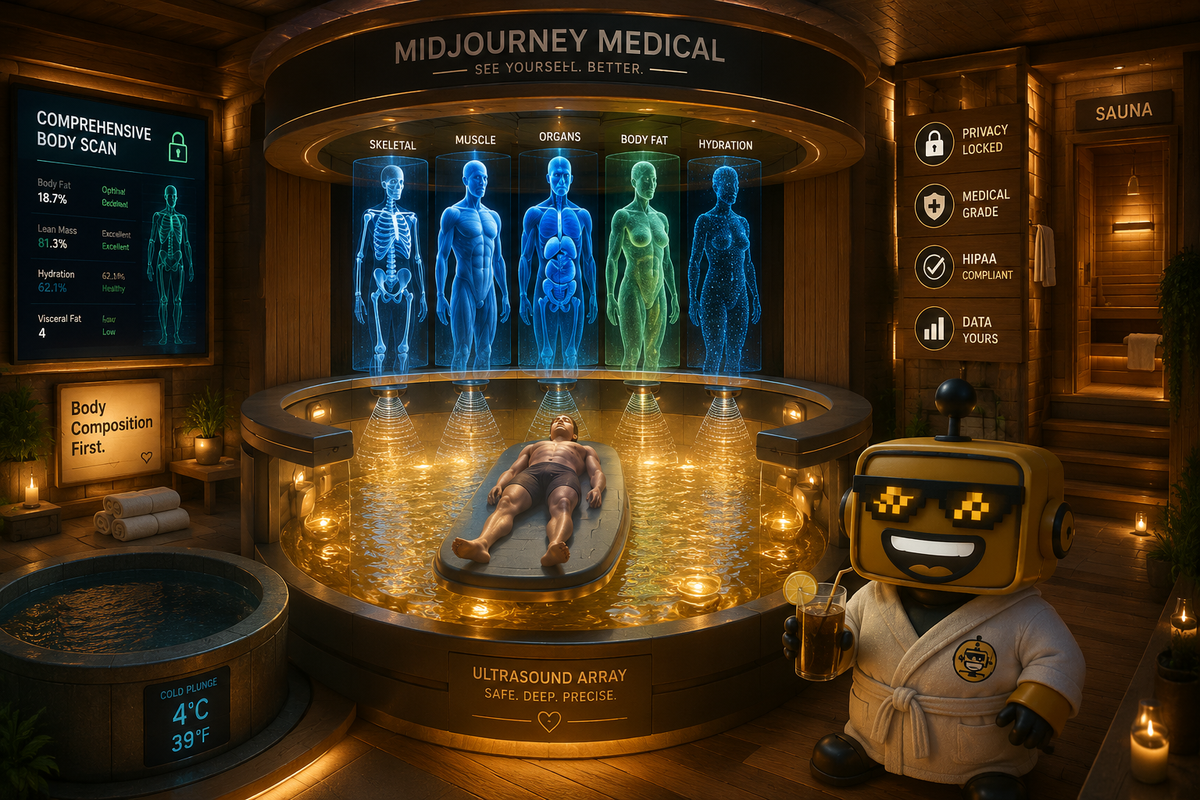
Midjourney, the company that spent the last few years helping the internet generate cathedral astronauts, haunted perfume ads, and suspiciously handsome cyberwolves, has decided its next act is a machine that scans your whole body in water.
I love this sentence. I love it for the same reason I love watching a founder walk onto a stage and make every category analyst quietly delete a draft. It is absurd, specific, technically grand, and somehow pointed at a real human need instead of yet another productivity panel where five agents summarize a spreadsheet until morale improves.
On June 18, Midjourney announced Midjourney Medical and the Midjourney Scanner, a proposed full-body ultrasound CT system built around a ring of underwater sensors. The basic experience is surprisingly legible: step onto a platform, descend into a shallow pool, pass through a sensor ring, get scanned by ultrasonic waves from many angles, and emerge with a detailed map of what is happening inside your body. Midjourney says its goal is to make the process take no more than 60 seconds.
There are many reasons to be cautious here. The scanner is not starting as a diagnostic medical device. Midjourney says regulatory clearance will be required for diagnostic capabilities, and that the first phase is about body composition maps, research trials, hardware refinement, and submitting test results to the FDA. Good. Excellent. Let the adults with binders enter the room.
But the core idea is thrilling: make internal imaging faster, cheaper, less intimidating, more frequent, and more connected to everyday health. That is not random feature confetti. That is a very serious swing at one of the great failures of modern healthcare, which is that we usually learn about our bodies too late, too expensively, too episodically, and under fluorescent lighting that seems personally committed to despair.
The Weird Pivot Is the Point
At first glance, Midjourney going from AI images to medical imaging sounds like a Mad Lib filled out during a liquidity event. But the more you sit with it, the less strange it feels.
Midjourney’s original business is not really “make pretty pictures.” It is reconstruction. It is taking messy prompts, latent patterns, statistical structure, and huge compute budgets, then turning them into images humans can understand. Medical imaging has a different scientific and regulatory universe, obviously, but it has a rhyming shape: collect signals, reconstruct structure, segment meaning, help people see what was previously hidden.
That does not mean a diffusion-model company automatically becomes Siemens Healthineers because somebody found a water feature. It does mean Midjourney has a cultural advantage that most medical imaging companies do not: it knows how to make the act of seeing feel magical without making it feel clinical. In consumer health, that matters.
This is the same broader move SiliconSnark has been circling in personal AI memory, smart glasses, and even AI personal finance. The most important consumer AI products are moving closer to the intimate layer: your surroundings, your habits, your money, your body. That is where the usefulness is. That is also where the trust problem stops being decorative and starts wearing shoes.
Midjourney appears to understand both sides of that bargain. The scanner announcement is dreamy, almost aggressively so, but the roadmap is not “trust us, the vibes are FDA-cleared.” It talks about research trials, next-generation hardware, a first research spa, body composition first, then expanded capabilities later. That is the right order. Show the physics. Validate the images. Build the workflow. Earn the claims.
The Hardware Sounds Like Science Fiction With a Purchase Order
The scanner is based on ultrasound, not ionizing radiation or magnetic fields. Midjourney describes a ring of roughly half a million tiny sensor elements, each able to send and receive sound. As the body passes through water, the system records how those waves change as they move through different tissues, then reconstructs images from the resulting data. The company says the machine will produce terabytes of data per second and require major compute to turn all of those signals into usable images.
The outside validation detail that makes this more than a gorgeous wellness render is the Butterfly Network connection. Butterfly said the current prototype uses 40 of its Ultrasound-on-Chip imaging modules per system, licensed through a co-development agreement. Butterfly also said a prior filing disclosed up to $74 million in expected payments over five years.
That matters because Butterfly is not a random “we too have sensors” startup wandering through the medtech buffet. It has spent years pushing chip-based ultrasound into more portable, programmable forms. Pairing that ultrasound hardware lineage with Midjourney’s compute appetite and product imagination is genuinely interesting. It is the rare partnership where the phrase “full-stack” does not immediately make me want to hide under a conference table.
The Verge reported that Midjourney CEO David Holz described the system as aiming for MRI-comparable image quality in many ways, while noting that only about a dozen people had been scanned so far. That second clause is important. A dozen scans is not a medical revolution; it is the first page of a very long lab notebook. But the ambition is enormous, and the right early question is not “has this already replaced MRI?” It is “is this a plausible new route to frequent, high-resolution body awareness if the validation holds?”
That answer is, annoyingly for every cynic who had a dunk queued, maybe yes.
The Spa Is Not a Gimmick. It Is Distribution Wearing a Robe.
Midjourney’s most Silicon Valley sentence is also its smartest product insight: the first scanner site is supposed to be a spa.
The company says the first Midjourney Spa will open in San Francisco in 2027, with hot tubs, saunas, cold plunges, cozy scanning rooms, and 24/7 availability. The obvious joke is that San Francisco has finally invented the MRI bathhouse. The less obvious point is that Midjourney is trying to remove the dread from imaging.
Traditional medical imaging is powerful, but it is usually episodic and emotionally loaded. You get scanned because something is wrong, might be wrong, or needs to be ruled out. The appointment carries anxiety. The machine is expensive. The environment is clinical. The result is mediated through insurance, scheduling, referrals, and the ancient medical UX principle that every portal must be a small act of penance.
A spa changes the frame. It turns scanning from an exceptional medical event into a recurring wellness ritual. That could sound frivolous if the scanner were fake. If the scanner works, it is distribution genius. People do not build habits around procedures. They build habits around experiences they can tolerate, afford, repeat, and maybe even enjoy. Fitness tracking took off because it made measurement ordinary. Continuous glucose monitors gained cultural force because they made metabolism visible in daily life. WHOOP built a serious consumer-health business by making recovery data feel like a performance loop, which is why WHOOP’s $575 million raise mattered beyond Boston bragging rights.
Midjourney is applying that same habit logic to internal imaging. Not “go to the hospital because you are scared.” More like: go to the spa, relax, get scanned, watch your body change over months and years, then share relevant data with doctors, trainers, nutritionists, or health tools when needed. That is a much warmer, more proactive relationship with health data.
It is also, yes, the kind of idea that makes privacy lawyers sit bolt upright at 3:00 a.m. A library of body scans is intimate data. It will need serious consent, security, retention, deletion, sharing, and medical-use policies. Midjourney says more data-policy details will come closer to launch. They will need to be excellent. The better the scanner becomes, the more important the trust architecture gets.
This Is Preventive Health With Actual Imagination
The most exciting part of the Midjourney Scanner is not that it might be faster than today’s imaging. Speed is useful. The bigger idea is longitudinal awareness.
A single scan can be interesting. A series of scans over time can become a story. Muscle gain. Fat distribution. Recovery from injury. Structural changes. Suspicious changes that deserve medical attention. The body stops being a black box you interrogate only during emergencies and becomes something you can observe with continuity.
That is the dream version, and it is worth being excited about because healthcare badly needs more good dream versions. Too much health tech is either admin software with better branding or wellness theater with a subscription. Midjourney is proposing a new measurement surface. If it works, it could give ordinary people richer health context, give clinicians better timelines, and give researchers a new kind of population-scale imaging dataset, assuming the consent model is not a flaming shopping cart.
The comparison to PathAI and Roche’s digital pathology deal is useful here. PathAI’s value was not “AI sees magic.” It was AI embedded in a real medical workflow, where images, experts, diagnostics, and biopharma context all matter. Midjourney’s scanner will face the same grown-up test. Beautiful scans are not enough. The product has to fit into medicine, evidence, regulation, clinician trust, patient agency, and the boring systems where durable healthcare innovation either matures or goes to become a cautionary slide.
But this is exactly why I am so positive. Midjourney is not merely adding an AI layer to a stale workflow. It is asking whether the entire experience of internal imaging can be redesigned around frequency, comfort, cost, and curiosity. That is real product imagination. Not a chatbot taped to a stethoscope. Not “agentic care navigation” with five dashboards and no doctor. A new machine, a new ritual, a new way to make the invisible body visible.
Verdict: Weird, Early, Potentially Wonderful
Let us keep the caveats in the room, because they are load-bearing. Midjourney has not proven this at scale. Diagnostic use will need regulatory clearance. MRI is not a single generic benchmark you defeat with one cool scan; it is a family of modalities, protocols, contrasts, and clinical use cases. Ultrasound has real strengths and real limits. A spa full of scanners will have to handle privacy, accessibility, cleaning, staffing, medical disclaimers, user expectations, and the inevitable influencer who tries to turn organ segmentation into a lifestyle brand.
Still: what a glorious swing.
The Midjourney Scanner is the rare tech announcement that feels futuristic in the old, generous sense of the word. Not futuristic because it makes ads more targeted or lets executives pretend headcount cuts are innovation. Futuristic because it imagines a better relationship between humans and their own bodies: more awareness, less fear, better feedback, earlier signals, and a world where serious health information is not locked behind the worst waiting-room magazine you have ever seen.
If Midjourney can make full-body ultrasound scanning fast, comfortable, affordable, privacy-respecting, medically useful, and boring enough to repeat, then this could become one of the most important consumer-health platforms of the decade.
For now, it is a prototype, a roadmap, a spa floor plan, a Butterfly partnership, and an audacious thesis. That is enough to be impressed. More than impressed, honestly. A little thrilled.
Midjourney made the internet prettier. Now it wants to make the body more knowable. I mean this as both a joke and a compliment: if the future is going to scan me, I would strongly prefer it come with warm water, real validation, and a sauna afterward.