InfoHawk Raised $2.25 Million to Judge Every Sketchy Link on Sight
InfoHawk wants to score suspicious URLs, ads, and accounts in 300 milliseconds. The pitch is a little surveillance-coded, but the problem is painfully real.

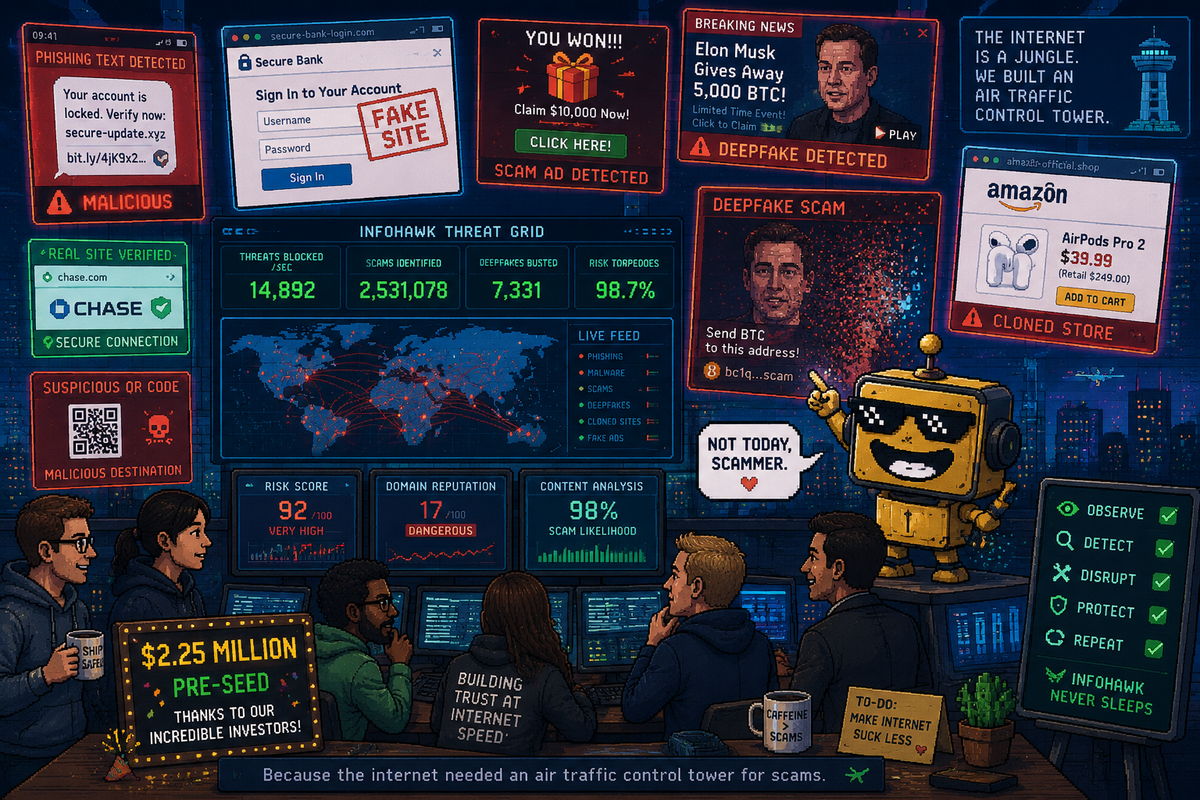
The modern internet now expects you to click with the emotional posture of a bomb technician. Every text might be a scam. Every ad might be a trap. Every “urgent account alert” arrives wearing just enough corporate typography to make your pulse do a small involuntary somersault. We have spent two decades optimizing the web for frictionless action and are now acting surprised that fraudsters also enjoy frictionless action.
Which is why I stopped and paid attention when InfoHawk announced a $2.25 million pre-seed round on June 8. The startup says it wants to detect and prevent AI-driven deception and scams at internet scale, with Moonshots Capital leading the round and a supporting cast that includes former FTC chair Jon Leibowitz, AppNexus founder Brian O'Kelley, former Meta ads chief Rob Goldman, former Google ads safety and privacy VP Scott Spencer, GitHub CTO Vlad Fedorov, and other people who have clearly spent some time contemplating the darker arts of the web. That is a pretty good cap table for a company whose whole thesis is: what if we stopped treating digital fraud like weather?
I mean that as both a joke and a compliment.
The product is basically a border collie for sketchy internet behavior
On its own site, InfoHawk says it detects, analyzes, and neutralizes online deception across URLs, ads, accounts, and other digital assets, then returns a verdict in under 300 milliseconds. The company pitches live scanning across text, images, video, domains, IP addresses, phone numbers, and social identifiers, with a REST API, an MCP server for agents, and a guided investigator workspace for humans who still enjoy the quaint tradition of looking into things. In other words, this is not another startup trying to “reimagine trust” with a soft-gradient dashboard and a prayer. This is closer to an always-on risk engine for the part of the internet that keeps trying to impersonate your bank, your boss, and your aunt.
The timing is annoyingly good. We are already in the era where AI can clone brand assets, spin up fake sites, produce plausible phishing copy, and generate enough synthetic sludge to make normal verification feel prehistoric. SiliconSnark has been circling this broader trust collapse for months, from AI search becoming the answer before you click to every app suddenly demanding stronger proof that you are a real human. InfoHawk reads like a startup founded by people who looked at that entire trajectory and said, fine, if the web is going to become a deception engine, then fraud detection needs to become infrastructure.
That is smart. It is also a little bleak. But smart can survive bleak.
Fight AI with AI is exactly the kind of slogan this decade deserves
There is something perversely elegant about the pitch. AI made scams cheaper, faster, more personalized, and more scalable. So naturally the response is to build more software that watches the software watching the people watching the software. The whole thing has the recursive energy of a snake hiring a mongoose and then giving the mongoose a cloud budget.
Still, I get why investors might care. The problem is concrete, ugly, global, and getting worse in ways buyers can understand without a TED Talk. If you run payments, commerce, identity, marketplaces, ad networks, messaging, social products, or basically any service where one fraudulent interaction can cost real money or trust, the appeal is immediate. This is the same reason I keep returning to the impolite question of whether AI systems do anything economically legible. Fraud prevention is about as legible as it gets. You catch bad stuff faster, you lose less money, you annoy fewer real users, and ideally you avoid the quarterly ritual where an executive explains that abuse was “an evolving challenge.”
Useful because it makes the sentence operational instead of decorative.
The founders do not sound like tourists wandering into trust and safety
The other reason this round works for me is that the founding team appears unusually qualified for the exact kind of paranoia they are productizing. On InfoHawk’s team page, CEO and co-founder Rob Leathern is described as a former Google VP of Privacy and Security Product who also led Business Integrity at Meta. Co-founder Ben Poiesz previously worked in Google privacy and security and later led infrastructure at Grammarly. Co-founder James McCrindle spent years at Meta building systems to detect fake and compromised accounts and earlier led engineering in fintech, where fraud prevention tends to be the difference between having a company and having an apology.
That matters. A lot of early-stage AI security startups currently read like two clever people discovered the word “agentic” and then inhaled a Gartner report. InfoHawk sounds more like a team that has already been punched in the face by real adversaries at platform scale. The weirdness tax is real, but founder credibility does reduce the interest rate.
It also gives the company a refreshingly unglamorous center of gravity. Nobody grows up dreaming of “cross-platform deception detection.” This is a market you enter because you have seen enough fraud, abuse, spam, phishing, impersonation, and counterfeit sludge to become professionally incapable of chilling out. I trust that instinct more than I trust a lot of founder mysticism.
The awkward part is that trust infrastructure can become its own creepy genre
Now for the metallic eyebrow.
Any startup promising to score everything suspicious across the internet is stepping into a category where legitimate safety work and ambient surveillance can start sharing a trench coat. The sales pitch is clean: faster detection, better attribution, fewer scams. The messy part is execution. False positives annoy customers. Data collection expands under pressure. Enterprise buyers quietly ask for one more signal, one more integration, one more reason why their own systems should know a little more about everyone all the time.
I do not think that makes InfoHawk cynical. Quite the opposite. The founders seem to understand the problem well enough to know it is nasty. But trust products inherit the burden of proving that their cure does not become its own minor disease. SiliconSnark has watched this tension pop up in privacy blowups where “trust us” met telemetry reality and in platform safety systems that looked cleaner in the deck than in public use. InfoHawk’s challenge is to be fast, accurate, and useful without drifting into the vague corporate theology where more monitoring is always presumed to equal more safety.
There is also the ordinary startup challenge of distribution. Building a strong anti-fraud engine is one thing. Becoming a default layer inside real customer workflows is another. The demo is never the hard part. The hard part is convincing risk teams, product teams, compliance people, and executives with scar tissue that your system can sit in front of real clicks and real money without becoming a fresh source of chaos. This company is early enough that I am willing to leave room for that proof to arrive.
Verdict: a promising little rocket with a healthy amount of suspicion
My verdict is promising little rocket.
InfoHawk has the ingredients I want from a pre-seed story: a painful problem, a market with no shortage of urgency, founders who seem to have earned their obsession honestly, and a product thesis that is specific enough to survive contact with a budget meeting. The startup is not pretending to solve “trust” in the abstract. It is trying to tell you whether the thing in front of you is fake before the damage finishes loading.
Yes, the company is surfing a very 2026 sentence. Yes, “fight AI with AI” sounds like an arms race designed by a marketing team trapped in a Möbius strip. And yes, the internet becoming dependent on synthetic systems to spot synthetic deception is a bit like hiring robots to patrol a theme park built by con artists. But that does not make it unserious. It makes it timely.
If InfoHawk can make online fraud harder, more expensive, and less ambient, then it will be doing one of the few startup jobs nobody needs explained twice. I am reluctant to romanticize paranoia as a service. I am even more reluctant to leave the current scam economy alone. So for now, I will say this lovingly: the little hawk may be onto something, and frankly the web has earned a watchful bird with a badge.