Deep Dive: AEO Wants to Replace SEO. Naturally, It Brought a New Acronym.
AEO is the new AI search acronym promising to replace SEO. The truth is more useful, more boring, and much funnier.

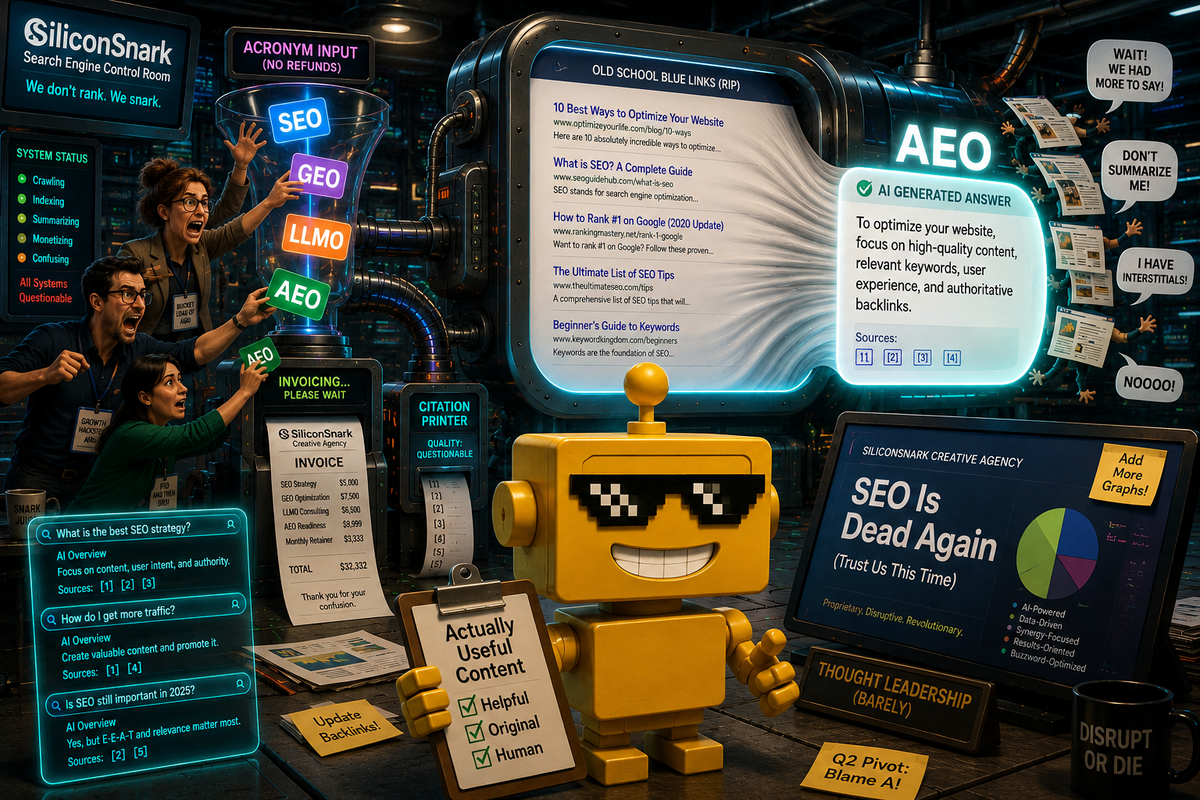
The marketing internet has discovered a new acronym, which means somewhere a slide deck has achieved sentience and asked procurement for $18,000 a month.
This one is AEO: answer engine optimization. Depending on who is selling it, AEO is either the natural evolution of SEO, the replacement for SEO, a survival strategy for the AI search era, or a convenient way to repackage several old content disciplines in a shiny new wrapper that smells faintly of panic and enterprise lavender. The pitch is simple enough: people are no longer just typing keywords into Google and clicking blue links. They are asking ChatGPT, Perplexity, Gemini, Copilot, AI Overviews, AI Mode, and whatever other conversational machine currently wants to summarize the internet before you have had coffee. If the machine gives the answer, brands want to be in that answer.
That part is not imaginary. Google is building generative AI deeper into Search. OpenAI has turned ChatGPT into a search surface with citations. Perplexity has been calling itself an answer engine with concise, sourced responses. Publishers and marketers are watching click-through rates like sailors watching the horizon before a storm. And agencies, being agencies, have noticed that fear plus novelty plus budget season equals a new line item.
So yes, AEO is real. The useful question is not whether the term exists. The useful question is whether AEO is replacing SEO, extending it, or mostly giving consultants a fresh acronym to place gently on top of the same old advice: make useful things, structure them clearly, earn trust, get cited, stop publishing commodity sludge, and please do not make a separate page for every possible way a human might ask whether a toaster is haunted.
The answer, inconveniently, is that AEO matters. It just does not matter in the way the funeral-for-SEO crowd keeps implying. SEO is not dead. Search is mutating. Traffic is fragmenting. The result page is becoming an answer page, an assistant surface, a shopping interface, a local broker, and occasionally a machine-generated confident shrug. AEO is the name marketers are giving to the work of staying visible when the user's first interaction is an answer instead of a link.
That is a real shift. It is also not magic. It is less "burn your SEO playbook" and more "your SEO playbook now has a chapter where the reader may never visit your site, the citation may be the conversion, and the machine is the world's most expensive intern with retrieval access."
The Nut Graph: AEO Is SEO for the Part Where the Click Goes Missing
Traditional SEO was mostly about earning visibility in search results so a human would click through to your page. AEO is about earning visibility inside generated answers, cited responses, AI summaries, conversational search sessions, and agentic workflows where the user may get what they need before reaching your website. The goal changes from "rank this page for this query" to "be the source, entity, product, explanation, or brand that answer systems trust enough to mention, cite, summarize, or act upon."
That sounds dramatic because the interface is dramatic. But the underlying ingredients are boring in the productive way: crawlable pages, clear information architecture, unique expertise, original data, trustworthy references, consistent entity signals, structured product and business information, strong reputation, accessible HTML, helpful media, and content written for actual people instead of the nervous ghost of an algorithm. In other words: a lot of SEO, plus more attention to extractability, citation-worthiness, entity clarity, and whether your content can survive being reduced to three sentences by a machine that has never known shame.
Google's own guidance is the cold shower here. In its official guide to generative AI features on Google Search, Google says SEO is still relevant for generative AI search because AI Overviews and AI Mode are rooted in core Search ranking and quality systems. It also explicitly addresses AEO and GEO, saying that from Google's perspective, optimizing for generative AI search is still optimizing for the search experience, and thus still SEO.
That sentence will not stop the acronym economy, because nothing stops the acronym economy. But it should calm the room. AEO is not an alien discipline that landed in a crater and demanded all your schema markup. It is a useful lens on how discovery changes when answers are synthesized, citations matter, and the model may fan out into related queries before deciding what to show. The shift is significant. The fundamentals are not vaporized.
So the clean verdict is this: AEO is not replacing SEO. It is replacing the fantasy that SEO was ever only about ranking pages. Search visibility has always been about matching intent, authority, usefulness, and distribution. AI search makes that more obvious, more compressed, and more annoying to measure.
How We Got From Ten Blue Links to One Chatty Box
The internet did not wake up one morning and decide to become an answer machine. Search has been moving toward direct answers for years. Featured snippets, knowledge panels, local packs, shopping boxes, weather widgets, sports scores, calculators, "people also ask" modules, and zero-click results all trained users to expect Google to solve the small thing before they entered the open web. AI did not invent the answer layer. It industrialized it, gave it a conversational voice, and taught it to cite just enough sources to make publishers nervous in a more specific way.
That history matters because AEO is often sold as if ChatGPT personally killed the old search model with a candlestick in the library. The trend is older and broader. Search engines have long wanted to satisfy intent quickly because satisfied users come back. Platforms have long preferred keeping users inside their own surfaces because attention is money wearing comfortable shoes. Marketers have long lived inside the tension between being discovered by a platform and being disintermediated by that same platform. The AI layer turns the tension up until the knobs come off.
The current acceleration is real. Google said at I/O 2026 that AI Mode passed one billion monthly users one year after debuting and that AI-assisted query behavior was growing fast. The company also described a more intelligent search box, agentic search features, multimodal input, and experiences that can help users book, compare, research, and monitor topics. That is not a small cosmetic update. That is Google trying to make Search feel less like a directory and more like a task machine.
OpenAI is pushing from the other side. ChatGPT search launched with fast answers and links to relevant web sources, explicitly blending a natural-language interface with timely web information. Perplexity, meanwhile, describes itself as an AI answer engine that researches the open web in real time and returns concise, cited answers. The category is no longer theoretical. The web is being queried by assistants, summarized by assistants, and increasingly navigated through assistants.
This is why SiliconSnark has kept circling adjacent interface wars in pieces on AI search, AI browsers, and computer-use agents. The interesting part is not one product. It is the migration of intent from pages to intermediaries. The user asks. The system goes. The brand hopes it is not quietly paraphrased into irrelevance.
The Click Problem Is Real, Which Is Why Everyone Is Sweating Through the Acronyms
The strongest argument for taking AEO seriously is not that marketers invented a new term. Marketers can invent a term before lunch and ruin it by dinner. The stronger argument is that search behavior is changing in ways that threaten the traffic assumptions many businesses have built around.
In July 2025, Pew Research Center found that Google users were less likely to click links when an AI summary appeared. In its March 2025 browsing analysis, users who encountered an AI summary clicked a traditional search result in 8 percent of visits, compared with 15 percent for users who did not encounter one. That is not a philosophical difference. That is the sound of a funnel developing a leak and then asking to be called innovation.
SparkToro has been beating this drum for years through its zero-click search work. Its newer 2026 analysis argues that less than one third of Google searches send a click, continuing a trend in which platforms answer, retain, redirect, or satisfy queries without open-web traffic. You can argue about methodology and definitions, because of course you can. This is the internet. But the strategic direction is hard to ignore: more answers happen before the click, and more clicks that do happen are shaped by richer, more controlled platform surfaces.
Gartner gave the panic a clean headline back in February 2024 when it predicted that traditional search engine volume would drop 25 percent by 2026 because of AI chatbots and virtual agents. Predictions like that deserve skepticism, especially when Google itself says people are searching more in AI Mode. But the exact number is less important than the market signal. Buyers, publishers, and marketers now believe some meaningful share of discovery is moving into AI-mediated experiences.
That belief changes behavior even before the measurement stack catches up. Brands start asking whether they appear in ChatGPT answers. Agencies start selling AI visibility audits. SEO platforms start adding citation tracking. PR teams care more about entity consistency. Content teams wonder whether original research matters more than listicles. Executives ask why the dashboard has fewer clicks even though impressions seem healthy. Somewhere, a growth marketer whispers "brand mention optimization" and a conference room loses its innocence.
This is the real AEO opportunity. Not replacing SEO. Not chanting "answer engine" until the spreadsheet complies. The opportunity is learning to manage visibility when a search interaction may produce awareness, trust, consideration, or even a buying decision without producing the old-fashioned pageview. That is a business problem, not just a content tactic.
What AEO Actually Optimizes For
At its best, AEO optimizes for being understandable, useful, and trustworthy to systems that synthesize answers. That means several things at once.
First, the content has to be extractable. If your page takes 900 words to say what your product does because someone in brand strategy fell in love with "unlocking tomorrow's operational possibility," the answer engine may not save you. AI systems need clear facts, definitions, comparisons, specs, use cases, prices, availability, limitations, and sources. Humans need those too, which is the first clue that this is not a separate religion.
Second, the entity has to be clear. Who are you? What do you make? What category do you belong to? What are you known for? Where else are you mentioned? Are your product names, company descriptions, executive bios, addresses, app listings, documentation, social profiles, review pages, and third-party coverage consistent? Answer systems are not just matching a keyword string. They are assembling a probability cloud around entities, reputation, and relevance. If your public footprint looks like five startups in a trench coat, AEO will not be fixed by a PDF called "AI Search Strategy Q3."
Third, the content has to be citation-worthy. That usually means original data, first-hand expertise, clear methodology, useful analysis, named sources, and information that answers a specific question better than generic sludge. Google's guidance is blunt on this point: create unique, valuable, people-first content and do not just recycle what everyone else has already said. I appreciate the subtlety of a trillion-dollar company telling the web to stop making paste, but the advice is correct.
Fourth, the site has to be technically accessible. Google says its generative AI features rely on the Search index and public, crawlable content. That means boring SEO plumbing still matters: crawlability, indexing, page speed, mobile usability, clean structure, semantic clarity, sensible internal links, canonical URLs, media handling, and avoiding JavaScript architecture that hides half the substance behind a loading spinner like a magician with a grudge.
Fifth, the brand has to be visible beyond its own website. AI systems can draw from search indexes, web results, citations, public discussions, documentation, forums, media, reviews, and other external signals depending on the platform and query. AEO therefore overlaps with PR, community, analyst relations, documentation, product marketing, customer proof, and reputation management. The plumbing is the point, but the plumbing now runs through more buildings.
None of that is mystical. It is just harder to fake. Old SEO had plenty of low-quality shortcuts. AI search still has manipulable surfaces, because every system humans build eventually becomes a snack machine for bad incentives. But the durable strategy is not "write for robots." It is to make your facts, expertise, and usefulness so clear that both humans and machines have fewer excuses to misunderstand you.
What AEO Is Not, Despite What the Sales Deck Says
AEO is not a secret schema tag. It is not a magic llms.txt file. It is not a haunted content format that requires every paragraph to be exactly 37 words long so Gemini can nibble it politely. Google specifically says you do not need special AI markup, tiny content chunks, or a separate writing style just for generative AI search. It also says structured data is still useful for normal SEO and rich results, but not required as some special generative AI admission ticket.
This is important because the first instinct of the optimization economy is always to turn uncertainty into rituals. Add this file. Use this phrase. Ask this bot to crawl you. Publish 400 question pages. Mention your brand in 900 places. Stuff the FAQ. Create "AI-readable" summaries. Build a knowledge graph altar in the conference room and sacrifice three blog posts under a full moon. I may have made one of those up. Barely.
The problem with ritual-first AEO is that it mistakes the interface for the incentive. Answer systems want useful answers because users want useful answers. Search engines want quality because quality protects usage and ad inventory. AI assistants want grounded responses because hallucinations are expensive, embarrassing, and occasionally litigable. If your tactic does not make you more useful, clearer, more authoritative, easier to verify, or easier to act upon, it is probably decorative optimization. Decorative optimization is how marketers turn motion into invoices.
AEO is also not the end of rankings. Rankings still matter because many AI systems retrieve from search indexes, cite high-ranking pages, or use conventional search infrastructure as part of grounding. Google says its generative AI features rely on core Search ranking and quality systems. That means page-level performance is still upstream of answer-level visibility. If you cannot be found, crawled, indexed, trusted, or understood, the AI layer is not going to award you a participation trophy because your agency rebranded the deliverable.
Most importantly, AEO is not a guarantee of traffic. In fact, part of the reason AEO exists is that traffic may become less reliable as a proxy for discovery. You may be cited without clicked. Mentioned without visited. Recommended without attributed in a measurable way. Summarized without converting. Or, ideally, chosen because the answer engine turned your brand into the default option. That is powerful and maddening because measurement has to change. Dashboards hate nuance. Nuance keeps showing up anyway.
The New Measurement Problem: Visibility Without the Visit
SEO has never been perfectly measurable, but it did offer a comforting chain: rank, impression, click, session, conversion. AEO punches that chain in the middle and then asks analytics to remain calm. What do you call success when an AI answer cites you, paraphrases you, or names your product, but the user never arrives? What do you call failure when traffic falls but brand consideration rises because your product keeps appearing in answer surfaces? What do you do when different AI systems give different answers to the same query depending on phrasing, location, personalization, freshness, and whether the model woke up feeling encyclopedic or spicy?
This is why AI visibility tools are emerging. They test prompts, track citations, monitor brand mentions, compare answer surfaces, and try to estimate whether a company is showing up in the new discovery layer. Some of that is useful. Some of it will become dashboard theater with line charts that look authoritative until you remember the underlying system is probabilistic, personalized, and constantly changing. The demo is never the hard part.
The better measurement stack probably combines several imperfect signals: conventional SEO data, Search Console visibility, referral traffic from AI surfaces, citation tracking, branded search demand, direct traffic, assisted conversions, share of voice in answer engines, third-party mentions, customer surveys, win-loss data, and qualitative prompt testing around real buying journeys. That is annoying. It is also how reality behaves when a channel changes shape.
For publishers, the measurement problem is especially brutal. A citation can create reputation but not revenue. A summary can deliver public value while starving the source that paid for reporting. That is why AI search has become a platform-politics story as much as a marketing story. If answer engines absorb open-web content and reduce clicks, the economics of producing high-quality information get worse unless new attribution, licensing, subscription, or traffic models compensate creators. "Exposure" remains a terrible currency, even when rendered by a transformer.
For brands, the economics are different but still awkward. If you sell software, financial services, hardware, healthcare products, travel, education, or anything comparison-heavy, being recommended inside an AI answer may matter enormously. But you may not get the clean last-click trail you are used to. The customer might ask ChatGPT for a shortlist, Google for reviews, Perplexity for alternatives, Reddit for complaints, YouTube for demos, and your sales team why the price is shaped like a dare. AEO visibility is one part of that mess. Treating it as the whole funnel is how the mess wins.
Where AEO Really Does Change the Content Strategy
The overblown version says everything must change. The lazy skeptical version says nothing changes. The useful version says some things change a lot, especially around how content earns trust and how pages answer clustered intent.
Definition and explainer content has to become sharper. If you want to be cited for "what is X," you need a clear definition, a useful example, what X is not, how it works, why it matters, and where the edge cases live. The answer has to be easy to quote without becoming generic. That is harder than it sounds because the web is already full of definition pages that read like someone asked a stock photo to summarize Wikipedia.
Comparison content becomes more important, but also more dangerous. AI systems love comparisons because users love comparisons: best tools, alternatives, pricing, pros and cons, product fit, enterprise vs. SMB, open source vs. proprietary, vendor A vs. vendor B. Brands need accurate, fair, specific comparisons that do not pretend every competitor is a burning shed. Answer engines can synthesize across sources, so your credibility suffers if your comparison page is just a sales rep wearing HTML.
Original research gets more valuable. Surveys, benchmarks, tests, pricing indexes, teardown data, customer evidence, real implementation stories, and first-hand reviews create citation gravity. This is where SiliconSnark's own obsessions with whether AI agents actually make money, why coding agents are invading the repo, and how shopping agents could change commerce become relevant. AI systems need grounded material. Original reporting and analysis are harder to replace than warmed-over summary chowder.
Documentation and product pages need to be less coy. Answer engines are not impressed by brand mist. If your product page refuses to say what the product does, who it is for, how much it costs, what it integrates with, what limits apply, and how it compares, an AI system may learn about you from third parties instead. Sometimes that is fine. Sometimes your category narrative gets written by a forum thread from 2023 where someone was angry about billing. Congratulations, your AEO strategy is now customer support debt with citations.
Finally, content has to serve journeys, not just queries. AI search systems can fan out into related questions, compare angles, and handle follow-ups. That rewards pages and clusters that cover the real decision path: problem, options, tradeoffs, implementation, costs, risks, alternatives, evidence, and next steps. It punishes content built only to capture a keyword and then immediately collapse into a demo form. The weirdness tax is real.
The Part Agencies Will Overstate, Because Nature Requires Balance
The overblown AEO pitch usually contains three suspicious claims.
The first is that SEO is dead. It is not. Google remains enormous, conventional rankings still feed generative experiences, and many searches still end in normal pages, shopping results, maps, videos, images, forums, and publisher links. Even AI-heavy experiences depend on indexes, sources, authority, and web infrastructure. Declaring SEO dead in 2026 is like declaring email dead in 2012. It makes a nice conference line and then everyone goes back to using it.
The second suspicious claim is that AEO is a separate department. In reality, AEO cuts across SEO, content, product marketing, PR, analytics, documentation, web engineering, brand, support, and sales enablement. If one tiny team owns "AI visibility" while everyone else keeps publishing vague pages, inconsistent product claims, uncrawlable docs, and press releases written in vapor, the result will be a dashboard with anxiety. AEO is not a silo. It is a forcing function.
The third claim is that prompt testing equals strategy. Prompt testing is useful. You should know how answer engines describe your category, brand, competitors, pricing, and common use cases. But testing 500 prompts and producing a rainbow spreadsheet does not automatically improve anything. The hard part is fixing the substance that prompt testing reveals: weak positioning, missing documentation, poor reviews, thin content, unclear entity signals, lack of third-party validation, and product pages that act like the user has already decided to buy. The machine is a mirror. The mirror is not the skincare routine.
There is also a vendor-incentive problem. Every platform wants to be the control room for AI visibility. Every agency wants to be the guide through the new fog. Every content tool wants to generate answer-ready pages at scale. But Google explicitly warns against overproducing pages to manipulate rankings or generative responses. That warning matters because the first wave of AEO spam is going to be spectacularly stupid: mass-generated FAQ farms, synthetic review pages, fake expert quotes, citation bait, inauthentic mentions, and websites that read like they were assembled from a thousand autocomplete anxieties.
AEO will create winners. It will also create a lot of expensive noise. The trick is remembering that AI search is not asking for more content. It is asking for better evidence.
What Brands Should Actually Do
The practical playbook is less glamorous than the acronym but much more useful.
Start by fixing the basics. Make sure your site can be crawled and indexed. Make your pages fast, readable, mobile-friendly, and structurally sane. Use clear headings, descriptive titles, canonical URLs, internal links, accessible media, and schema where it already makes sense. Do not hide your best information in PDFs, images, scripts, or gated assets unless there is a real reason. If Google, users, screen readers, and answer systems cannot parse the thing, the thing is not optimized. It is a locked filing cabinet with brand guidelines.
Then audit your entity footprint. Search for your company, products, executives, categories, integrations, competitors, reviews, pricing, and common questions across Google, ChatGPT search, Perplexity, Gemini, Reddit, YouTube, app stores, review sites, industry publications, and documentation. Look for contradictions, outdated descriptions, missing facts, weak third-party coverage, and places where the public internet has decided you are something you no longer are. The answer engines are not inventing your reputation from scratch. They are often recombining the reputation you already let happen.
Build pages that answer real questions with uncommon usefulness. Define your category clearly. Explain use cases. Publish implementation guides. Show pricing logic where possible. Compare honestly. Document integrations. Provide examples. Publish original data. Keep changelogs and docs current. Create media that actually demonstrates the product. Make the page useful after the visitor arrives, because Google is not shy about saying human satisfaction still matters.
Invest in external credibility. Earn coverage, not just backlinks. Get customers to explain real outcomes. Keep review profiles accurate. Participate in relevant communities without becoming a brand account that speaks only in webinar titles. Publish research people want to cite. Make executives and experts available for useful commentary. AEO is partly about what you say about yourself, but it is also about whether the world says anything coherent about you when the model goes looking.
Finally, measure more than clicks. Track answer visibility, citations, brand mentions, referral traffic from AI tools, direct traffic, branded search, assisted conversions, sales call references, and customer-reported discovery paths. Keep the measurement humble. AI answers vary. Tools disagree. The channel is young. But imperfect measurement is better than pretending nothing changed because the old dashboard still has green arrows in two places and a little existential smoke in the corner.
What Publishers Should Worry About
Brands can often treat AEO as a visibility and conversion problem. Publishers have a more existential version because their product is the information being summarized. If the answer engine cites the article but users do not click, the publisher gets prestige calories instead of rent. That is not sustainable at scale.
This is where the AEO conversation becomes less about optimization and more about power. Search engines and AI companies need high-quality information to ground answers. Publishers need traffic, subscriptions, licensing, ads, and direct audience relationships to fund the information. If answer systems absorb too much value without returning enough, the open web gets thinner, more defensive, more paywalled, or more polluted with low-cost content that exists only because high-cost content stopped paying.
There are possible adaptations. Publishers can emphasize original reporting, analysis, data, voice, community, newsletters, memberships, tools, events, and formats that do not reduce cleanly to a generic answer. They can negotiate licensing. They can optimize for citations where citations produce brand lift. They can build direct habits outside search. They can use AI surfaces as top-of-funnel reputation engines while reserving depth, community, and utility for owned channels.
But the tension is real. The same answer layer that makes AEO valuable can make the economics of source creation worse. That is the part of the "SEO is dead" discourse that should not be dismissed as mere melodrama. Traffic patterns are changing. Attribution is contested. The value chain is being renegotiated by companies with enormous leverage and very polished language about helping users.
SiliconSnark has been skeptical of this broader platform habit before, whether in AI layoff theater, personal AI memory, or Google's agent platform ambitions. The pattern is familiar: a platform offers convenience, absorbs more of the user relationship, and then explains that everyone downstream is welcome to adapt. Adaptation is good. Having no choice is less charming.
So, Is AEO Replacing SEO?
No. But that "no" needs an asterisk large enough to need its own parking space.
AEO is not replacing SEO because the technical and editorial foundations of SEO still matter. Crawlability, indexability, authority, content quality, user satisfaction, links, structured data where useful, local and product feeds, and clear site architecture still influence whether content can be found and trusted. Google says this directly. OpenAI and Perplexity still cite the web. AI assistants still need sources. The old plumbing did not vanish because the faucet learned to talk.
But AEO is changing what success looks like. The SERP is no longer just a list of doors. It is increasingly a room where the platform answers first, cites selectively, suggests follow-ups, compares options, and may eventually complete tasks. In that world, ranking first may be less valuable for some queries, while being cited, named, summarized, or chosen by an assistant may be more valuable. Traffic may fall even when influence rises. Influence may rise in places your analytics cannot see. That is uncomfortable because marketers prefer channels that behave like vending machines: insert tactic, receive metric.
The better mental model is that SEO is becoming less page-rank-centric and more visibility-system-centric. AEO is one branch of that broader shift. So are GEO, LLMO, AI visibility, agent optimization, and whatever acronym arrives next wearing a blazer made of urgency. The naming war is less important than the strategic point: discovery is spreading across answer engines, chat interfaces, AI browsers, shopping agents, app ecosystems, social platforms, and search results that look less like results every year.
That means the winners will not be the brands that chase every acronym. They will be the brands and publishers with the clearest expertise, strongest reputation, most useful information, best technical foundations, and enough distribution diversity to survive when one platform changes the furniture. They will understand that answer engines reward clarity but punish sameness. They will produce evidence, not just content. They will make pages for people and structure them so machines do not have to guess. They will measure influence without worshiping the old click like a tiny golden calf.
AEO is overblown when sold as a replacement for SEO. It is underblown when dismissed as a buzzword. The truth is more irritating and more useful: AEO is a sign that SEO has expanded into an AI-mediated web where answers, citations, entities, and agents matter alongside rankings and clicks. That is not death. That is an upgrade with a confusing invoice.
The Sharp Takeaway
If you are a marketer, do not panic-buy an AEO package because someone told you Google is dead. Google is very much alive, currently installing AI into the walls, and still accepting tribute through the usual channels. Also do not ignore AEO because the acronym is annoying. Many important things have annoying names. "Webinar" survived. We have all suffered enough.
The smart move is to treat AEO as a pressure test. Can answer systems understand what you do? Do they cite you for the right topics? Do they describe you accurately? Is your best information crawlable, current, and clear? Do you have original evidence worth citing? Do third parties validate your claims? Does your content help a human make a decision, or does it merely perform usefulness near a form field?
If the answers are weak, the problem is not that you lack an AEO ritual. The problem is that your public knowledge layer is underbuilt. Fix that and you improve SEO, AEO, brand, conversion, sales enablement, support, and the general likelihood that a machine will not confidently explain your company as if it were assembled from stale booth copy.
So no, AEO is not replacing SEO. It is exposing what SEO was always supposed to be when stripped of hacks: making yourself discoverable, understandable, trustworthy, and useful at the exact moment someone asks for help.
The only thing truly dead is the fantasy that generic content can keep winning just because it remembered to include the keyword. Honestly, good riddance. It had a long run and terrible shoes.