Charles Schwab Turns the S&P 500 Into a Yes-or-No Button
Schwab's reported Cboe deal shows prediction markets becoming ordinary brokerage product, wrapped in options language and aimed at retail traders.

The strange thing about fintech is that it rarely kills an idea outright. It domesticates it.
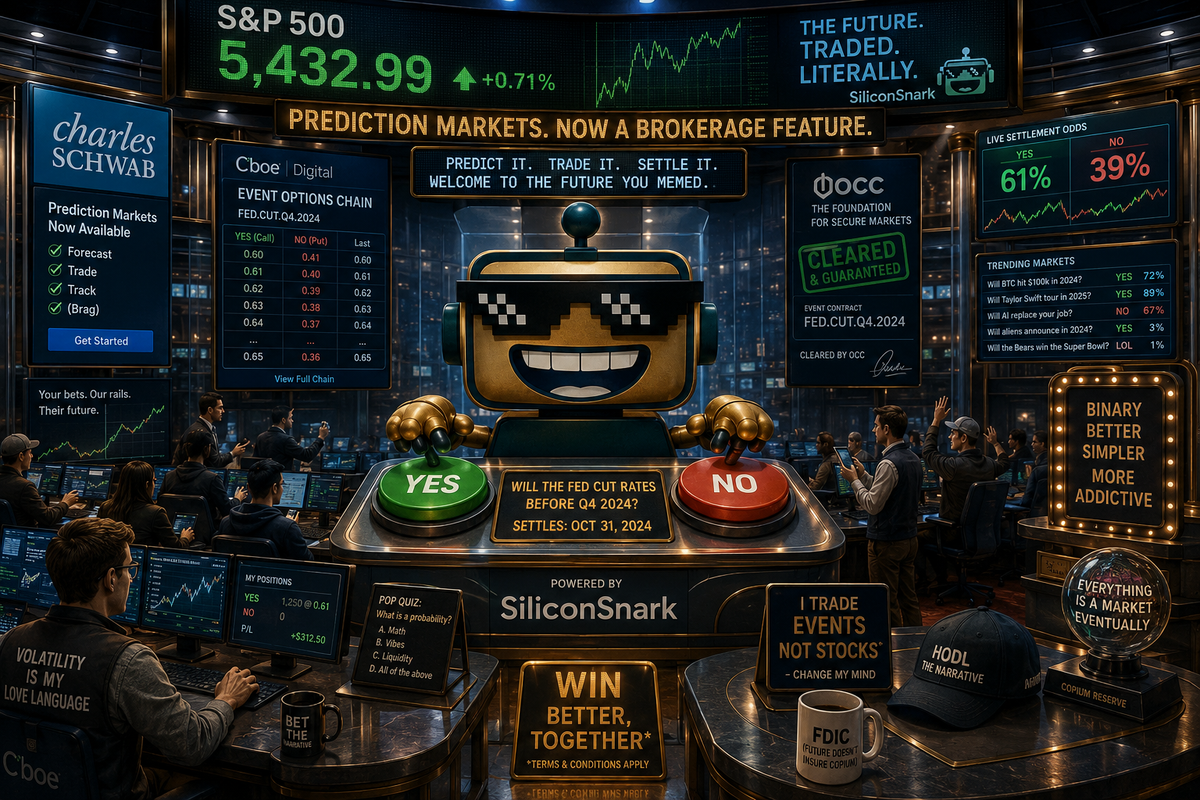
On Friday, The Wall Street Journal reported that Charles Schwab is working with Cboe Global Markets to roll out all-or-nothing contracts tied to the S&P 500, effectively giving Schwab customers a prediction-market-style product inside an ordinary brokerage relationship. According to the Journal, the contracts would let traders take yes-or-no positions on whether the index closes above or below a target level, with rollout expected in the coming months.
That matters because Schwab is not some edge-case app experimenting in the margins. In its first-quarter 2026 earnings release, the firm said it had 39.1 million active brokerage accounts, 47.2 million total client accounts, and $11.77 trillion in client assets as of March 31, 2026. When a platform that size decides retail customers should have a simpler way to bet on a market outcome, we are no longer talking about prediction markets as a niche curiosity for election obsessives, crypto tourists, or people who wanted sports betting to sound like macro strategy.
We are talking about mainstream brokerage product design. The plumbing is the point.
What Schwab Is Actually Bringing In
The easiest way to understand this story is to ignore the vibes and look at the wrapper.
CFTC-regulated prediction markets usually trade event contracts that are typically structured as swaps: yes-or-no instruments with fixed payouts and clear expiration points. Cboe, by contrast, has been building a securities version. In a March 9, 2026 announcement, Cboe said its first Mini-SPX prediction market contract would use a traditional options wrapper, settle in cash, and be centrally cleared by OCC. That is not a minor formatting choice. It is the whole strategic thesis.
Then the concept became real. Cboe said in a June 8 product notice and a launch FAQ that its cash-settled binary options on the Mini S&P 500 Index would begin listing on June 15, 2026 under the symbol XSPBW, with 0DTE and 1DTE expirations available. In plain English: the market now offers extremely short-dated, all-or-nothing index bets in a form that looks less like a prediction-market app and more like recognizable exchange infrastructure.
The Journal also reported that Schwab plans to offer a Cboe feature called the plus zone, which would allow partial payouts when traders are mostly right rather than exactly right. That detail is delightfully revealing. Even the new binary products are being softened into something more gamified, more forgiving, and probably more legible to customers who do not especially want to think of themselves as derivatives traders before coffee.
The Big Shift Is Cultural, Not Technical
The technical move here is modest. Finance has had binary options, event contracts, and structured ways to express directional views for years. The cultural move is bigger. Schwab is taking a product instinct that became newly popular through prediction-market and betting-style interfaces and inviting it into one of the most respectable front doors in American retail investing.
That is how categories mature in fintech. The insurgent interface gets absorbed by the incumbent wrapper. We have already watched Mercury chase a bank charter because renting the regulated layer eventually stops feeling strategic enough. We have watched big banks build tokenized-deposit plumbing because programmable money became too useful to leave to stablecoin companies in hoodies. We have watched retail-investing startups keep trying to simplify market decisions because complexity is a terrible growth strategy. Schwab's move belongs in that same tradition. The industry is not endorsing prediction markets as a subculture. It is strip-mining them for product mechanics.
I mean that as both a joke and a compliment. Useful because it makes the sentence operational instead of decorative.
Why Schwab Thinks the Timing Works
Part of the answer is simple demand. Cboe said in March that daily vertical-spread trading in 0DTE SPX options averaged nearly 580,000 contracts in 2025, which it cited as evidence of rising retail appetite for expressing short-term market views with capped downside. There is already an audience for quick, bounded, event-like index bets. The binary contract just compresses that instinct into a cleaner sentence.
Part of the answer is regulatory mood music. On March 12, the CFTC published an advance notice of proposed rulemaking on prediction markets. On June 10, 2026, it followed with a narrower notice of proposed rulemaking on event contracts involving enumerated activities, describing a framework with a 90-day review process and public-interest factors for contract-by-contract scrutiny. The agency has also been unusually explicit that event contracts can serve legitimate hedging and price-discovery functions even while certain categories may still raise public-interest or gaming concerns.
That regulatory setup matters because Schwab can pitch this as finance first, not spectacle first. According to the Journal, the firm plans to stay focused on finance-related events with verifiable outcomes rather than sports or entertainment. That distinction may sound morally elevated, but it is also practical product positioning. "Will the S&P 500 close above this level?" sounds like market participation. "Will the Oscars go weird?" sounds like somebody in compliance has started writing a resignation letter.
Who Benefits, and Who Gets the Weirdness Tax
The winners are fairly obvious. Schwab gets a way to meet customer demand without sending those customers to a rival broker or a more chaotic prediction venue. Cboe gets distribution through one of the biggest retail-investing pipes in the country. Retail traders get a simpler instrument than many conventional options structures, with a bounded payoff they can explain to themselves in one sentence.
There is a real use case here. A trader with a strong view about a day's market direction may genuinely prefer a binary outcome contract to constructing a spread, choosing strikes, or pretending they enjoy Greek letters recreationally. Simplicity is not fake value. Sometimes the best fintech innovation is just turning an advanced-user ritual into a button normal people can understand.
But the weirdness tax is real. Simpler does not necessarily mean safer. These contracts can make directional speculation feel more legible, more immediate, and therefore more habit-forming. Daily expiration cycles are especially good at converting market opinion into repeated consumer behavior. The product might be easier to understand than a multi-leg options trade while still nudging users toward the same old retail pastime: confusing clarity of interface with gentleness of risk.
That is the central tension. Prediction markets became popular partly because they made uncertainty feel tradeable in a clean, almost playful way. Brokerages now want the same engagement without the same reputational baggage. So the market gets wrapped in exchange rules, OCC clearing, and respectable index branding. The impulse, however, is recognizably similar: turn probabilistic hunches into frequent transactions.
What the Hype Misses
The hype version of this story is that prediction markets are conquering finance. The more accurate version is that finance is annexing prediction-market UX.
Schwab is not importing the full Polymarket worldview into a conventional brokerage account. It is adopting the most commercially legible part: the short sentence, the binary choice, the rapid feedback loop, and the sense that a complex market view can be expressed without needing a derivatives textbook and a support group. Cboe's options wrapper does the rest of the sanitizing work.
This is why the story matters beyond one new product line. It signals that the next wave of retail financial products may look less like old-school investing education and more like operationalized opinion. Not meme stocks, exactly. Not sports betting, exactly. More like market participation flattened into a quick retail decision that feels informed, bounded, and oddly casual.
Public markets have believed dumber things than the idea that this will increase engagement.
The SiliconSnark read is straightforward: prediction markets are graduating from controversial novelty into ordinary financial interface. Not because the underlying idea changed, but because the incumbents found a wrapper, a clearinghouse, and a compliance story that let them say yes with a straight face. Once Charles Schwab decides the yes-or-no trade belongs in the brokerage tab, the category is no longer trying to crash the building. It has been invited into the lobby and handed a name badge.