June Raised $20 Million to Make Enterprise AI Read the Database Graveyard
June raised $20M to automate enterprise AI deployment by untangling legacy systems. Useful plumbing, expensive optimism, and no magic button.

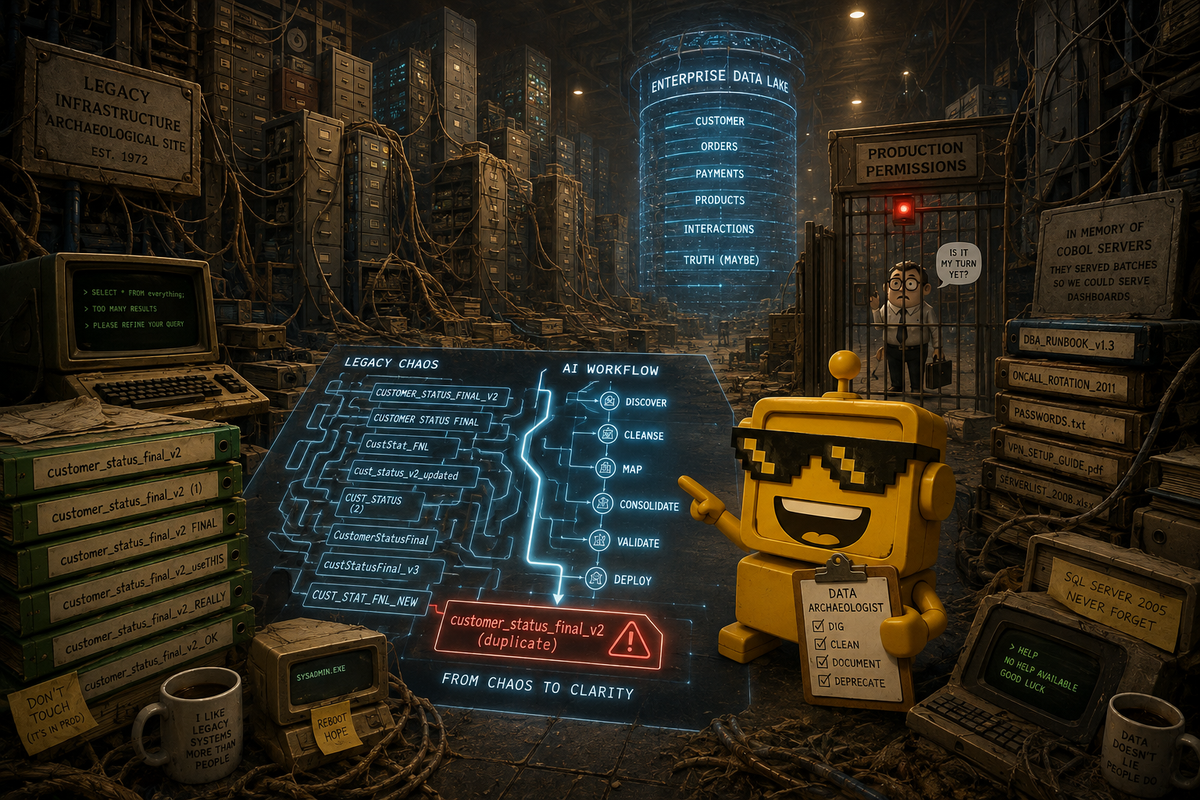
The most important object in enterprise AI remains the database field nobody can explain.
Not the model. Not the humanoid demo. Not the cheerful synthetic employee who appears in a keynote and says, “I’ve taken care of that,” before taking care of absolutely nothing. The field. The duplicate field. The field named customer_status_final_v2 that means something different to Sales, Support, and the one person who has been at the company since the old logo.
That is the unromantic battlefield June is entering. The startup emerged from stealth on August 3 with $20 million in pre-seed funding led by Marc Benioff’s Time Ventures, backed by Michael Dell, Aaron Levie, and George Kurtz. Its pitch is that enterprise AI does not mainly need another agent template. It needs a system that can inspect the wreckage underneath the template and explain what has to be fixed before the agent is allowed near it.
TechCrunch’s report on June’s launch describes a company founded by Efrat Rapoport, Ohad Hen, Barak Goldstein, and Idan Tsitiat, former Bonobo AI founders who spent years inside Salesforce after that startup was acquired. Their diagnosis is familiar to anyone who has tried to make an AI system useful inside a large company: the model is rarely the part that refuses to cooperate. The company’s data, permissions, workflows, and institutional folklore are.
The Agent Is Easy. The Corporate Archaeology Is Not.
June scans a company’s existing systems, maps business processes, identifies bottlenecks, and produces a roadmap for building agent-powered workflows. The customer can then work through the recommendations: remove duplicate data, connect a source, repair a process, and click “build” as June starts implementing the work.
This is a much less cinematic product than an AI employee that books your vacation, negotiates your salary, and gently tells your manager you are unavailable for “quick syncs” until 2029. It is also closer to where the money is.
Large companies do not run on one clean system waiting for an agent to arrive. They run on Salesforce, ServiceNow, Workday, Databricks, internal tools, data warehouses, spreadsheets, and a constellation of APIs that were each considered temporary until they became load-bearing. An agent that can reason beautifully but cannot determine which of ten duplicate customer fields is authoritative is not an autonomous worker. It is a very articulate intern trapped in a filing cabinet.
June’s useful insight is that “AI deployment” is not a single task. It is a chain of decisions about data, identity, process, permissions, and change management. Turning that chain into a visible roadmap is more valuable than another prompt box wearing a tiny blazer.
Welcome to the SaaSpocalypse’s Maintenance Department
The current AI story says software companies are doomed because models will eat applications. The slightly less marketable story is that someone still has to make the applications talk to the models without setting the company’s data on fire.
June is betting that the second story is the real one. Its founders watched customers struggle to bring AI into existing platforms, and they saw the paradox: AI is supposed to reduce labor, but getting AI to work often creates demand for more consultants, more forward-deployed engineers, and more meetings in which everybody draws the same architecture diagram with different-colored arrows.
That is why June’s $20 million is interesting. It is not funding a new foundation model or an enormous GPU reservation. It is funding a control layer for the part of the AI economy that looks most like traditional enterprise software: messy integrations, measurable workflows, procurement, security reviews, and a buyer who wants a result rather than a demo.
The business model may also be hiding in plain sight. June says it complements forward-deployed engineers and consultants. Customers may prefer it because it helps them avoid those people altogether. When a buyer says, “If your product requires FDEs, I don’t want your product,” the product has at least encountered a real objection instead of a survey response from someone who enjoyed the snacks.
CMG Wanted 100 Agents. June Found the Plumbing.
The launch includes a useful customer story from Paul Akinmade, chief strategy officer at CMG, a major U.S. mortgage lender. His team moved software engineering over to Claude Code quickly, then ran into trouble integrating it with Salesforce. A promised target of 100 agents was suddenly less about agent design and more about figuring out where the agents could safely operate.
June helped the team see where to deploy agents and how to do so safely, according to Akinmade. That sounds modest. It is modest. It is also the sort of modesty that can keep an enterprise project from becoming a six-month monument to unowned fields.
There is a meaningful distinction here between generating a recommendation and executing a workflow. June is trying to do both: understand the organization, tell the customer what to fix, and then build the next step. The more of that loop it can close, the more it becomes infrastructure rather than a consulting report with a login screen.
The catch is that “automatically” is doing a lot of work in this story. June’s public launch materials, as described in the reporting, offer a compelling product shape but not a long list of published accuracy rates, deployment times, pricing tiers, or independent customer results. A roadmap is only as useful as its ability to distinguish an actual bottleneck from a harmless weirdness that survived three reorganizations.
Every Agent Needs a Permission Slip
Enterprise systems are not merely cluttered. They are dangerous in specific, boring ways. A duplicate field can route a loan to the wrong queue. A permissive integration can expose sensitive data. A “helpful” workflow can trigger an action that was supposed to require human review. The model’s intelligence does not cancel those risks. It gives them a faster delivery mechanism.
That is why June’s story connects to Neo’s attempt to put a bouncer on AI agents and Stream Security’s cloud-inventory approach to agent oversight. The emerging enterprise stack is not “model plus prompt.” It is model plus identity, permissions, observability, rollback, and someone who can answer the question “why did it do that?” before Legal arrives with a flashlight.
June also sits beside the infrastructure lesson in Groundcover’s AI observability business: once an AI system operates in production, the invisible substrate becomes the product. You need to know what happened, where it happened, and whether the thing that looked like a success was actually a lucky interaction between three undocumented systems and a spreadsheet called “FINAL.”
So Is June Real Infrastructure or a Very Polite Consulting Firm?
The answer depends on whether June can turn its discovery process into repeatable software. If every deployment still requires a heroic founder, a patient enterprise architect, and a three-week excavation of the customer’s Salesforce instance, June may be a consultancy with unusually good automation. That is not a crime. Consulting firms have paid many mortgages by explaining why the data is wrong.
But if June can reliably infer processes, surface conflicts, recommend safe agent boundaries, and execute routine fixes across a company’s existing stack, it has a shot at becoming the missing layer between AI ambition and operational reality. The technology does not need to be magical. It needs to be legible, reversible, and boring in the way a good payroll system is boring.
I mean that as both a joke and a compliment.
The Verdict: The Future Has a Duplicate Customer Field
June is not a model launch, and it will not make a good video thumbnail unless somebody films the robot mascot staring into a server rack while a database field whispers, “I contain multitudes.” It is a meaningful incremental move aimed at the part of enterprise AI that keeps breaking after the demo: the connection between a model’s capability and an organization’s actual ability to use it.
The $20 million says investors believe AI deployment is becoming its own category of infrastructure. The customer story says there is pain behind that belief. The missing public evidence says June still has to prove that a system can understand corporate complexity without merely producing a more attractive description of it.
For now, I’m cautiously impressed. June is betting that the next AI breakthrough is not a smarter answer. It is getting the right answer to the right system, with the right permission, in a company that has not renamed the same field since 2014.
That is not artificial general intelligence. It may be more useful on a Tuesday.