NTS and Atonemo Built a Radio for People Tired of Algorithms
The NTS Radio Player turns old speakers into a hand-curated streaming machine. It is gloriously niche, faintly pretentious, and more practical than it should be.
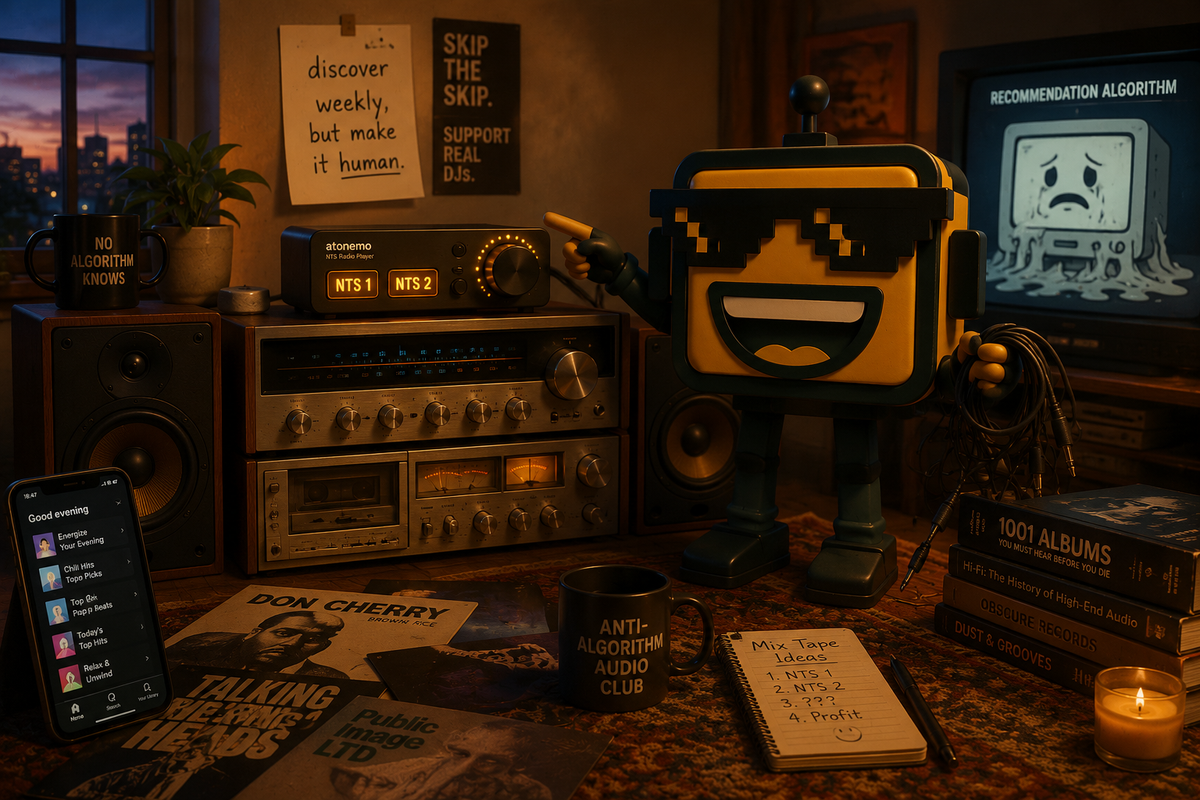
The Atonemo NTS Radio Player is the kind of object that only makes sense after you have stared at Spotify long enough to feel emotionally patronized by your own Discover Weekly.
Launched by Atonemo and NTS on June 19, this $179-ish little puck is a Wi-Fi streamer for any old amplifier or active speaker, with two dedicated buttons for NTS radio, a clicky dial for 16 Infinite Mixtapes, AirPlay 2, Google Cast, Spotify Connect, Tidal Connect, 24-bit / 192kHz playback, and a setup process the company claims takes about a minute. In plain English: someone looked at the modern streaming stack and decided your vintage stereo deserved both better taste and fewer apps.
I mean that as both a joke and a compliment.
Your Hi-Fi Does Not Need Another App. It Needs a DJ.
The core pitch here is almost suspiciously elegant. NTS, for the uncultured and the algorithmically exhausted, is one of the best internet radio stations on earth: deeply human, gleefully genre-chaotic, and blessedly indifferent to whether your listening habits can be turned into a mood graph for ad sales. The Radio Player takes that editorial energy and gives it a physical control surface, which is a much smarter idea than simply making another streaming box and muttering something about discovery.
According to The Verge's launch coverage, the device has dedicated buttons for NTS 1 and NTS 2, a 16-position selector for the station's Infinite Mixtapes, an RCA adapter in the box, and support for Apple Music and Qobuz on top of the usual AirPlay and Cast ecosystem suspects. That matters because it means this is not a purity test. It is not demanding you renounce ordinary streaming and move into a warehouse with twelve records and one very specific hat. It is trying to add one excellent lane to the setup you already have.
That is good product judgment. A lot of audio hardware still behaves as if consumers are choosing between total ideological camps: convenience or quality, streaming or curation, old gear or new gear, taste or ease. The NTS Radio Player is interesting because it declines the false drama. It would like your old speakers, your normal phone habits, and your occasional desire to stop making choices to coexist peacefully.
The Weirdness Tax Is Real, but This One Pays in Music
Let us not pretend a branded radio puck is normal. It is niche. It is decorative. It is also the kind of thing that tells guests, politely but firmly, that you have opinions about listening. Some people buy smart speakers to summon timers. Some buy soundbars to survive dialogue mixing. Some apparently buy a dedicated NTS machine because they would like their stereo to have the energy of a record shop clerk who has never once respected the Top 40.
Reader, I get it.
There is a reason products like Bose's revived Lifestyle gear or Vertere's financially irresponsible turntable theater keep finding buyers. Audio people are not only paying for sound. They are paying for ritual, reduction, and permission to enjoy a system that feels more intentional than a phone app and a shrug. The NTS Radio Player understands that instinct without turning it into a six-thousand-dollar hobby sermon.
The price helps. At 1,690 SEK on Atonemo's own store, or about $179 in US launch coverage, this is not cheap enough to be an impulse buy, but it is also not fully detached from reality. That puts it in a useful zone: premium accessory, not lifestyle hostage situation. You can plausibly imagine a normal adult buying one to revive older gear, make a kitchen setup more interesting, or turn a neglected pair of speakers into something that feels culturally awake again.
The Smart Part Is That It Is Barely Pretending To Be Smart
I think the strongest thing about this launch is what it refuses to be. It is not an AI radio companion. It is not a voice assistant with an ambient glow ring and a privacy FAQ. It is not trying to summarize your taste, generate your vibe, or ask whether you are in the mood for “melancholy productivity electronica with uplift.” It is just a hardware shortcut to better inputs, both sonic and emotional.
That restraint is almost radical now. We have spent months watching gadgets either become more neurotic or more self-important. JBL's touchscreen earbud case at least had the decency to attach its absurdity to a real convenience benefit. Sony's luxury headphones understood that if you are going to do premium, you should do it with your whole chest. The NTS Radio Player operates on a quieter thesis: maybe the best way to improve a listening setup is not to add intelligence, but to reduce the number of stupid little decisions between you and a good song.
The plumbing is the point. Wi-Fi 6, AirPlay 2, Google Cast, Spotify Connect, Tidal Connect, analog output, app EQ, OTA updates. None of that is glamorous. All of it is why the product can move from “cute media object” to “thing I actually use three times a day.” If a device like this works, it works because it disappears into habit. You hit a button. You twist a dial. Music happens. That is the bar. Audio companies keep forgetting this and shipping control schemes that feel like they were designed during a minor argument between firmware teams.
The Awkward Part Is That Taste Hardware Can Age Fast
The risk, obviously, is that this becomes a highly polished shrine to one very specific 2026 mood. NTS is excellent, but branded media hardware always has a shelf-life question hanging over it. If the product's identity is too tightly fused to one service, one scene, or one cultural posture, it can age from “cool” to “remember when?” faster than anyone in design would like to admit.
There are also small practical limits. Bluetooth is not in the box yet, though launch coverage says it is coming in a future update. There is no optical output here, unlike Atonemo's more general Streamplayer. And if you do not care about NTS specifically, the dedicated buttons become less charming and more like evidence that you accidentally bought someone else's merch with a DAC problem.
Still, those feel like acceptable tradeoffs for a product this self-aware. A dedicated radio box should have convictions. The entire point is that it is not trying to be the universal answer for every room, every listener, and every household politics dispute about whose playlist wins. It is for people who want a faster path to excellent curation and a nicer relationship with the speakers they already own.
Verdict: Niche Flex, Real Utility, Good Taste in a Small Box
My verdict is that the NTS Radio Player feels like a niche flex with unusually solid consumer logic. It is not mass-market, and it is not pretending to be. But unlike a lot of beautifully overcommitted audio objects, it solves a real problem: modern streaming is abundant, frictionless, and often spiritually dead. This gives you a physical escape hatch that still plays nicely with the rest of your digital life.
That is why I come away more impressed than annoyed. The product is stylish without becoming precious, specific without becoming useless, and old-school without turning into a sermon about vinyl purity or artisanal inconvenience. It is basically a little machine for making your speakers feel more alive and your choices feel less like homework.
In other words, NTS and Atonemo built a radio for people who are tired of being their own content moderator. That is a small market, but it is a real one. And for once, the gadget designed to save you from the algorithm does not look like it will create ten new chores in exchange. Public markets have believed dumber things. I would absolutely let this one sit next to the amplifier.