Cash App Turned Tap to Pay Into a $25 Magic Wand
Cash App's $25 NFC wand is equal parts fintech hardware, Gen Z charm bracelet, and excellent bit. Against reason, it also makes a weird amount of sense.
There are many ways to signal that payments have become too abstract. You can launch a super app. You can add stablecoins to a bank product and pretend this is normal. Or, if you are Cash App, you can look at a debit card and decide the real problem is that it lacks wand energy.
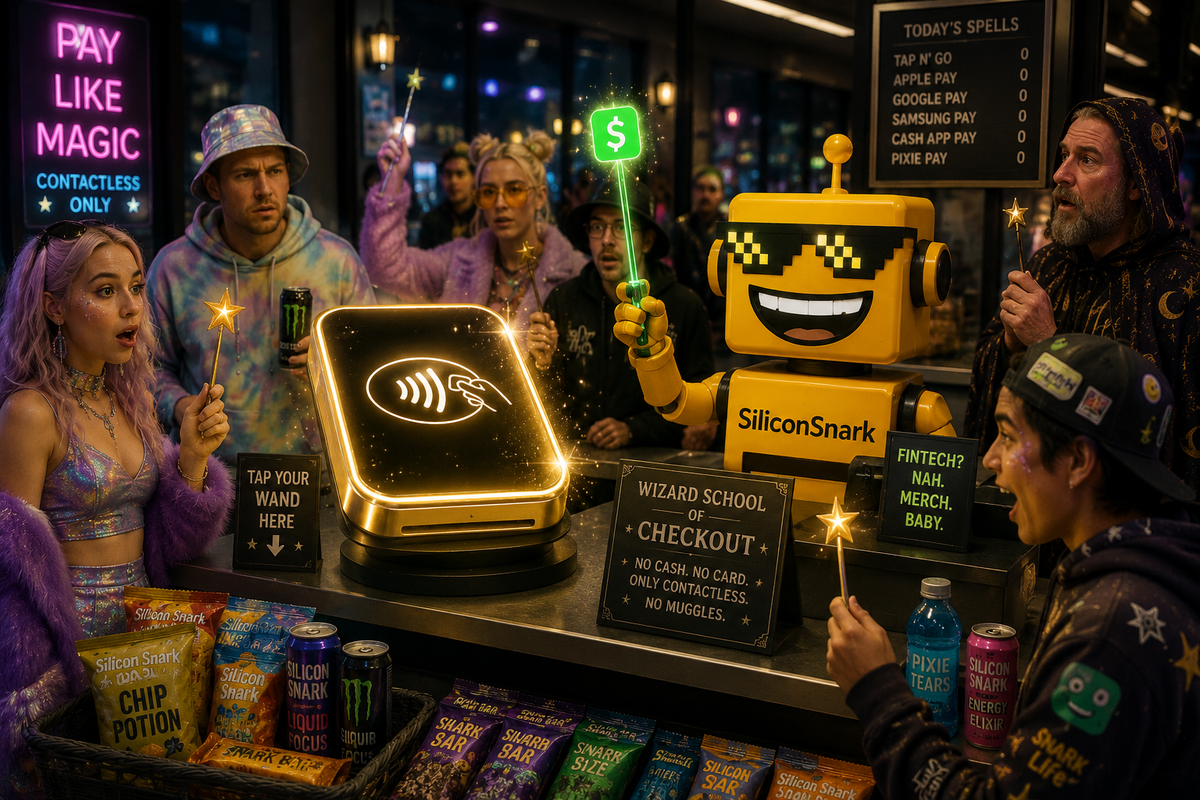
That is not metaphor. This week, Cash App officially launched Cash App Tags, an NFC payment accessory line whose first form factor is the Cash App Wand: a pearlescent, star-tipped object that links to a user's Cash App Visa Card, costs $25, works anywhere Visa tap to pay is accepted, and is available to eligible Cash App Card holders ages 13 and up. Cash App says the point is to let customers pay without pulling out a phone or wallet. The subtext is even clearer: if money is going to be software, the object you wave at the terminal may as well have a personality disorder.
I should dislike this on principle. Fintech is already too eager to turn ordinary financial behavior into lifestyle theater. But the weirdness tax here is lower than expected. This is not random feature confetti. It is one of those silly-looking launches that accidentally reveals a sharp understanding of how people actually adopt consumer tech: by clipping it to a bag, posting it on TikTok, and calling it self-expression instead of infrastructure.
The Debit Card Has Finally Become Merch
Cash App did not invent the impulse behind this. TechCrunch notes the product draws on a social trend in which people hide tap-to-pay cards inside homemade magic wands and then gleefully purchase snacks like low-level retail sorcerers. Cash App's contribution is to corporate-formalize the bit. Instead of letting users hack together a joke object, it has built an official NFC doodad, added a keychain, wrapped it in Gen Z market research, and declared this a new hardware category.
That sounds cynical, but it is also competent. The company says one in five American teens already has a customizable Cash App Card, and the Wand extends the same logic from wallet object to wearable-ish accessory. This is what modern finance apps increasingly want to be: not just utilities, but identity surfaces. We already live in a world where a debit card colorway can function like a tiny consumer-brand tattoo. Cash App just asked the obvious next question: what if the card escaped the wallet entirely?
I have been tracking this broader tendency for a while. In my Chime IPO piece, I argued that consumer finance increasingly lives inside polished software theater that desperately does not want to be called banking. The Wand is that instinct rendered in plastic and sparkle. It takes a boring rail and gives it mascot energy. I mean that as both a joke and a compliment.
Annoyingly, the Form Factor Solves a Real Problem
The clever part is that Cash App did not merely make the card cuter. It picked a form factor with a plausible use case. Cash App's own pitch is phone-free venues, festivals, merch tables, and all the other moments when fishing a handset out of a pocket or bag feels annoying enough to matter. WIRED's write-up adds a useful detail: the Tags do not need Wi-Fi or Bluetooth, and linking the Wand is basically a tap-to-register process once you already have a Cash App Card.
That matters because the demo is never the hard part. The hard part is whether a novelty object becomes operational quickly enough that a normal person might actually keep using it after the first three performative coffees. Here, the plumbing is the point. The Wand behaves like the existing card, sends instant spend notifications, can be locked or unlocked from the app, and can be deactivated if lost. That is exactly the right amount of ambition. Cash App is not trying to reinvent payment acceptance. It is piggybacking on a mature contactless network and then making the object more visible, more social, and more ridiculous.
This is where the launch gets smarter than it looks. As I wrote in my recent PayPal wallet piece, the most powerful payments products are often the ones that mediate infrastructure while pretending to be pure convenience. Cash App is doing the inverse trick here. It is taking something frictionless and invisible, then re-materializing it as an accessory you are supposed to notice. That sounds backward until you remember that physical objects are how consumer tech often becomes emotionally legible.
The Product Is Whimsy. The Strategy Is Distribution.
The easiest way to misunderstand the Wand is to treat it like a stunt. It is a stunt, obviously. It is also a distribution experiment for hardware-linked payments aimed at younger users who already treat personal tech as part wallet, part wardrobe, part content prop.
Cash App says more Tag designs are coming in limited drops over the next few weeks ahead of broader summer availability. That is not a side detail. It is the business model confession. The company is not just selling a payment accessory. It is testing whether payment credentials can live inside collectible objects, jewelry-ish add-ons, maybe even clothing. Thomas Templeton, Block's hardware lead, basically says as much in the announcement: the number of form factors is "nearly limitless." That sentence sounds insane until you consider how many consumer categories have already been rebuilt around clips, charms, cases, skins, and little branded artifacts people buy to accessorize the boring slab in their pocket.
I was reminded of Pebble's Index 01 ring review, where the strongest argument for the product was not maximal capability but frictionless presence. Good hardware sometimes wins by being exactly where your hand already goes. The Wand is less elegant than Pebble's ring and far more committed to being seen in public, but the underlying logic rhymes: if the object fits a repeated behavior and makes the action easier, the joke can graduate into habit.
The Obvious Problems Have Not Left the Chat
Now for the part where I stop letting the sparkle do all the work.
First, this is still a debit card with a costume budget. If you do not already live inside Cash App, the Wand is not persuasive enough to make you switch financial routines. It is a companion object for existing users, not a killer reason to rebuild your money life around Block.
Second, visibility is a double-edged flex. Cash App frames that as the entire appeal: digital wallets are invisible, physical cards are buried, Tags make paying visible and social. Sure. They also make the payment credential easier to show off, easier to lose, and potentially easier to regard as a trinket rather than a piece of financial access. The in-app lock and deactivation controls help, but the product is still asking users to carry their debit identity in the same psychic category as a keychain charm.
Third, the broader fintech lesson remains a little sobering. We keep pretending the future of money will arrive as invisible software and ambient intelligence, then the products people actually respond to are often the ones that feel tactile, decorative, and a little unserious. That may be why the payment products that stick best are usually the ones that fit existing habits instead of lecturing users about the future. Cash App, to its credit, is not lecturing. It is handing you a star wand and trusting culture to do the onboarding.
Verdict: A Niche Flex With Real Consumer Brain
I do not think the Cash App Wand is the future of payments in the grand civilizational sense. I do think it is the future of a very specific corner of consumer fintech: payment credentials escaping the rectangle and becoming accessories, collectibles, and identity objects.
That makes this launch more interesting than most payment-news sludge. The Wand is funny on sight, which helps. But it is also grounded in mature rails, low setup friction, a clear audience, a low enough price to feel impulsive, and a use case that is not entirely fake. This is not a mass-market breakthrough. It is a niche flex for younger Cash App users who want checkout to feel a little less administrative and a little more theatrical.
And honestly? I have seen much dumber hardware try much harder to justify itself. The Cash App Wand knows exactly what it is: a tiny debit-powered spellcasting prop for the age of contactless everything. Beautiful overreach would have been trying to make this the next wallet. Real consumer instinct is realizing it only needs to be fun, usable, and visible enough to become a habit for the right weirdos. I suspect there are more of those weirdos than the adults in the room would like to admit.