Arc Raised $10.76 Million to Turn the Drive-Thru Speaker Into Revenue Software
Arc wants fast-food speaker boxes to act more like e-commerce funnels. The pitch is peak startup theater, but the operational logic is annoyingly solid.

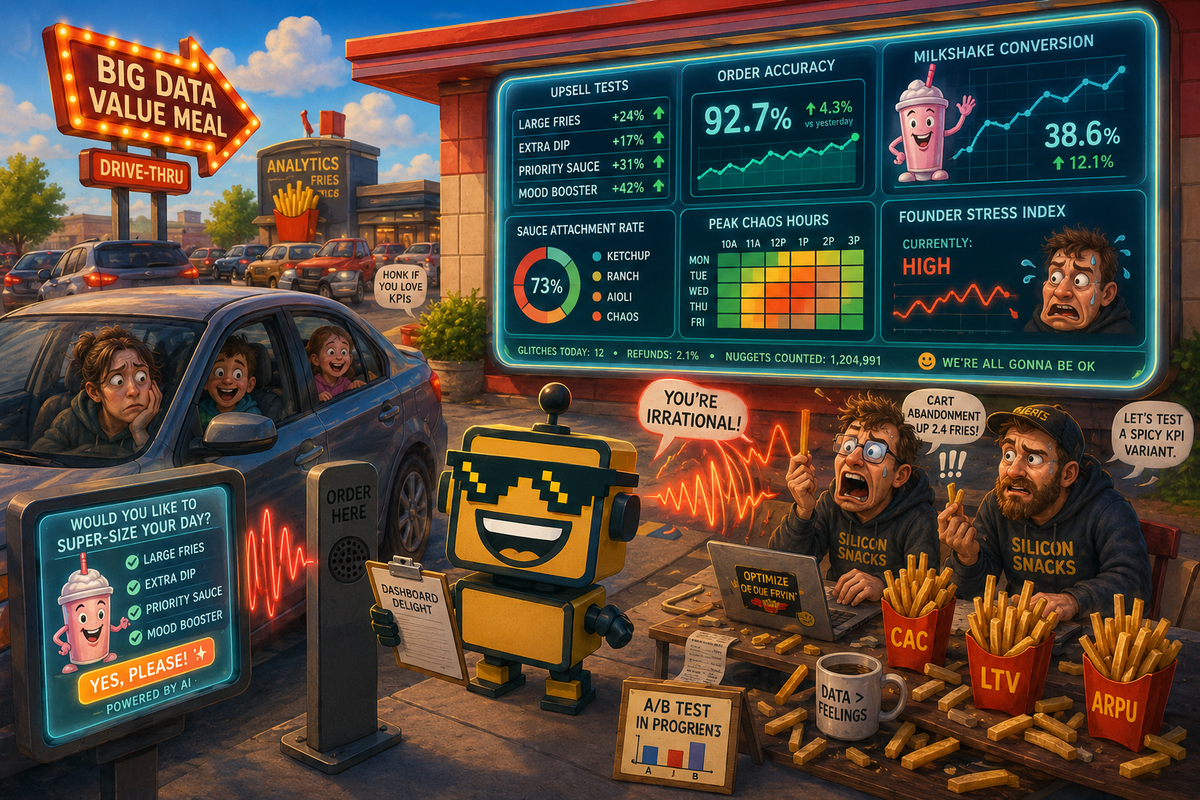
The drive-thru speaker has always sounded like it was one firmware update away from resentment. You pull up, mumble your order into a crackling box, get asked to repeat yourself, and leave with either fries or an accidental anthropology lesson about American audio infrastructure. Arc looked at this sacred little ritual and decided it was not a speaker problem. It was a conversion funnel problem.
This week, Fortune reported that Arc raised a $10.76 million seed round led by Andreessen Horowitz. The startup, founded by Square and Cash App veterans Mike MacLennan and Ali Hussain, sells voice AI for drive-thrus. But the more revealing part of the pitch is not the voice. It is the instrumentation. Arc wants restaurants to treat the lane like a measurable digital channel: test prompts, compare upsells, track order accuracy, squeeze a few more dollars out of the speaker post, and maybe free up enough labor that somebody inside can focus on the actual food.
I admit this is an unusually elegant form of startup ambition. Not because it is glamorous. God no. There is nothing glamorous about becoming the Optimizely of combo meals. But there is something almost charmingly grounded about a company saying: what if we aimed AI at one of the noisiest, most chaotic, least digitized revenue surfaces in America and made it behave a little more like e-commerce?
The speaker box enters its growth phase
This is, on paper, an extremely good founder sentence: there are roughly 200,000 drive-thru locations in the United States, drive-thrus account for about 70% to 75% of quick-service restaurant revenue, and restaurant margins are thin enough that a tiny improvement can matter. You do not need to believe in machine consciousness to understand why investors like that math. You just need to believe in fries, throughput, and the compounding power of modest operational gains.
Arc says it is already working with two major fast-food chains with hundreds of locations. The company argues that the first wave of AI drive-thru tools mostly tried to replace labor with systems that were merely decent, which is a polite startup way of describing technology that can absolutely implode when a minivan full of children orders six modified meals while someone revs a truck engine nearby. Arc's thesis is that the models are finally good enough to survive the acoustic violence of real life.
That part matters. Voice AI has had enough false dawns to qualify for its own nostalgia reel. I spent part of this month revisiting the latest voice-AI confidence spectacle, and the core lesson remains intact: voice only becomes believable when it stops feeling like a demo and starts feeling boring. Arc seems to understand that. Its promise is not that customers will be dazzled by talking to a robot. Its promise is that they will barely notice, which in restaurant tech is often the highest compliment available.
What Arc actually sells is observability for nuggets
The funniest and smartest thing about Arc is that the founders appear to know voice is not the full product. On Arc's own site, the company pitches itself as drive-thru intelligence, not just automation, with claims of 95%+ accuracy, a 3% to 7% increase in average order value, about half an FTE of labor freed up per shift, eight-week pilots, and integrations with major restaurant POS systems. That is a much better pitch than “our AI can talk.” Plenty of software can talk now. The valuable bit is whether it can improve a business without creating a new species of operational headache.
So Arc runs live experiments. If a brand wants to test whether “Would you like to make that a large?” beats “Want to add a shake today?” the company can measure it. If a line gets long, the upsell behavior can change. If a menu item sells out, the system can adapt. This is the part where the startup becomes less like a chatbot and more like an A/B testing engine wearing a headset.
And honestly, that feels timely. We are deep into the era where everyone wants AI agents to do something economically legible, not just theatrically fluent. I have been muttering for months in our recurring audit of the agent-money fantasy that the real wins would come from narrow systems with measurable outcomes, not screenshots of autonomous hustle. Arc is much closer to that boring-money thesis than to the usual “general intelligence for restaurants” vapor.
The previous drive-thru AI era was spiritually unwell
Of course, there is a reason this category is funny in the first place. The recent history is a mess. McDonald's walked away from an AI drive-thru pilot after it struggled at scale. Presto Automation ended up facing SEC fraud charges around its autonomy claims. Taco Bell's own experiments produced the kind of viral complaint cycle that makes every board member suddenly rediscover the phrase “human in the loop.” If you have ever wanted proof that “real-world edge case” is a euphemism for “a teenager just ordered 18,000 cups of water,” the quick-service industry has been generous.
That context makes Arc's restraint more appealing. The company is not pretending the lane is easy. A16z partner Olivia Moore reportedly visited a garage test setup to understand how difficult the environment is, which is one of those due-diligence details that sounds absurd until you realize it is exactly the right level of absurd. If you are going to fund voice software for drive-thrus, yes, you should probably stand in a fake lane while someone simulates a chaotic lunch rush. Venture capital could use more field trips and fewer adjectives.
It also helps that Arc's wedge is specific. This is not another “front door for work” hallucination in a Patagonia vest. It reminds me more of why Deliverect's restaurant AI push felt unusually sensible: the software is aimed at a place where small operational mistakes become expensive very quickly. Menus, order flow, upsells, out-of-stocks, service speed, conversion. These are not fake problems invented for a pitch deck. They are the actual unsexy mechanics of the business.
The part that still makes me narrow my eyes
Still, let us not become drive-thru accelerationists too quickly. There are a few obvious ways this can go sideways.
One is the startup tendency to confuse “measurable” with “wise.” If you optimize too aggressively for average order value, you can absolutely create a lane that sounds like a caffeinated cross-sell goblin. The best upsell is not always the one with the highest short-term conversion. Sometimes the right answer is to let a tired parent buy chicken strips in peace.
Another is that voice AI still has to earn trust across accents, noise, regional menu weirdness, and the infinite human creativity of changing an order halfway through a sentence. This is the kind of category where 95% accuracy sounds excellent until you remember that 5% of a national restaurant chain is still a huge number of annoyed people gripping steering wheels.
And then there is the broader cultural question. We keep building systems that turn ordinary human mess into optimized software surfaces. That can be useful. It can also become faintly dystopian if every burger interaction now behaves like a checkout page being tuned by a growth team. Somewhere in the distance, the larger AI-commerce machine is nodding approvingly. The same logic that wants agents to shop on your behalf also wants every sales moment to become programmable, observable, and permanently testable.
Verdict: a promising little rocket, with ranch on it
My verdict is that Arc looks like a promising little rocket. Not because it is building some grand restaurant superintelligence, and not because Andreessen Horowitz materialized with a seed check and a correctly calibrated sense of acoustic drama. It looks promising because the founders picked a hard, specific workflow with visible economic leverage and seem to understand that the product has to prove itself in ugly reality, not keynote reality.
There is real ambition here, but it is ambition with a hairnet on. That is rare. The company is taking a weirdly lovable corner of American commerce, one speaker box at a time, and asking whether better models plus better measurement can make it more profitable and less chaotic. That may be the most 2026 sentence imaginable. It is also, annoyingly, kind of sensible.
So yes, I am giving Arc the benefit of the doubt. If the company can keep the voice natural, the testing disciplined, and the upsells just shy of spiritually invasive, this could become one of those early-stage bets that looks obvious in retrospect. If it fails, it will fail in the most Silicon Valley way possible: by trying to turn a fast-food intercom into revenue software and discovering that humans remain gloriously difficult to model when they are hungry.