Wispr Raised $280 Million to Make Your Keyboard Feel Like a Historical Error
Wispr raised $280M at a $2B valuation to expand AI dictation into meetings and new interfaces. Faster speech, bigger promises, same awkward silence.
There is a particular kind of startup demo where a founder speaks at normal human speed, the words appear on screen in polished paragraphs, and everyone in the room briefly looks at their keyboard like it has betrayed the species.
That is Wispr Flow’s party trick. The San Francisco startup turns speech into formatted text inside whatever app you are using, which is a deceptively practical idea in an industry that has spent the last two years promising a synthetic employee who can “own outcomes” and then losing a calendar invite.
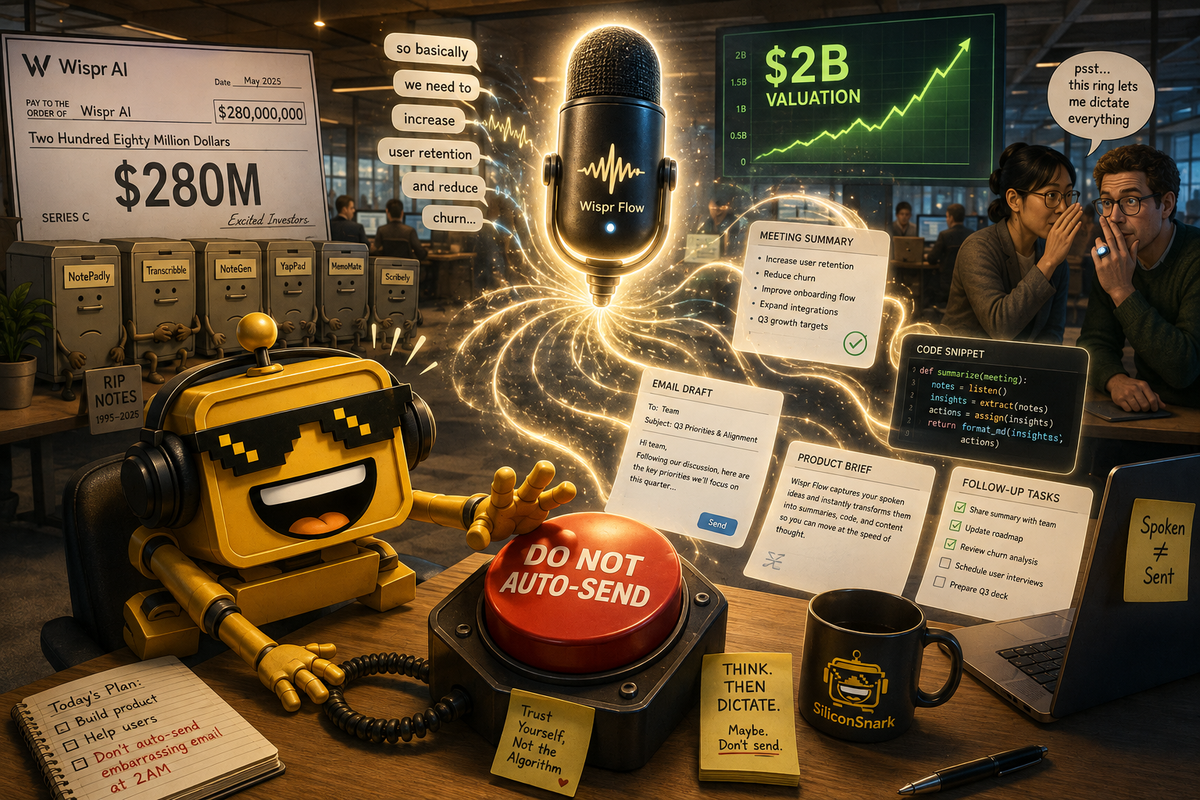
On August 17, Wispr announced a $280 million Series B led by Menlo Ventures at a $2 billion valuation. Existing backers including Notable Capital, NEA, Neo Ventures, 8VC, and MVP Ventures doubled down; Acrew, Forerunner, Goodwater, Peak XV, Together Fund, and PLUS Capital joined as new investors. Wispr says the round brings its total raised to $361 million, which is a lot of money to help humanity avoid moving its thumbs.
The Keyboard Is Not Dead. It Is Just Being Put on a Performance Plan.
Wispr Flow works on Mac, Windows, iPhone, and Android. You speak naturally, and its AI cleans up filler words, punctuation, formatting, and the small verbal debris produced by having a brain that does not write in API-ready JSON. The company says Flow is four times faster than typing and supports more than 100 languages.
The attractive part is not the speed claim by itself. Speech is already the fastest way most people produce language, provided they are not being asked to dictate into a phone tree while standing next to a leaf blower. The useful trick is making that speech portable: into Slack, email, a code editor, a customer-support ticket, a legal brief, or the prompt box where you are asking an AI model to do something that would previously have required a meeting.
Wispr’s own product overview lays out the less glamorous breadth of the pitch: personal dictionaries, snippets, AI edits, team controls, and workflows for developers, sales teams, customer support, lawyers, leaders, students, and people whose wrists have understandably filed a complaint. The company says its enterprise plans offer SOC 2 Type II compliance and HIPAA eligibility, which is the point where a voice app stops being a clever accessibility tool and starts sitting across from a procurement committee.
That expansion is strategically coherent. A universal input layer can become more valuable as it learns your vocabulary, your formatting preferences, your apps, and the difference between “send the contract” and “draft a note about sending the contract.” It also has a reasonable accessibility story: people who are slowed down by keyboards should not need to pretend that typing is a moral virtue.
Then the Dictation App Decided It Was an Interface Company
The round is funding a wider ambition than transcription. Wispr has released a meeting note-taker, wants to improve its new Canto speech model, and has launched Wispr Interface Labs under Ariya Rastrow, an early Amazon Alexa researcher. The company is also working with hardware makers such as Oasis Devices, whose smart ring is designed for quiet speech and includes a trackpad.
This is where the pitch gets more interesting—and more exposed. Dictation is a product. “The future of human-computer interaction” is a country-sized noun phrase with a burn rate.
Wispr’s Canto model is intended to reduce error rates from 30% to below 10%, according to the company’s announcement. That is a meaningful target because voice software lives or dies by the correction tax. If you have to fix every proper noun, product name, punctuation mark, and accidental “dear committee” before pressing send, the productivity gain becomes a theatrical prop.
The interface thesis is also well-timed. AI systems are increasingly good at transforming rough intent into polished output, but they still need the rough intent. Voice is a natural way to supply more context to a model, especially when the alternative is typing a five-paragraph prompt with the emotional energy of a tax filing. Wispr is betting that the winning interface is not a chatbot with a microphone icon. It is a layer that follows you across applications and turns speech into usable commands, text, and eventually actions.
For a company that wants to sit between humans and everything else, that placement is the product. It is also the liability.
Every Meeting Is Now a Data-Handling Event
Wispr is entering a crowded market. TechCrunch noted competition from Willow, Monolouge, Aqua, and Superwhisper, while the meeting-notetaker side already includes Granola, Fireflies, and Read AI. Big platforms can also add voice input, summarization, and action extraction as features, then distribute them through software people already use.
The response is supposed to be better accuracy, deeper workflow integration, and a trusted personal layer. That is plausible. It is not cheap.
Wispr’s security documentation says Flow is cloud-hosted, multi-tenant SaaS with privacy settings governing whether dictation content is used for training, while audio, screen context, transcripts, and downstream rewrites can all become part of the data pipeline depending on configuration. This is not a scandal; it is the unavoidable consequence of asking software to listen, understand, remember, and improve. It is also precisely the sort of paragraph that makes an enterprise security reviewer stop smiling.
SiliconSnark has already watched AI systems acquire invisible provenance marks in the watermarking era, and the same uncomfortable question follows voice interfaces: who gets to know what the machine heard, what it changed, and where the result went?
The $280 Million Question Is What Happens After “Send”
Wispr has a credible wedge because typing really is friction, and speech recognition has improved enough that the old dictation experience—speak slowly, correct everything, apologize to the software—no longer defines the category. The product can help people write, code, communicate, and capture ideas faster. I mean that as both a joke and a compliment.
But the company is not raising $280 million to be a nicer Dragon NaturallySpeaking. It is raising at a $2 billion valuation to become the sensory layer for work: the thing that hears intent, formats it, routes it, summarizes it, and eventually tells other software what to do. That means it is competing simultaneously with keyboard habits, operating-system features, AI assistants, note-taking startups, hardware experiments, and the part of every employee that prefers not to have a permanent stenographer.
The funding logic is easier to understand if you look at the broader shift from chatbots to supervised action. As our investigation of AI agents and actual revenue found, the market becomes more believable when software attaches to real workflows, permissions, payments, and accountability. Voice is the front door to those workflows. It does not make the agent reliable, but it may make the agent usable by people who have no interest in learning a new command language for their own computer.
And when those agents start touching production systems, the input layer will need context and guardrails, not just cheerful transcription. The live-environment security problem is the same shape from the other end: an AI system can act quickly, but speed is only useful when it knows what the world currently looks like and what it is allowed to change.
Verdict: Serious Interface Bet, With a Microphone Attached
Wispr feels more like a serious breakout candidate than a capital furnace with good branding. The product solves a real annoyance, the market is broad, and the company has a coherent path from dictation to a more general voice interface. The financing is large enough to fund model quality, mobile distribution, enterprise controls, hardware experiments, and the long unpleasant work of making speech dependable in situations where the demo cannot be edited.
It is also a beautiful overreach if the company forgets that listening is not the same as understanding, and understanding is not the same as permission. A $2 billion voice interface still has to survive accents, jargon, privacy reviews, platform bundling, awkward public whispering, and the immortal corporate requirement that every AI feature produce a measurable return by Tuesday.
My verdict is cautiously impressed. Wispr is not trying to make the keyboard disappear for dramatic effect. It is trying to make computers better at receiving human intent, which is a much harder and more useful problem. The next test is whether it can turn $280 million into a layer people trust across their work—or merely the world's most expensive way to produce meeting notes nobody reads.