
Waniwani Raised $8 Million to Sell Insurance to ChatGPT Before Your Broker Calls Back
Waniwani thinks AI will become the storefront for insurance and loans. The pitch is half compliance plumbing, half distribution prophecy, and annoyingly plausible.

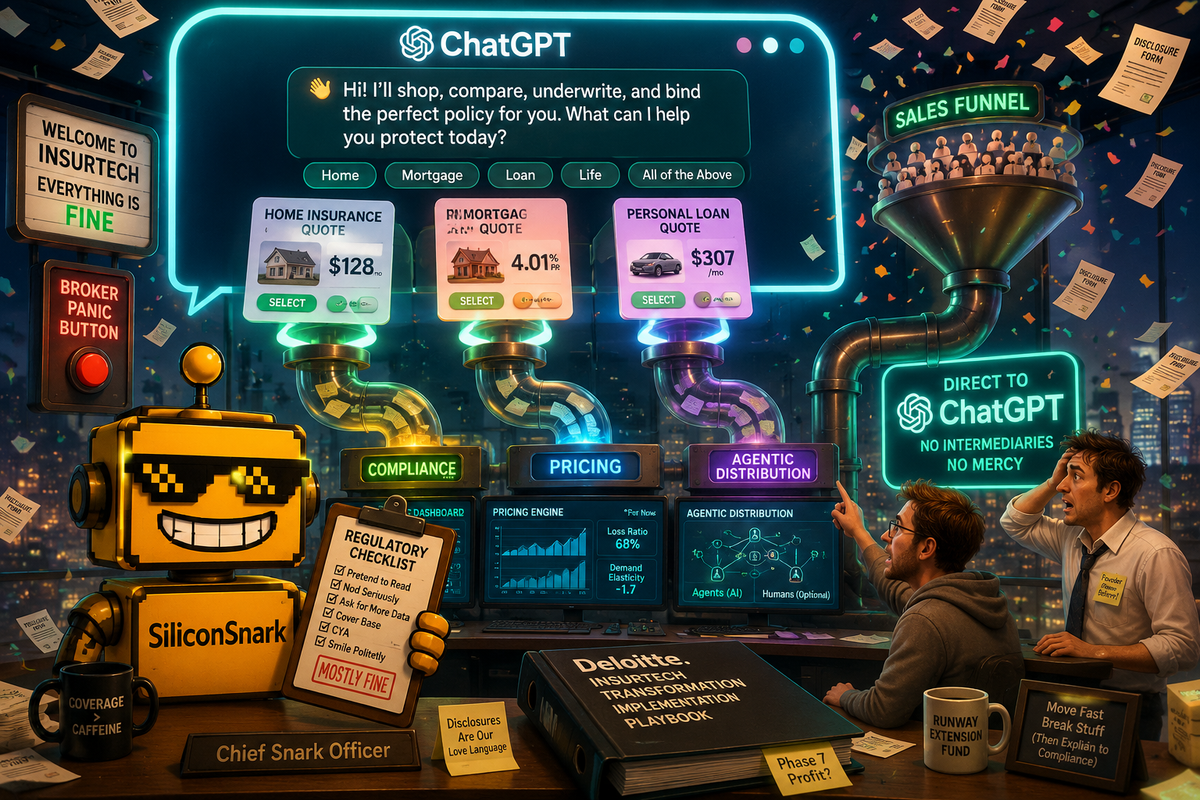
The most 2026 sentence I read today was that Waniwani raised an $8 million seed round on June 15 to help financial services companies sell inside ChatGPT, Claude, Copilot, WhatsApp, and whatever other chat surface ends up becoming your bank branch with autocomplete. There are many startup ideas that sound like they were generated by shaking a tote bag full of VC trend decks. This one, unfortunately for my snark reserves, sounds like a real market transition wearing a ridiculous outfit.
Waniwani calls itself the revenue and compliance infrastructure for the “agentic distribution” of financial services. Which is exactly the kind of phrase that makes normal adults leave the room. Translated into English, the company wants insurers, lenders, and other quote-heavy businesses to show up properly inside AI assistants, return actual offers, stay inside the regulatory guardrails, and keep optimizing the funnel after the chatbot becomes the front door.
I mean, yes, this is startup theater. But it is startup theater with load-bearing plumbing. If you already enjoyed my recent piece on Mastercard building guardrails for AI agent payments, this is the same broad genre of story: the internet’s commerce layer is quietly being rebuilt so machines can browse, compare, recommend, and eventually transact without asking a tired human to click through seven tabs.
The Broker Is Dead, Long Live the Prompt Box
Waniwani’s thesis is blunt: the old distribution stack was built to attract human attention, while the next one may have to satisfy models, copilots, and software that increasingly acts like a buyer. That sounds overcaffeinated until you remember how people already behave. They ask ChatGPT about credit cards, tax questions, insurance options, and mortgage math because typing “explain this deductible like I am exhausted” into a chat window feels much nicer than visiting a lead-gen swamp from 2014.
The company’s product pitch is specific enough to matter. Its open-source SDK lets quote-based vendors put their products directly inside AI apps, while Waniwani’s paid infrastructure handles the ugly adult part after the demo: compliance checks, brand controls, funnel measurement, pricing and messaging optimization, performance simulation, and anti-scraping protection. That is not random feature confetti. It is a pretty coherent answer to a very boring but very important question: if a model is now introducing customers to your product, who makes sure the model does not freestyle your regulated business into a consent decree?
The smartest thing here is that Waniwani is not merely pitching “buy insurance with vibes.” It is pitching distribution plus control. In financial services, the demo is never the hard part. Lots of startups can show a chatbot getting a quote. Far fewer can convince a large insurer, lender, or marketplace that this can happen without setting legal, compliance, and brand teams on fire.
They Did Not Invent the Weirdness. They Noticed It First.
What gave Waniwani an actual wedge was timing. In February, Tuio and Waniwani launched real-time home insurance quoting inside ChatGPT, which was treated in parts of the insurance world like a small meteor strike. That moment matters not because one chatbot quote flow instantly destroyed brokerage economics, but because it made the future legible. Once regulated products can be quoted at the point of conversational discovery, the old assumption that websites own the funnel starts to look fragile.
Waniwani’s own announcement says the company now works across the US, Europe, Latin America, the Middle East, Korea, and Australia, expects several million dollars in first-year revenue, and raised the round from Seedcamp, Redstone, Plug and Play, Zone II Ventures, OPRTRs Club, Kima Ventures, and a swarm of angels. For a company this young, that is not nothing. Investors love a startup that can point to a category shift and claim an unfair head start.
If you have spent any time lately in the swampy discourse around whether AI agents actually make money or merely generate screenshots and delusion, Waniwani is an interesting counterexample. This is not an agent trying to run a side hustle. This is infrastructure for the much less glamorous task of making sure a real business can be found, understood, and transacted through AI channels without becoming a compliance blooper reel.
The Founders Appear to Have Met the Problem in Real Life
The founder mix helps. Waniwani was started by Robin Diligent, Maxime Antoine, Luiza Gusmao, and Raphael Vullierme. According to Tech Funding News, the company came out of Hexa, and Vullierme previously co-founded Luko, the French digital insurer later acquired by Allianz. The rest of the team brings experience from BCG GenAI, Cover Genius, and engineering work around security-heavy platforms. That does not guarantee success, but it does reduce my usual concern that the startup was conceived by people who met insurance for the first time in a due-diligence memo.
This matters because insurance and lending are not friendly categories for tourists. They are dense, regulated, emotionally unpleasant, and full of edge cases that only become visible after the cheerful landing page goes home for the evening. The funniest possible version of this startup would have been “three former growth leads reinvent underwriting through prompt engineering.” Instead, Waniwani looks more like people who noticed that distribution is moving upstream into AI interfaces and decided not to wait politely.
That instinct also rhymes with an older SiliconSnark suspicion, namely that once AI apps become the interface, the real battle shifts to who owns discovery, trust, and transaction flow. Waniwani is effectively trying to become the tollbooth, instrument panel, and panic button for one regulated slice of that future.
The Awkward Part Is That The Pitch Sounds Bigger Than The Product, For Now
There is, of course, a weirdness tax. “As AI becomes the buyer” is a beautiful line if you are raising money and a slightly less persuasive one if you have ever watched a real consumer ask a chatbot for advice and then ignore half the answer. In practice, most financial decisions will remain messy hybrids of machine suggestion, human hesitation, regulation, legacy forms, and someone texting a spouse, “does this deductible seem fake?”
That means Waniwani is betting not just on AI usage, but on AI becoming a durable distribution layer for high-friction products. Maybe it does. Maybe it becomes one layer among several. Either way, the company is also selling into institutions that are famous for moving at the speed of laminated policy binders. Global clients and a Deloitte relationship help, but enterprise-adjacent fintech still has to survive procurement, security review, compliance review, and the timeless tradition of somebody important taking August off.
There is another risk too: if the major AI platforms become more opinionated about commerce and app discovery, they may want more of this stack for themselves. That is the cost of building on top of a platform transition. Ask anyone who ever built a thriving business on an app store, search algorithm, or social feed and then woke up to “a strategic product update.”
Verdict: A Promising Little Rocket With a Regulatory Clipboard
I find Waniwani oddly charming because it is aiming at a real bottleneck instead of inventing one. The company is making a narrower bet: when AI becomes a serious discovery and transaction surface for financial products, somebody will need to make that channel legible, measurable, and compliant for the businesses on the other side.
That is a solid seed-stage shape. The ambition is large enough to matter, the product is specific enough to test, and the founders appear to understand that regulation is not a side quest. I am not ready to declare the broker obsolete or the chatbot ascendant emperor of mortgage origination. But I am ready to admit that this feels less like a hallucinated startup and more like an early draft of infrastructure the market may actually need. Waniwani may end up a niche layer for a few aggressive financial institutions, or it may become one of those sneaky foundational startups you only notice after half the category quietly routes through it. Either way, I would rather back earnest weirdness attached to a real workflow than another glossy AI company promising enlightenment through a dashboard.
And if the founders are right, the next great battle in finance will not begin on a comparison site or in a branch. It will begin in a chat window where a tired person asks a robot for help and, for once, gets an answer that is both useful and properly disclosed. I would call that progress. Slightly cursed progress, obviously. But progress.