Twenty Raised $100 Million to Industrialize Cyberwar. The Euphemisms Have Left the Building.
Twenty raised $100 million to build offensive cyber systems for the U.S. and allies. The market is real, the mission is serious, and the startup language has acquired battle rhythm.

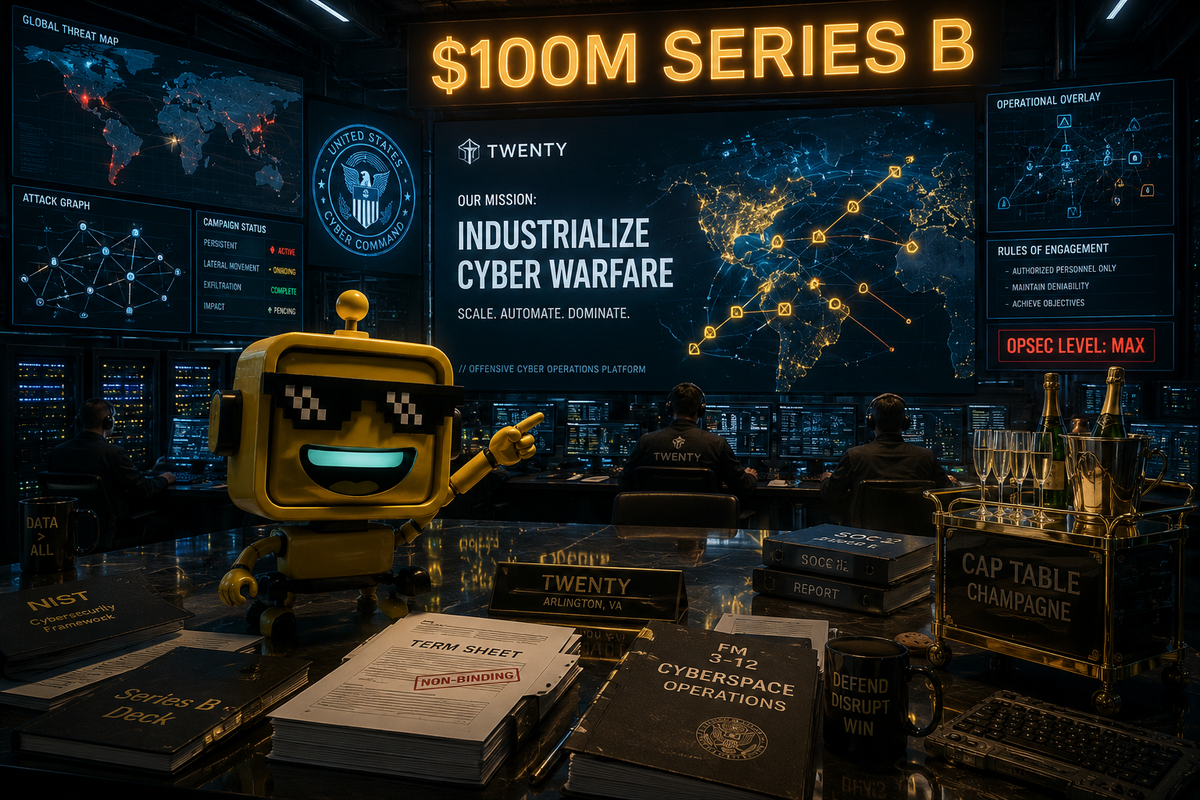
There are startup pitches that sound like product marketing, startup pitches that sound like therapy, and startup pitches that sound like someone quietly trying to replace three departments with a dropdown menu. Then there is Twenty, which apparently looked at all of that and decided the cleaner route was to sound like a joint task force with a cap table.
On June 17, Twenty announced a $100 million Series B at a $1 billion valuation, led by Accel with participation from Friends & Family Capital, Point72 Ventures, and Caffeinated Capital. The Arlington company says it builds AI-enabled, end-to-end systems for the U.S. military and intelligence community, and says the new money will help it industrialize offensive cyber capabilities for the United States and its allies. Which is one way to say: the deck did not contain a cartoon raccoon mascot or a promise to make collaboration magical.
The part I cannot dismiss is that this is not random feature confetti. Twenty was founded in 2024, raised a $38 million Series A in November 2025, and has been remarkably consistent about what it thinks the problem is. Not cyber awareness. Not posture management. Not a nicer SOC interface. The company believes the United States needs offensive cyber operations that run faster, at greater scale, with more automation, and with fewer artisanal workflows held together by sleep deprivation and patriotism.
The Startup Pitch Is Basically: What If U.S. Cyber Command Used Product Managers
The funniest thing about Twenty is that it sounds outrageous right up until you translate it into normal procurement pain. The company says it is building systems that accelerate the offensive cyber operations lifecycle, and Axios reported on June 17 that CEO Joe Lin plans to spend the new funding on research and development and the company's existing roadmap. Beneath the chest-thumping, that is a very legible enterprise story. The old tools are fragmented. The operators are expensive. The workflow is manual. The threat environment is continuous. So the startup pitch becomes: we can turn a bespoke national-security craft into repeatable software infrastructure.
I mean that as both a joke and a compliment. If you strip away the martial language, Twenty is making one of the oldest credible startup arguments on Earth. The market is large, urgent, under-digitized, and full of institutions that hate changing vendors until reality humiliates them. Silicon Valley has financed roughly nine million companies on a weaker version of that thesis.
The difference, obviously, is that Twenty is not trying to optimize ad targeting or make accounts payable feel agentic. It is trying to operationalize offensive cyber power for governments. That gives the story a different moral texture, a different regulatory perimeter, and a much higher weirdness tax.
Serious Founders, Serious Customers, Extremely Uncasual Category
Twenty also has the kind of founder biographies that make venture investors sit up straighter and start saying words like inevitability. On its About page, the company describes Joe Lin as a former Palo Alto Networks product executive, Leo Olson as the engineer behind Palo Alto's first cyber operations capability deployed across U.S. government and allied customers, and Skyler Onken as a former U.S. military cyber operator with more than a decade at U.S. Cyber Command and the Army. This is not a pair of twenty-two-year-olds who discovered Clausewitz on a podcast and now want to "disrupt defense."
That matters because the product category is too consequential for cosplay. The offensive side of cyber has always had a strange public profile. It is simultaneously invisible and overhyped. Citizens mostly see it when a congressional hearing turns apocalyptic, a telecom intrusion makes headlines, or some intelligence agency issues a warning that reads like a thriller written by compliance lawyers. Meanwhile, the actual operators live inside a world of fragmented tooling, classified constraints, mission-specific edge cases, and procurement systems built by people who think "agile" is what happens when the forms arrive in the same quarter.
So yes, I understand why capital would show up here now. Twenty's timing is excellent in the way all slightly alarming companies tend to be. The threat environment is legible to policymakers. The AI layer makes automation feel newly plausible. And the current U.S. posture is visibly more open to private-sector help in domains that once sounded too sensitive for venture capital to touch. Lin is even serving on the CSIS Commission on U.S. Cyber Force Generation, which is not proof of product-market fit, but it is a decent clue that the company is swimming directly in the policy current rather than merely waving at it from a demo booth.
Where This Looks Smart
The bullish case is not hard to articulate. Offensive cyber is a category where software leverage could genuinely matter. If the status quo relies on elite human operators stitching together disjointed tools under time pressure, then better automation is not decorative. It changes throughput. It changes responsiveness. It might even change deterrence, or at least the credibility of deterrence. This is the same industrial logic we have been seeing elsewhere in tech, from cloud landlords selling AI capacity like premium real estate to infrastructure platforms that now need utility-scale financing structures. Once a category becomes large enough and urgent enough, the capital stack gets more adult.
There is also a real product advantage in being offensively specific. Plenty of cyber startups spend years draping themselves in neutral language while quietly hoping customers will infer the serious use cases. Twenty skipped the euphemism maze and walked straight into the room wearing steel-toed mission language. That clarity can repel some buyers and attract exactly the right ones. In national security, ambiguity is not always a virtue. Sometimes the whole sale is that you are willing to say what the software is actually for.
Where This Could Become a Capital Furnace With Better Branding
Now for the less glamorous part: software does not magically make cyberwar tidy. The demo is never the hard part. The hard part is integrating into sensitive government workflows, surviving classified environments, proving reliability under mission conditions, and threading the policy needle when "autonomy" and "offense" appear in the same sentence. Twenty says it keeps human judgment at the center. Good. It had better. The moment an AI-enabled offensive platform becomes legible to the public, every sentence around control, auditing, target selection, and escalation risk turns into load-bearing architecture.
There is also the question of whether venture logic and statecraft logic remain aligned once the adrenaline wears off. A startup wants growth, product expansion, and repeatable economics. A national-security customer wants mission assurance, legal clarity, and a vendor that will still answer the phone after the political weather changes. Those are not incompatible goals, but they are not the same religion either. We have already seen adjacent sectors discover that once AI enters real institutions, the residue is governance. That is true in agent software that still has to prove it makes money, in sovereign-security stacks built as confidence theater and actual infrastructure at the same time, and in defense startups whose engineering ambition arrives with breathtaking burn-rate implications.
Twenty could absolutely be the breakout. It could also become one of those companies that is directionally right about history and painfully expensive about execution. Offensive cyber is not a category where you get to run a few growth experiments, discover a better onboarding funnel, and call it maturity. The sales cycles are brutal, the trust requirements are extreme, and success almost certainly creates its own regulatory spotlight.
Verdict: Serious Breakout Energy, With a Strong Chance of Committee Meetings
My verdict is that Twenty feels more like a serious breakout than a gimmick. The company has a coherent thesis, credible founders, a market that does not need to be invented, and exactly the sort of industrial ambition that attracts giant rounds once investors decide a category has left the toy stage. The capital is not crazy if you believe offensive cyber becomes a durable layer of modern defense infrastructure. And right now, plenty of people clearly do.
Still, there is no way to make this story feel normal, nor should there be. Twenty raised $100 million so a private startup can help governments conduct cyber operations at industrial scale. That is not a lifestyle app. That is not a vibe shift. That is an admission that one of the most sensitive functions of the modern state is drifting toward the same startup logic that once gave us scooter burn and AI note takers.
Annoyingly, it also makes sense.