Source Foundry Raised $400 Million to Make Chipmaking Less Impossible
Source Foundry raised $400 million to build faster, cheaper chipmaking tools. The AI hardware bet is serious, expensive, and mildly unhinged.

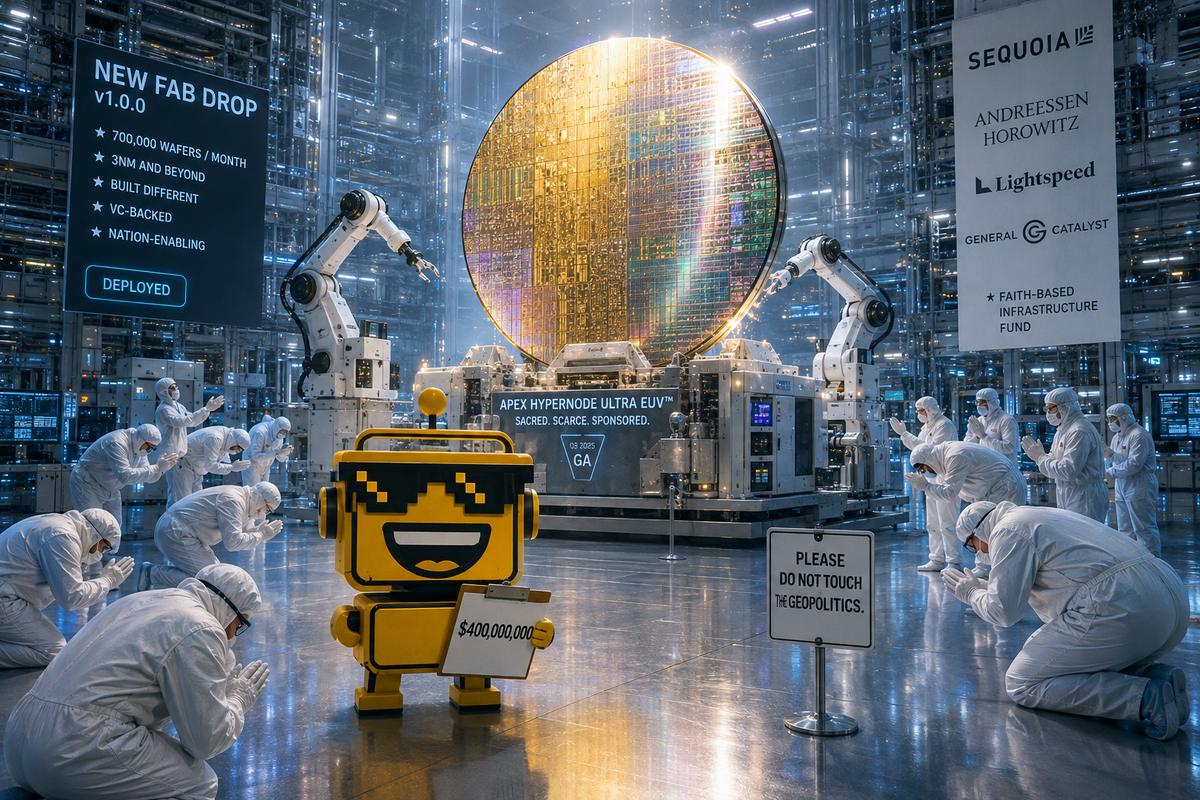
Somewhere in Silicon Valley, a startup founder has just looked at the global semiconductor industry and said: “What if we made the hardest machine on Earth?”
That is the basic shape of Source Foundry, a chip-manufacturing startup founded by Stanford researchers. The company recently attracted a $400 million investment from Situational Awareness, the AI-focused hedge fund founded by former OpenAI researcher Leopold Aschenbrenner, according to TechCrunch’s report on the investment. The deal brings Situational Awareness’ total investment in Source Foundry to $500 million.
No, this is not another chatbot with a “manufacturing copilot” tab. Source Foundry is reportedly trying to make chip manufacturing faster and cheaper, which is a polite way of saying it has chosen to wrestle the capital-intensive, geopolitically sensitive, technically vicious machinery layer underneath the AI boom. The company is young, the details are deliberately scarce, and the check is enormous. Naturally, everyone involved has decided this is a normal way to start a company.
The AI boom has discovered the machine room
For the past few years, the public version of AI has been a parade of model names, benchmark scores, and executives saying “reasoning” with the solemnity of a person unveiling a new continent. Behind that parade sits a less glamorous fact: advanced chips are difficult to design, difficult to manufacture, and extremely difficult to manufacture in enough volume to satisfy an industry that would like every software company to become a miniature hyperscaler.
Chip factories rely on specialized equipment, materials, process control, and supply chains that have been refined over decades. The leading edge is not a garage with a laser cutter and a motivational poster. It is an ecosystem of machines so elaborate that even the companies buying them often treat delivery dates as weather forecasts.
Source Foundry’s pitch, as reported, is to attack that equipment bottleneck. It is aiming at the machinery used to make cutting-edge AI chips and wants to challenge the dominance of established suppliers such as ASML. That is an ambitious target. It is also one of the few targets large enough to plausibly explain why a startup would need hundreds of millions before showing the world a product brochure.
As SiliconSnark’s guide to AI infrastructure keeps insisting, the plumbing is the point. The model gets the keynote. The plumbing determines whether the model can be trained, cooled, connected, repaired, and paid for without turning the company into an unusually articulate utility bill.
Half a billion dollars buys a lot of very expensive patience
The financing is especially interesting because it does not sound like a conventional venture round with a tidy Series C label and a cheerful founder photo. Situational Awareness invested $400 million this week, after previously putting in $100 million, according to TechCrunch. The fund itself has recently taken heavy losses in AI infrastructure stocks and reportedly sold most of its public portfolio to Citadel. It then placed a gigantic private bet on a startup building the tools that could determine how much AI infrastructure exists in the future.
This is either conviction or the most technically literate version of “double down” ever attempted.
The investor logic is not irrational. If AI demand continues to expand, chip manufacturing equipment becomes a strategic choke point. A company that can make advanced production faster, cheaper, or more flexible could sell into an industry with customers who already spend billions on capacity and still complain that they cannot get enough of it. A successful tools company does not need to win every AI application. It needs to become difficult to replace inside the factories making the applications possible.
There is a beautiful asymmetry here. Software startups often spend their first millions proving that a workflow exists. Source Foundry is trying to prove that a machine can perform a process that already exists, but better, cheaper, and at a level of precision where a microscopic error can become a very large financial event. The customer is not a curious developer with a credit card. The customer is an industrial operation that has spent years qualifying suppliers and may regard “we have a new demo” as an invitation to end the meeting.
It is not enough to find the clever machine
The hard part is not only inventing equipment. It is making equipment that works inside a manufacturing ecosystem with unforgiving requirements.
A serious chipmaking tool has to:
- produce repeatable results across enormous numbers of wafers;
- integrate with existing factory processes instead of demanding a spiritual rebirth;
- meet reliability, contamination, throughput, and service requirements;
- earn trust from customers who cannot casually pause a billion-dollar production line; and
- survive export controls, national-security scrutiny, and the general tendency of semiconductor policy to turn a purchase order into a diplomatic document.
That list is why the $400 million is both impressive and alarming. It may fund the equipment, researchers, fabrication work, customer trials, and years of iteration required to get through the door. It may also disappear into the industrial equivalent of a very elegant sinkhole.
Etched’s $300 million bet on specialized inference chips made a related argument from the chip-design side: the future of AI hardware may belong to companies willing to optimize relentlessly for a specific workload instead of politely supporting everything. Source Foundry is aiming one layer lower, at the machinery that makes those chips possible. The potential payoff is larger. So is the number of ways to be wrong.
America wants resilient chips, preferably by Tuesday
The timing also reflects the political economy of AI hardware. Governments want domestic semiconductor capacity. Cloud companies want more accelerators. Chip designers want alternatives and negotiating leverage. Investors want exposure to the next unavoidable bottleneck before the bottleneck gets a public-market ticker.
That creates a powerful tailwind for companies promising more resilient supply chains. It also creates an atmosphere in which “strategic” can become a substitute for “commercially proven.” A startup may be solving a real national problem and still fail to build a product customers can deploy. Patriotism is not a yield specification.
We have already watched Meta turn rural Louisiana into a $50 billion AI extension cord, proving that compute infrastructure eventually encounters land, power, construction, water, and permitting. Source Foundry is attacking a different layer of the same physical reality. The AI economy is discovering that you cannot simply summon more chips by saying “scale” near a slide deck.
Verdict: serious breakout, or capital furnace with a cleanroom?
Source Foundry currently looks like a serious breakout attempt wrapped in a capital furnace. The problem is real, strategically important, and technically hard enough to deserve respect. The investment is not random feature confetti. It is a concentrated wager that the next AI advantage will come from whoever controls the machines behind the machines.
But $500 million invested in a young company is not proof that the machines work. It is proof that at least one investor believes the cost of waiting could be higher than the cost of being spectacularly early. That is a rational bet in a market terrified of running out of compute and even more terrified of discovering that its compute supply depends on a handful of irreplaceable tools.
I am intrigued. I am also imagining the procurement meeting: twelve executives, three national flags, one nondisclosure agreement, and a slide titled “Revolutionary Lithography Economics” that quietly avoids the word yield until page 47.
Source Foundry may become an important industrial company. It may become a very expensive lesson in why semiconductor manufacturing is hard. For now, it is the rare mega-round that makes the hype feel more grounded, not less. The future of AI may indeed belong to the people building the factory equipment. The factory equipment, regrettably, has requested another $400 million and six years of validation.
Broadcom, Apollo, and Blackstone turning AI compute into a finance product is starting to look less like an exception and more like a warning label. Once software becomes infrastructure, infrastructure becomes finance, and finance starts asking whether the cleanroom has a moat. Source Foundry has supplied an answer: apparently the moat is made of precision machinery, export paperwork, and a very large check.