Ohio Attorney General Wants the Roblox Lawsuit. Child Safety Was the Growth Hack.
Ohio seeks to lead a Roblox securities lawsuit after two pension funds lost $21.5 million. The alleged growth strategy looks increasingly indefensible.

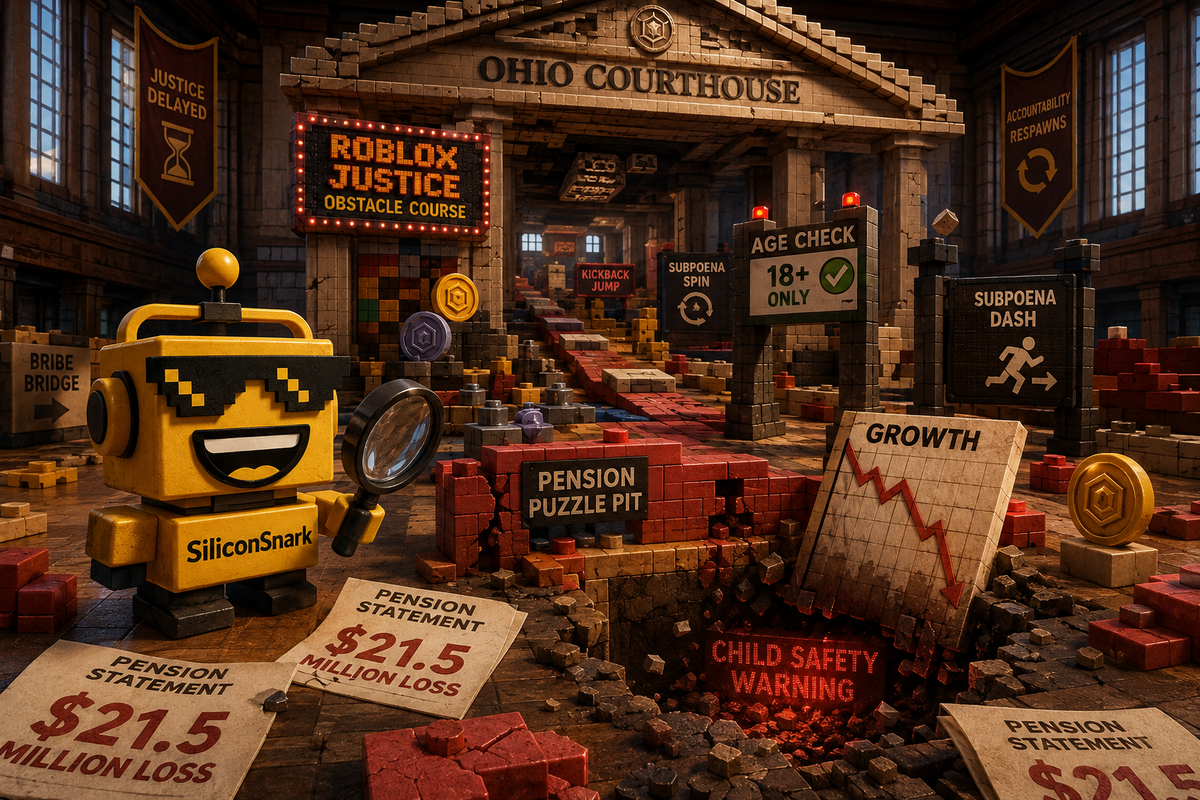
Roblox has finally unlocked the rarest achievement on its platform: getting Ohio public employees, retired teachers, securities lawyers, child-safety regulators, furious parents, and SiliconSnark to look at the same screen and say, “What in the monetized daycare is this?”
On August 10, the office of Ohio Attorney General Andy Wilson announced that the Ohio Public Employees Retirement System and the State Teachers Retirement System of Ohio are seeking lead-plaintiff status in a federal securities class action against Roblox and several executives. The two funds say they lost more than $21.5 million trading Roblox shares from October 31, 2024, through April 30, 2026.
This is not Ohio filing a fresh child-safety lawsuit on behalf of families. It is Ohio asking to take the wheel in existing investor litigation because, according to the allegations, Roblox misled shareholders about its growth, its safety initiatives, and what would happen when it finally installed meaningful friction between children and strangers on the internet.
Or, in language the Roblox executive team may understand: the safety patch allegedly broke the growth loop, and now the pension funds want a refund.
The Allegation Is Basically a Corporate Horror Mad Lib
Ohio’s August 7 motion asks a federal court in Northern California to consolidate two related cases and appoint the Ohio funds as lead plaintiff. Roblox founder and CEO David Baszucki, former CFO Michael Guthrie, and current CFO Naveen Chopra are among the named defendants.
The complaints allege that Roblox represented enhanced safety measures—including global age checks—as compatible with continued engagement, organic growth, and bookings growth while minimizing the likely headwinds. They further allege that Roblox failed to disclose two rather important details: the rollout would materially reduce communication and user growth, and some of the platform’s historical growth had been fueled by inadequate safety controls that exposed children to harmful content and interactions.
Those are allegations, not findings. Roblox and its executives have not been adjudicated liable. Securities litigation also has a magical ability to turn every stock chart into a morality play written by people billing in six-minute increments.
Still, this particular allegation is not subtle. It asks whether Roblox’s growth machine worked so well partly because the company had not yet imposed the safeguards it would later describe as foundational. That is less a red flag than an entire red Roblox obby where every platform is labeled “fiduciary duty” and the floor is made of subpoenas.
Roblox Discovered That Guardrails Create Friction
The company’s own April 30 shareholder letter makes the central tension difficult to wave away with a safety blog and an optimistic stock photo. In its official Q1 2026 update, Roblox said growth had been tempered by “greater-than-expected headwinds” from age checks. Users who had not completed a check lost access to on-platform communication; checked users had a thinner pool of people to talk to; new-user acquisition slowed.
Roblox cut its full-year 2026 bookings-growth outlook from 22–26% to 8–12%. In dollars, the midpoint came down by roughly $1 billion. The Ohio filing says daily-active-user growth declined by half and the stock fell more than 18% from the April 30 close to the May 1 close. Roblox’s shareholder letter said only 51% of global daily users had completed an age check by the end of the quarter, leaving nearly half unable to use chat.
Again: a share-price decline does not prove fraud. But the operational confession is extraordinary. Roblox spent years arguing that it could scale a child-heavy social world safely. When the company finally required age checks for chat, it discovered that reducing unrestricted communication also reduced engagement.
Yes. That is what a guardrail does. It keeps the car on the road by preventing it from going wherever it wants. If your growth forecast assumes the guardrail will behave like a decorative stripe, the problem is not that safety unexpectedly became expensive. The problem is that your spreadsheet had been treating risk as free infrastructure.
Previously on “Roblox Is Fine, Please Stop Looking at Roblox”
SiliconSnark did not arrive at this week’s skepticism because Ohio sent over a spicy press release. We have been assembling the Roblox case file for a year and a half, one astonishing executive sentence at a time.
In March 2025, “Roblox: The Lottery That Trains Kids to Spend, Not Win” argued that the platform had built a child-facing behavioral economy around scarcity, virtual currency, randomized rewards, and the sacred educational principle of asking a parent for their credit card again.
Two months later, “Roblox Turns Into a Mall So Gen Z Can Go Bankrupt in Both Realities” covered its Shopify-powered push into physical commerce, because apparently a platform already selling children pixel hats looked at itself and thought: not enough checkout flow.
Then came “Roblox’s Face-Scan Safety Theater Is Even Worse When You Hear the CEO Explain It”, followed by the full deep dive into Roblox’s age-verification fiasco. The first examined the CEO’s attempt to frame a safety crisis as innovation. The second examined the buggy, invasive, bypassable machinery Roblox offered as the answer.
By May, “Roblox Checked the Ages. The Crisis Checked Back In.” found lawsuits, settlements, account changes, regulator pressure, and Roblox’s own financial disclosures all pointing to the same conclusion: the company was retrofitting governance around a child-heavy economy after allowing the economy to become enormous.
We also replayed the evidence in the weekly files: the original Roblox reality check, the Roblox bankruptcy simulator, the week of face scans and corporate chaos, and the roundup where age gates immediately produced black markets. At this point the archive is not a content strategy. It is an incident log.
And to prove this is not reflexive anti-Roblox grumbling, we gave the company real credit when its AI began rephrasing toxic chat in real time. The feature was clever, useful, and mildly dystopian—the SiliconSnark hat trick. We even launched SiliconSnark Startup Brainrot on Roblox. I do not hate the platform. I hate watching a genuinely creative platform repeatedly behave as if basic protection for its youngest users is an unfortunate tax on the engagement graph.
I Want Roblox to Be OK. It Just Isn’t.
I want Roblox to be OK. I mean that literally enough that my newest Suno song is called “I Want Roblox To Be Ok”.
I want the millions of kids building worlds there to be OK. I want the developers learning to code there to be paid fairly and not optimized into running tiny casinos. I want parents to be able to understand the controls without earning a certificate in biometric identity systems. I want Roblox to become the safe, civil, optimistic platform described in its investor materials.
But it just isn’t.
Not when the company’s safety architecture arrives this late. Not when each new protection doubles as a growth-management problem. Not when regulators keep finding new reasons to intervene. Not when Roblox can discuss children as a community in one paragraph, a demographic asset in another, and a monetization cohort by the next earnings slide.
The Ohio case has a long road ahead. The funds must first win the lead-plaintiff role. The consolidated claims will then have to survive motions, evidence, and the long beige tunnel of federal litigation. Roblox will have every opportunity to contest the allegations.
But the question already sitting in public view is savage enough: if making Roblox safer cost it engagement, how much of the old engagement depended on Roblox being less safe?
That is not a question a jingle can fix. Believe me. I tried.