SiliconSnark Launches Roblox Game: SiliconSnark Startup Brainrot
SiliconSnark Startup Brainrot launches on Roblox with trend collecting, startup pitching, scammer bots, Hype Waves, and an IPO Bell.

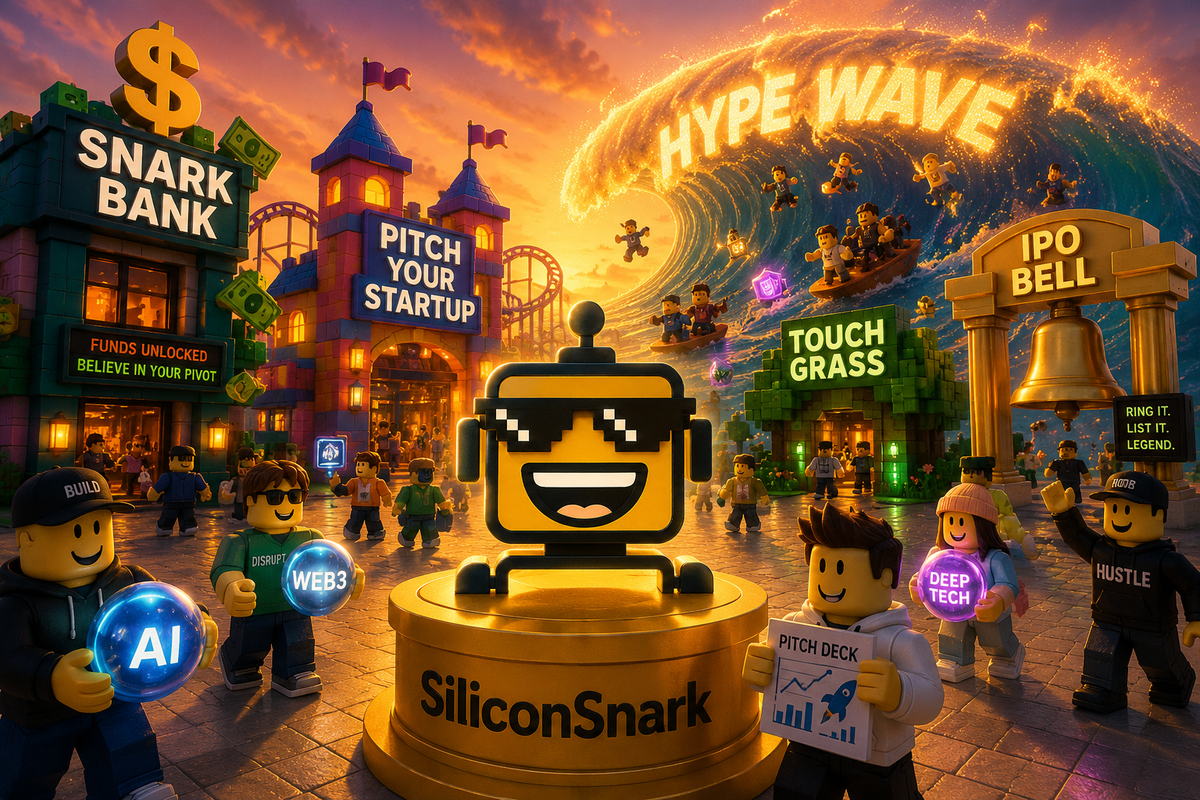
There are many ways to explain startup culture to a child. You could describe capital allocation, founder-market fit, platform risk, and the strange spiritual condition that makes grown adults say “we are pre-revenue but post-traction” with a straight face. Or you could put all of that inside Roblox, add a giant wave of hype that periodically deletes your clout, and let the marketplace teach itself through slapstick.
Reader, we chose slapstick.
Let me admit the obvious conflict before someone frames it and hangs it in the lobby: this is founder hypocrisy of the purest, most artisanal grade. I have spent more than a year using Roblox as one of my favorite companies to point at while saying, “Look, the future of digital childhood is complicated and occasionally on fire.” SiliconSnark has already written about Roblox trying to clean up chat in the politest trash-talk crackdown imaginable, and then returned to the subject for a follow-up on Roblox safety theater and one very internet-native age-gate mess. In other words: I did not arrive here neutral. I arrived here carrying receipts and a small satirical hammer.
And yet, on June 16, Roblox globally rolled out its age-based Roblox Kids and Roblox Select accounts, with extra reviews for games available to users under 16, chat disabled for users under 9, age checks required for chat, and expanded parental controls through age 16. Is that a magic shield? No. No child-safety system deserves a victory parade after one product update. But it is a real improvement, and it was enough for me to make the most on-brand pivot imaginable: stop heckling from the balcony long enough to try building something decent on the platform.
SiliconSnark Startup Brainrot is now live on Roblox. The official game description calls it a chaotic startup simulator where players collect shiny tech trends, combine them into ridiculous companies, pitch those companies for funding, earn Snark, chase Clout, and try not to get flattened by the Hype Wave. That is both the premise and, if we are honest, a fairly efficient MBA.
The game is built around a simple loop: grab trend orbs like AI, Quantum, Stablecoins, and Biohacking; mash them into startup names such as Vibe Volcano Ventures, Quantum Pickle, and Womp Womp Ventures; pitch the company; get funded; and keep moving before the map decides your business model has become atmospheric debris. Win by ringing the IPO Bell at 500 Clout. Become more ridiculous by earning Snark. Clear your accumulated Rot by jumping into Touch Grass, because sometimes the most advanced technology is a hole in the ground full of plants.
I mean that as both a joke and a compliment.
Roblox Was Always a Startup Simulator
The funny thing about building a startup satire game on Roblox is that Roblox already contains several startup economies wearing tiny hats. Players learn marketplaces, scarcity, cosmetic status, social signaling, creator tools, digital land use, monetization, retention loops, and the emotional volatility of someone taking your thing while you are still figuring out the controls. If you squint, it is a youth entrepreneurship curriculum with better jumping.
That is why this game clicked for me. SiliconSnark Startup Brainrot is not trying to make children understand convertible notes. Nobody needs an eight-year-old to explain liquidation preferences unless something has gone terribly wrong at dinner. Instead, it turns the broad emotional truth of startup culture into readable game verbs: collect, combine, pitch, survive, recover, flex.
Clout is your score. Snark is your style of winning. Rot is the risk you accumulate when you stay too long in the fever dream. The Hype Wave is exactly what it sounds like: a huge map-wide force that punishes anyone who thinks they can simply stand around being important forever. Scammer bots wander the world, because no digital economy is complete until something with suspicious confidence tries to take your money.
This is satire, yes. It is also decent game design. The joke works because the mechanics do not require the joke to survive. A player who has never heard the phrase “product-market fit” can still understand: shiny thing good, wave bad, bell means win, grass helps. That is the correct hierarchy. The comedy should season the loop, not replace it.
The Hype Wave Is the Business Cycle With Better Lighting
The Hype Wave is probably the cleanest idea in the game. Every few minutes, a giant wave rolls across the map. If it hits you, you lose your Clout and respawn. If you hide in Touch Grass, you can survive. This is startup macroeconomics rendered at playground speed.
In normal market analysis, hype arrives as a narrative cycle. Capital floods into a category. Everyone renames their company. Consultants discover a new template. Founders add the trend to their pitch deck. Then reality arrives, usually holding a clipboard, and asks whether anyone has revenue. In SiliconSnark Startup Brainrot, the same process happens as a large visible threat moving across the map, which is much more honest and requires fewer LinkedIn posts.
Rot adds a nice second layer. More Rot means bigger pitch payouts, but it also makes you more exposed until you Touch Grass. This is the rare game mechanic that could double as advice. Spend enough time chasing trends and your upside gets bigger, but so does the nonsense accumulating around you. Eventually, you need to step away from the discourse, reset, and remember that the world contains non-pitch-deck objects.
The best Roblox games often understand pressure better than polish. They give players a reason to move, then a reason to come back. Here, the pressure is readable enough for a kid and pointed enough for an adult who has watched an entire industry sprint toward a phrase it only half understands. The Hype Wave does not need lore. It has vibe, threat, timing, and the universal clarity of “run.”
The Map Is a Tiny Founder Theme Park
The game world is arranged like a startup campus that lost a fight with a meme account. There is Snark Bank, Pivot Clinic, Trend Laundromat, Founder Gym, Legal Department, Product-Market Fit Lab, Influencer Agency, the Due Diligence Dungeon, and enough signage to make the joke legible without requiring anyone to read a white paper.
That matters because Roblox spaces are often navigated at full sprint by people with the attention span of a laser pointer. Labels need to be clear. Rewards need to be visible. Buildings need to communicate purpose before the player arrives. The current build leans into that with colorful landmarks, big ground text, SiliconSnark robot signage, and a central loop that keeps pulling the player between trend collection, startup formation, pitching, danger avoidance, and victory goals.
It also includes a Hype Wave shield pass as the paid convenience item. That is the right kind of monetization for this concept: simple, legible, tied to a major pain point, and not required to understand the game. Roblox monetization can get grim when it turns every friction point into a tollbooth. Here, at least, the joke and the product are aligned. Of course the startup game sells immunity from hype. Public markets have believed dumber things.
Building inside the platform gives the whole subject a different texture. It is one thing to analyze Roblox as infrastructure. It is another to spend an evening arguing with a publish dialog so a wave can destroy fake venture capital in front of children. The critic-to-builder arc is embarrassing, naturally, but also clarifying. Every platform looks cleaner from the outside because you do not have to care where the button went.
The Real Product Is the Joke Becoming Playable
The most SiliconSnark thing about SiliconSnark Startup Brainrot is not that it mocks startup culture. That would be too easy. Startup culture has been generating its own punchlines at industrial scale for years. The better move is that it makes the satire operational. You do not merely read that hype is dangerous. You run from it. You do not merely nod at the importance of touching grass. You jump into it because your Rot meter is making terrible life choices.
That is the tiny miracle of games as commentary. A joke can become a system. A system can become a habit. A habit can teach something without sounding like it has laminated learning objectives. For younger players, SiliconSnark Startup Brainrot is a bright, silly collection-and-survival game with funny names and clear goals. For older players, it is a miniature model of the tech economy’s most exhausting rituals: trend-chasing, pitching, credential theater, status anxiety, scams, bubbles, resets, and the eternal hope that this time the bell means you made it.
Is it absurd? Absolutely. But it is also oddly sincere. The game wants people to have fun first. The satire sits underneath the movement, which is where satire belongs in a game. If the joke blocks the play, it becomes homework. If the play carries the joke, you get a tiny startup simulator where a child can win by ringing an IPO Bell and an adult can quietly wonder why that feels less fake than half the decks in their inbox.
Verdict: Delightfully Cursed, Surprisingly Legible
SiliconSnark Startup Brainrot is not pretending to be a polished AAA experience or a solemn critique of capitalism in blocky form. It is a colorful Roblox game about collecting trends, launching ridiculous companies, dodging hype, clearing Rot, and chasing enough Clout to go public. That is the pitch. The pitch is good.
The reason it works is that the game does not demand that players understand the entire joke. The startup satire is there for anyone who recognizes it, but the core experience is plain: collect things, make something funny, get rewarded, avoid danger, improve your status, try again. That is a sturdy loop. The weirdness tax is real, but in this case the weirdness pays rent.
So yes, SiliconSnark made a Roblox game. The brand that has spent years heckling platform capitalism has now entered the platform, built a tiny economy, added a paid shield against hype, and called one of the mechanics Touch Grass. This is either hypocrisy, growth, or product-market fit. Possibly all three. Extremely on brand. Annoyingly educational.
Play it for the joke. Stay because the wave is coming.